
Landscape in Practice
Project types, the drawing set, and maintenance as design intent.
Landscape architecture is realised across a spectrum — parks, plazas, campuses, streetscapes, waterfronts, restoration and roof gardens — and the landscape architect designs the connective tissue between buildings and the public realm. Learn the project typology, landscape's relationship to architecture and the city, the consultant's role and the landscape drawing set (layout, grading, planting, details), phasing, and — the discipline's deepest idea — that a landscape is never finished on opening day, so maintenance is design intent over the living timescale.
Learning objectives
By the end of this lesson, you will be able to — mapped to the course outcomes for Landscape Architecture:
Describe the typology of landscape projects and landscape's role in the city.
Explain the landscape consultant's role and the standard drawing set.
Explain phasing and the establishment period over a landscape's living timescale.
Treat maintenance as design intent and integrate landscape with architecture.
Project types & the city
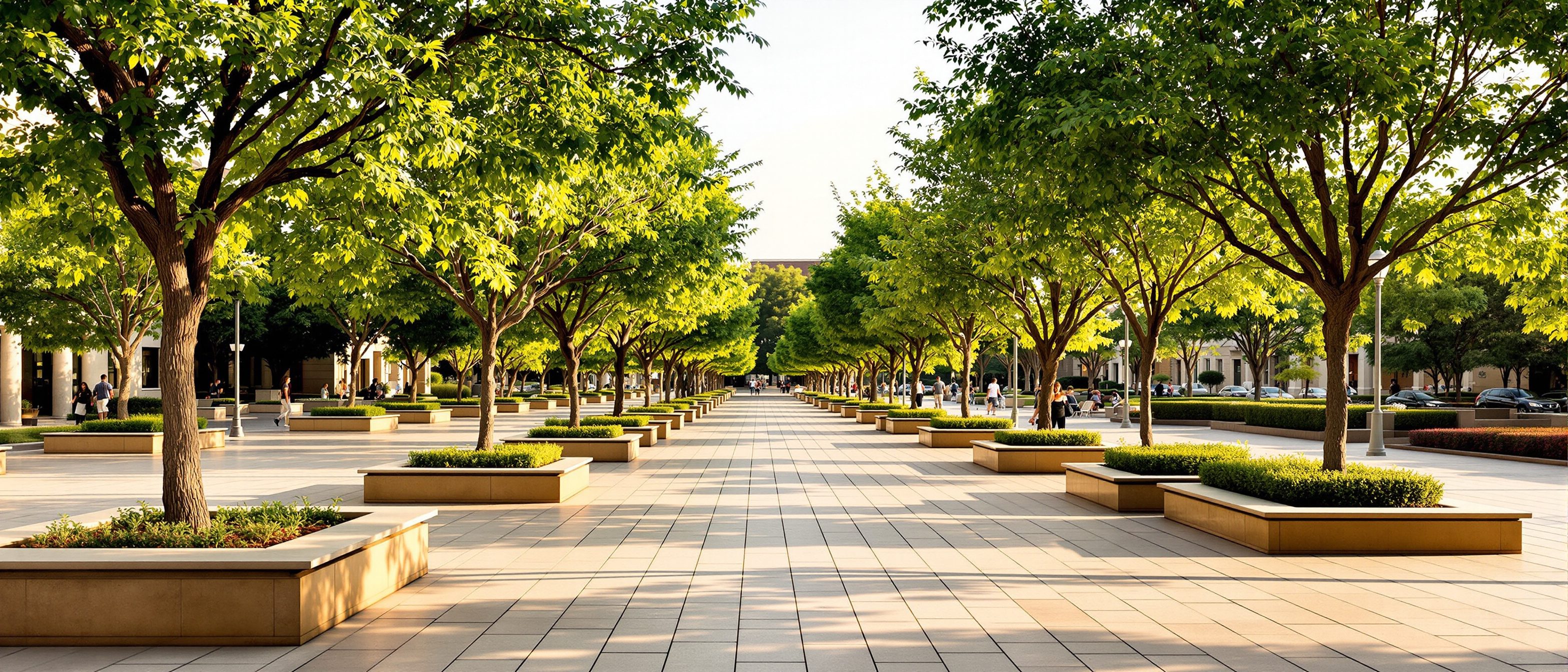
From parks to roof gardens, landscape is the connective tissue between buildings and the public realm — co-designed with architecture, not leftover space.[1, 3, 5]
Park to roof garden
The spectrum: urban parks (the public green lung), plazas and the public realm (hard civic open space), residential and garden, institutional/campus (large coherent landscapes), streetscape and avenues (the linear public realm), waterfronts (river edges, ghats, promenades), ecological/restoration (wetlands, quarries, riverbanks), and roof and terrace gardens (intensive/extensive green roofs in dense cities). Principles transfer; each type has distinct demands.[1, 2]
Delivery, phasing & maintenance
The consultant delivers the drawing set; landscapes are phased and need an establishment period; and maintenance is design intent, matched to real care capacity.[1, 2]
How it is delivered
The landscape architect usually works as a consultant in a larger team, spanning site analysis, concept and master planning, detailed design, documentation, tendering support and supervision — coordinating with engineering (drainage, levels, services) and horticulture. The drawing set: the LAYOUT/setting-out plan, the GRADING/contour plan (levels, slopes, drainage), the PLANTING plan (species, sizes, quantities, spacing by layer), and CONSTRUCTION DETAILS (sections through paving, walls, steps, tree pits, water features), plus specs and a BOQ.[1]
At a glance
| Aspect | Year 1 | Maturity |
|---|---|---|
| Planting | At handover (yr 1): young, sparse | At maturity (yr 10–20): full, layered |
| Appearance | Yr 1: 'thin', relies on hardscape | Maturity: realises the spatial design |
| Care need | Yr 1: intensive establishment care | Maturity: lower, steady management |
| Risk | Yr 1: highest (failure, neglect) | Maturity: stable if managed |
| Design lesson | Design FOR the future, not day 1 | Maintenance is what gets you there |
Key terms
The shared outdoor city of streets, plazas and parks.
The overall organising plan for a landscape project.
The dimensioned positioning drawing for all landscape elements.
The early years (~1–3) of aftercare until new planting is self-sustaining.
Staged delivery of a landscape over time and budget.
The specified long-term management regime — treated as design intent.
Studio task
For a landscape project of your choice, list the drawing set you would produce (layout, grading, planting, details) and outline a phasing plan that puts structural trees in early. Then write a one-page maintenance plan matched to a realistic care capacity — and explain, with a year-1 vs year-20 sketch, why the scheme must be designed for its mature future, not its opening day.
Self-assessment
1. Which statement best reflects mature landscape practice?
2. In the landscape drawing set, the drawing that fixes proposed levels, slopes and drainage is the —
3. The 'establishment period' of a landscape refers to —
Recap
References & further reading
- [1]John Ormsbee Simonds & Barry Starke, Landscape Architecture (practice, scope and documentation).
- [2]Norman K. Booth, Basic Elements of Landscape Architectural Design (elements through to delivery).
- [3]Geoffrey & Susan Jellicoe, The Landscape of Man (landscape's relationship to architecture and the city).
- [4]Tom Turner, Landscape Planning and Environmental Impact Design (landscape at the city scale).
- [5]Mohammad Shaheer & writings on contemporary Indian landscape architecture (verify specific attributions).
Further reading
- John Ormsbee Simonds — Landscape Architecture (the manual).
- Geoffrey & Susan Jellicoe — The Landscape of Man.
- Norman K. Booth — Basic Elements of Landscape Architectural Design.
Sources gathered and fact-checked June 2026. Published values vary by source, sample and method — treat as indicative and confirm against the cited standard before structural use.
The author
Amogh N P
Architect, interior designer, and creative polymath. Studio Matrx began in his notebooks — his vision of design made honest, useful, and open to everyone. Its Academy is written and taught in his memory, and free, forever.
More about Amogh →