
Ecology & Sustainability
Design with Nature — water-sensitive, native, and cooling the city.
The decisive 20th-century shift was the recognition that the designed landscape is ecological infrastructure — managing water, cooling cities, supporting biodiversity, restoring land. Today sustainability is the discipline's core purpose, especially in India where water scarcity, heat and biodiversity loss make it survival, not aesthetics. Learn Ian McHarg's Design with Nature and the layered overlay, native planting and biodiversity, water-sensitive design (rain gardens, bioswales, harvesting), xeriscaping, the urban heat island, and green infrastructure. Try the sustainable-landscape explorer.
Learning objectives
By the end of this lesson, you will be able to — mapped to the course outcomes for Landscape Architecture:
Explain ecology as the modern core and McHarg's Design with Nature / overlay method.
Use native planting and avoid invasive exotics for biodiversity.
Apply water-sensitive design — rain gardens, bioswales, harvesting — and xeriscaping.
Explain the urban heat island and how landscape (canopy, green roofs) cools it.
The ecological approach
Ecological reading should GENERATE the plan (McHarg's overlay); native planting builds biodiversity; tree canopy cools the city; living soil and mature trees are foundational.[1, 2, 3]
McHarg & the overlay
The intellectual turning point is Ian McHarg's Design with Nature (1969): land-use should follow the land's own ecological capacities. His layered 'sieve'/OVERLAY analysis maps each factor (slope, soil, hydrology, vegetation, habitat) on a transparent layer and overlays them — areas unsuitable on many layers are screened out, revealing where to build and what to protect. This is the direct ancestor of GIS suitability mapping. PITFALL: treating ecology as a bolt-on — McHarg's lesson is that it should GENERATE the plan.[1]
Water-sensitive & green infrastructure
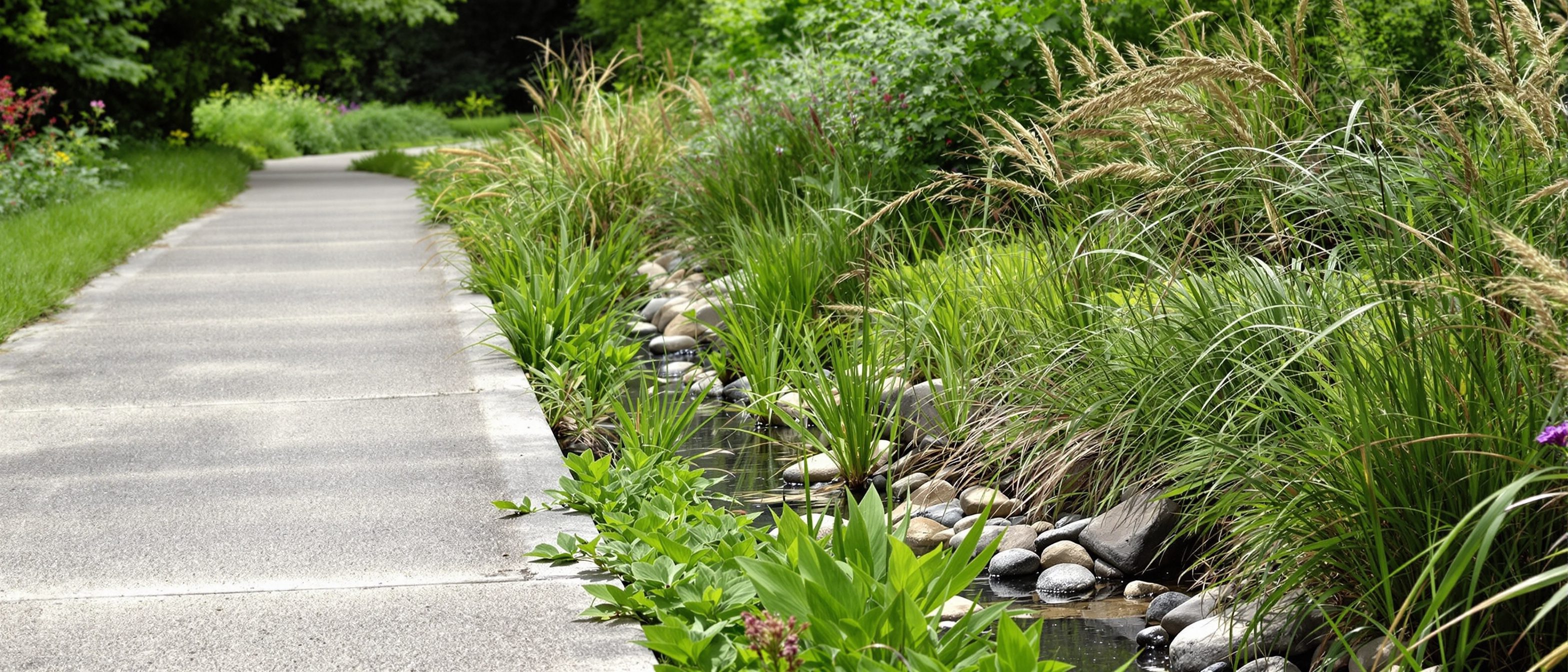
Treat rainwater as a resource (rain gardens, bioswales, harvesting); xeriscape for little water; and read the green network as functioning infrastructure.[4, 3]
Slow, soak, store
Water-Sensitive Urban Design / SUDS treats rainwater as a resource to slow, soak and store, not a nuisance to pipe away. Key devices: rain gardens (planted depressions that infiltrate runoff), bioswales (vegetated channels that convey and filter), permeable paving (recharge), rainwater harvesting (capture to storage/recharge — often mandated in Indian cities), and constructed wetlands (biological cleaning). For India's falling water tables, this is the single most consequential sustainability lever.[4]
Explore the techniques
Pick a water-sensitive or cooling technique and read how it works and its benefit.
Sustainable techniques · pick one
Rain garden
How it works: A shallow planted depression that catches surface runoff and lets it infiltrate the soil.
Benefit: Slows and soaks stormwater; recharges groundwater; filters pollutants.
In water-scarce, heat-prone India, water-sensitive and cooling landscape is survival, not aesthetics.
At a glance
| Aspect | Native | Exotic / other |
|---|---|---|
| Climate fit | Native: adapted to local climate | Exotic: may be ill-suited / thirsty |
| Water & care | Native: usually low | Exotic: often higher |
| Biodiversity | Native: supports local web | Exotic: often low; some invasive |
| Stormwater | WSUD: slow, soak, store on site | Grey: pipe it away fast |
| Best-practice default | Native + water-sensitive | Exotic chosen knowingly, never by default |
Key terms
McHarg's 1969 doctrine that design should follow the land's ecological capacity.
Mapping environmental factors on layers and overlaying them to find suitability.
Water-sensitive / sustainable drainage design that slows and soaks runoff.
A vegetated channel that conveys, slows and filters stormwater.
Planting design for minimal supplemental irrigation (natives, hydrozoning, mulch).
The tendency of cities to run hotter than their surroundings.
Studio task
For a campus or park site, propose a water-sensitive landscape: locate a rain garden and a bioswale where runoff collects, specify permeable paving and rainwater harvesting, and choose a native planting palette (and name one invasive exotic to avoid). Explain, in two lines, how your scheme cools the site and recharges its groundwater — and why a vast lawn would be the wrong default.
Self-assessment
1. 'Design with Nature' (1969) and the layered overlay method are associated with —
2. A bioswale is best described as —
3. The most effective landscape strategy against the urban heat island is —
Recap
References & further reading
- [1]Ian L. McHarg, Design with Nature (1969) — the foundational ecological-design text and overlay method.
- [2]Anne Whiston Spirn, The Granite Garden: Urban Nature and Human Design.
- [3]US EPA / urban-climate resources on the urban heat island and green infrastructure.
- [4]Nigel Dunnett & Andy Clayden, Rain Gardens: Managing Water Sustainably in the Designed Landscape.
- [5]CGWB / state rainwater-harvesting and groundwater guidelines (India-specific water rules).
Further reading
- Ian L. McHarg — Design with Nature.
- Anne Whiston Spirn — The Granite Garden.
- Dunnett & Clayden — Rain Gardens.
Sources gathered and fact-checked June 2026. Published values vary by source, sample and method — treat as indicative and confirm against the cited standard before structural use.
The author
Amogh N P
Architect, interior designer, and creative polymath. Studio Matrx began in his notebooks — his vision of design made honest, useful, and open to everyone. Its Academy is written and taught in his memory, and free, forever.
More about Amogh →