
Introduction & History
The design of outdoor space — and the great garden traditions behind it.
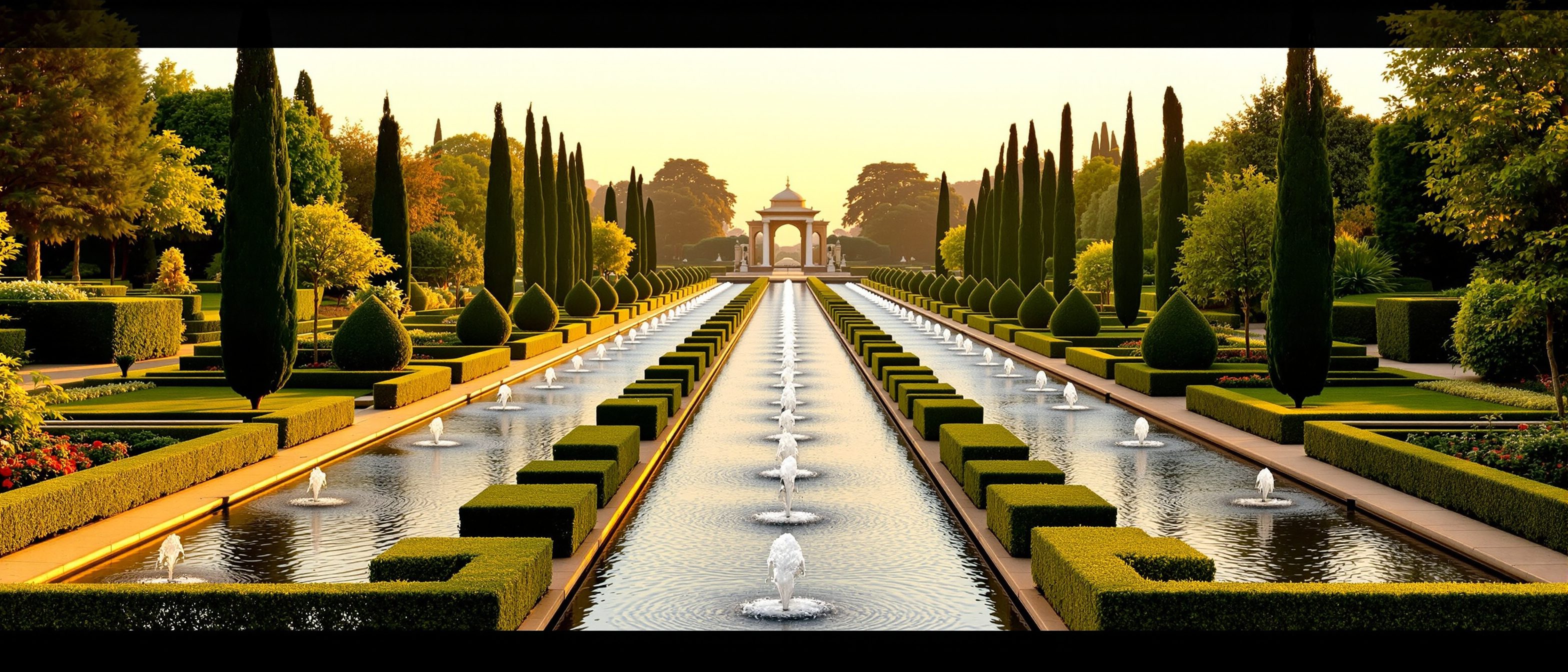
Landscape architecture is the design of outdoor space and of the land itself — composed with landform, vegetation, water and sky, in a medium that is alive and unfolds in time. It is not gardening. Learn what the discipline designs and how the profession began (Olmsted, Central Park 1858), then a concise global and Indian garden history — the Mughal char-bagh, Japanese and Chinese gardens, the Italian, French and English traditions, and India's own kunds, temple tanks and sacred groves — and the formal-to-naturalistic shift that runs through it all.
Learning objectives
By the end of this lesson, you will be able to — mapped to the course outcomes for Landscape Architecture:
Define landscape architecture and distinguish it from gardening and horticulture.
Explain the profession's origin (Olmsted) and landscape as public infrastructure.
Compare the major garden traditions — Mughal, Japanese, Chinese, Italian, French, English.
Recognise India's kund, temple-tank and sacred-grove traditions and the formal-to-naturalistic shift.
The discipline & its traditions
Landscape architecture designs a living, temporal medium; the great garden traditions encode each culture's idea of nature and order.[1, 2]
Outdoor space, in time
Landscape architecture designs outdoor space and the land itself — the ground plane, its modelling and surfaces, its planting and built elements — together with the relationship of buildings to their site. Because the medium is alive and temporal, it designs not a fixed object but a PROCESS unfolding in time. It is distinct from gardening (cultivating plants) and horticulture (the science of growing) — those are knowledge it draws on, not its core act.[2]
Key figures & milestones
From Olmsted and Le Nôtre to Capability Brown and India's anonymous makers of kunds and groves.[1, 5]
The profession's founder
Popularised the title 'landscape architect'; Central Park (1858, with Vaux). Framed designed landscape as public-health infrastructure for the industrial city.[1]
At a glance
| Aspect | Formal | Naturalistic |
|---|---|---|
| Organising idea | Formal: human order, axis, symmetry | Naturalistic: idealised nature, irregularity |
| Geometry | Formal: straight axes, parterres | Naturalistic: serpentine curves, rolling form |
| Water | Formal: axial channels, fountains | Naturalistic: serpentine lakes, natural edges |
| Experience | Formal: single commanding vista | Naturalistic: wandering, unfolding sequence |
| Examples | Mughal char-bagh, Versailles | English landscape garden (Brown) |
Key terms
The design of outdoor space, land and site relationships as a spatial-ecological discipline.
The quadripartite Persian/Mughal paradise garden divided by axial water channels.
The Japanese 'dry landscape' garden of rock and raked gravel, for contemplation.
'Borrowed scenery' — composing distant landscape into a garden view.
The 18th-c. aesthetic idealising irregular, painterly 'natural' scenery.
A stepped sacred temple tank integrating water storage, ritual and climate-cooling.
Studio task
Choose one historic garden tradition (e.g. the Mughal char-bagh or the English landscape garden) and analyse one example in a one-page study: its plan organisation, the role of water, the experience of moving through it, and the idea of nature and order it encodes. Then note one Indian indigenous tradition (kund, temple tank or sacred grove) and what it integrates that the formal garden does not.
Self-assessment
1. Who is credited with popularising the title 'landscape architect' in the 19th century?
2. The char-bagh is best described as —
3. The 18th-century English landscape garden is characterised by —
Recap
References & further reading
- [1]Geoffrey & Susan Jellicoe, The Landscape of Man, Thames & Hudson (the standard global garden-history survey).
- [2]John Ormsbee Simonds & Barry Starke, Landscape Architecture: A Manual of Environmental Planning and Design.
- [3]Elizabeth Barlow Rogers, Landscape Design: A Cultural and Architectural History.
- [4]Sylvia Crowe et al., The Gardens of Mughul India (the Indian char-bagh tradition).
- [5]Mohammad Shaheer — writings on Indian gardens and landscape conservation.
Further reading
- Geoffrey & Susan Jellicoe — The Landscape of Man.
- John Ormsbee Simonds — Landscape Architecture: A Manual of Environmental Planning and Design.
- Elizabeth Barlow Rogers — Landscape Design: A Cultural and Architectural History.
Sources gathered and fact-checked June 2026. Published values vary by source, sample and method — treat as indicative and confirm against the cited standard before structural use.
The author
Amogh N P
Architect, interior designer, and creative polymath. Studio Matrx began in his notebooks — his vision of design made honest, useful, and open to everyone. Its Academy is written and taught in his memory, and free, forever.
More about Amogh →