
Elements of Landscape
Softscape and hardscape — plants as a spatial material, not decoration.
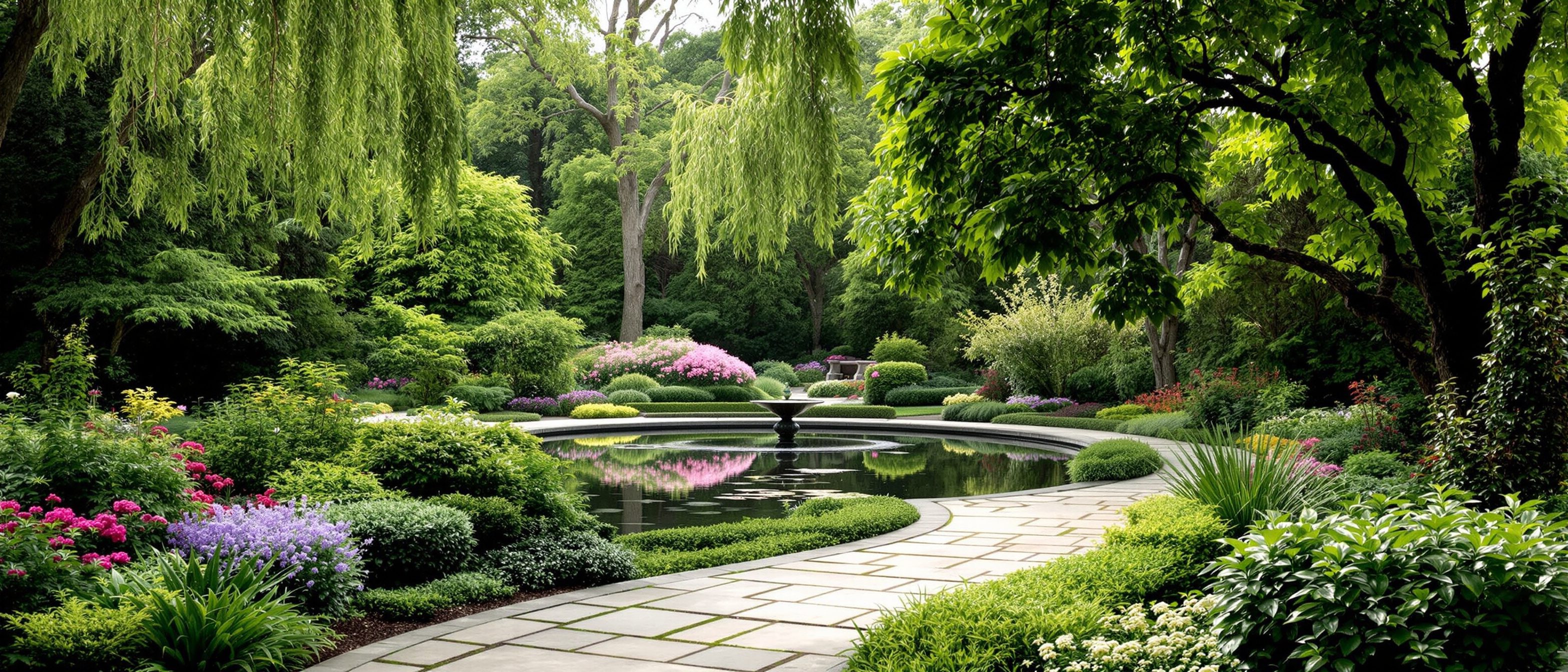
A landscape designer begins not with a blank page but with given natural elements — landform, water, vegetation, climate — then works with a design palette of softscape (living plants) and hardscape (built elements). The central shift this unit teaches is that plants are a building material used to MAKE space — to enclose, screen, frame, shade and cool — not decoration added at the end. Learn the vertical planting layers, plant form/texture/colour, landform and grading, and the hardscape palette. Try the planting-layer explorer.
Learning objectives
By the end of this lesson, you will be able to — mapped to the course outcomes for Landscape Architecture:
Distinguish the given natural elements from the softscape and hardscape design palette.
Use the vertical planting layers and plant form/texture/colour to compose space.
Read contours and apply grading basics (cut/fill, slopes) — levels and drainage first.
Select India-appropriate planting (native vs exotic) and use the hardscape palette.
Softscape — plants as material
Plants enclose, screen, frame, shade and cool — design them in vertical layers and in masses, in their mature form, and choose climate-matched natives by default.[1, 3]
Read the site as found
A designer begins with GIVEN elements — landform, water (hydrology), vegetation, climate, soil/rock — the site as found. The DESIGN palette then splits into softscape (living, planted) and hardscape (built, inert). Good design reads and respects the given before adding the designed.[1]
Explore the planting layers
Tap a vertical layer on the section and read its role and example species — the strata that give a planting depth and habitat.
Planting layers · tap one
Canopy / avenue trees
the roof
Shade, scale and climate-cooling — the tall layer that makes outdoor space habitable; design in the MATURE spread, not nursery size.
e.g. rain tree, Pongamia, Tabebuia, Cassia fistula (Amaltas)
All layers together give depth, habitat and resilience — design each in its mature form.
Landform, water & hardscape
Shape the ground (fix levels and drainage first), compose and harvest water, and use the hardscape palette — paving, steps, walls, pergolas — without over-paving.[1, 4]
Shape the floor first
The ground plane is the landscape's floor, and grading shapes it. Contours join points of equal elevation (close = steep, wide = gentle); cut and fill is ideally BALANCED on site; mounding/berming screens and encloses. Grading is both aesthetic (it sculpts space) and technical (it must drain water away from buildings). FLAG THE PITFALL: fix levels and drainage FIRST — everything else sits on them.[1, 4]
At a glance
| Aspect | Softscape | Hardscape |
|---|---|---|
| Material | Softscape: living plants, soil | Hardscape: stone, concrete, built |
| Over time | Softscape: grows, matures, changes, dies | Hardscape: stable, weathers slowly |
| Primary role | Softscape: climate, ecology, enclosure | Hardscape: structure, durable surfaces |
| Native vs exotic | Native: resilient, water-wise, biodiverse | Exotic: sometimes showier; can be invasive |
| Design risk | Softscape: under-designed as decoration | Hardscape: over-used → heat & runoff |
Key terms
The living, planted elements of a landscape design.
The built, inert elements — paving, walls, structures, water features, furniture.
The deliberate reshaping of landform for use and drainage.
A line joining points of equal elevation on a plan; spacing reads slope.
Grouping plants in deliberate masses rather than scattered specimens.
The vertical structure of planting — canopy → understorey → shrub → ground → climber.
Studio task
For a small courtyard, design a layered planting in section — canopy, understorey, shrubs, groundcover and a climber on a pergola — naming a climate-matched native for each layer and explaining what spatial job it does (enclose, screen, frame, shade). Then sketch the hardscape: paving (permeable where you can), a seat and a shade structure, with the ground graded to drain.
Self-assessment
1. In landscape terminology, 'softscape' refers to —
2. Closely spaced contour lines on a plan indicate —
3. The best reason to prefer climate-matched native trees over showy exotics is —
Recap
References & further reading
- [1]Norman K. Booth, Basic Elements of Landscape Architectural Design (landform, plants, pavement, water).
- [2]Catherine Dee, Form and Fabric in Landscape Architecture (the spatial vocabulary of landscape).
- [3]Nick Robinson, The Planting Design Handbook (planting as design material — form, texture, layering).
- [4]Strom, Nathan & Woland, Site Engineering for Landscape Architects (grading, contours, cut/fill).
- [5]National Building Code of India 2016 & accessibility guidelines (Indian dimensional/ramp norms).
Further reading
- Norman K. Booth — Basic Elements of Landscape Architectural Design.
- Nick Robinson — The Planting Design Handbook.
- Strom, Nathan & Woland — Site Engineering for Landscape Architects.
Sources gathered and fact-checked June 2026. Published values vary by source, sample and method — treat as indicative and confirm against the cited standard before structural use.
The author
Amogh N P
Architect, interior designer, and creative polymath. Studio Matrx began in his notebooks — his vision of design made honest, useful, and open to everyone. Its Academy is written and taught in his memory, and free, forever.
More about Amogh →