
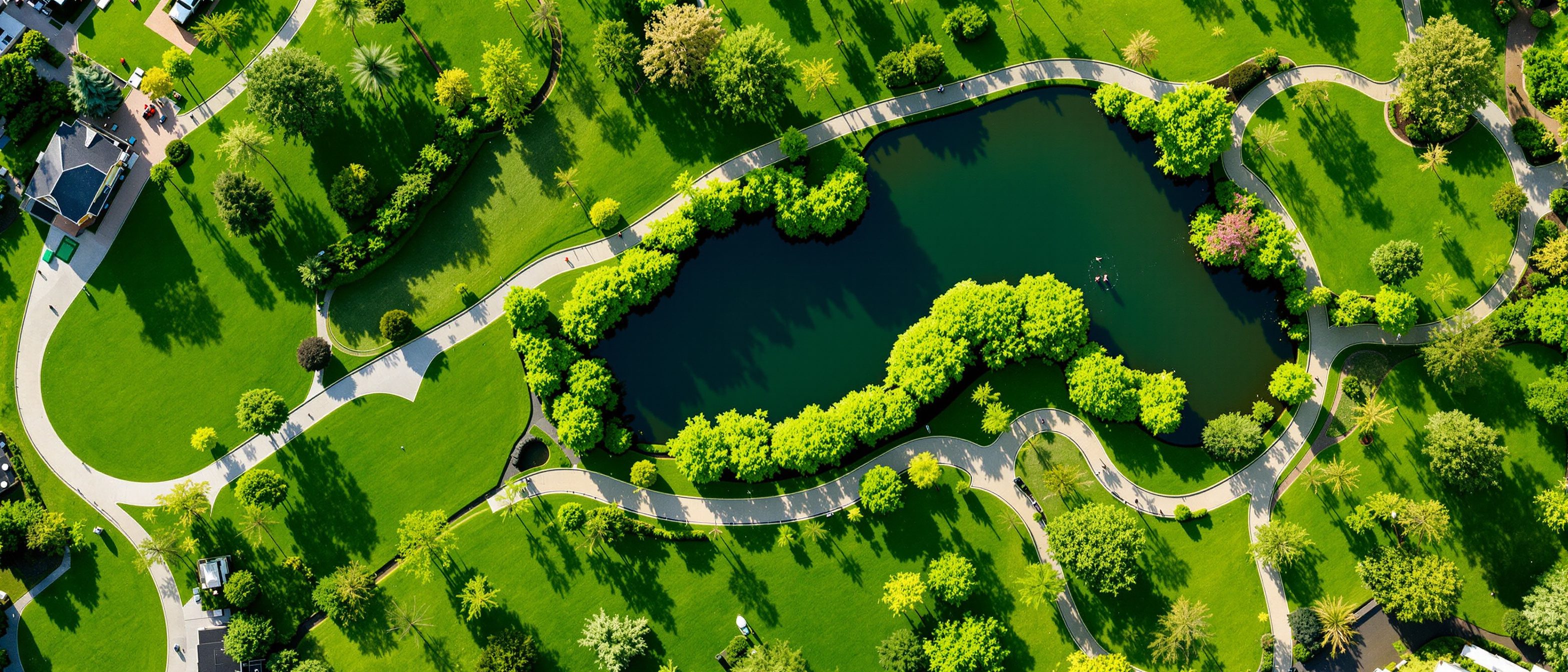
Design Process & Principles
Analysis drives form — site, sequence, the genius loci, and microclimate.
Because the site is a living system, landscape design is inventory-led: you cannot responsibly compose until you have read the land. The process runs site analysis → concept → zoning → circulation → composition, and its hallmark is that analysis drives form — the best designs feel found in the site. Learn the layers of a landscape site analysis, the composition principles (with sequence/movement as landscape's signature), the genius loci, the planting-design principles, and — central in India — designing the microclimate for thermal comfort.
Learning objectives
By the end of this lesson, you will be able to — mapped to the course outcomes for Landscape Architecture:
Run an inventory-led landscape site analysis and let it drive the concept.
Zone and compose outdoor space with circulation and spatial sequence.
Apply the composition principles and the genius loci to a landscape.
Design the microclimate (shade, wind, evaporative cooling) for thermal comfort in India.
Process & principles
Read the land first; compose with unity, sequence, enclosure and the genius loci — and design around every mature tree.[1, 2, 5]
Read the land first
Landscape design is inventory-led: site analysis → brief → concept → zoning → circulation → composition → detail. The hallmark is that analysis drives form — the best designs feel found in the site, responding to its slopes, water, trees, views and microclimate rather than imposed on it.[1]
Planting & microclimate
Compose planting in masses, layers and succession; and in India, design the microclimate (shade, wind, evaporative cooling) for thermal comfort as a primary concern.[3, 1]
Massing, layering, succession
Planting is composed, not scattered: by MASSING (groups read as form), LAYERING (the vertical strata for depth and habitat), SUCCESSION (designing for change — staggered flowering, the slow maturing of trees so the scheme performs across seasons and years) and SEASONAL INTEREST (sequencing colour and flower). Planting is designed in two time-frames at once: opening day and the mature decade.[3]
At a glance
| Aspect | Formal | Informal |
|---|---|---|
| Balance | Formal: mirror symmetry about an axis | Informal: balance of unequal masses |
| Circulation | Formal: straight, axial | Informal: curving, exploratory, sequence-led |
| Reveal of views | Formal: single commanding vista | Informal: progressive, surprising reveals |
| Feeling | Formal: order, control | Informal: naturalism, discovery |
| Best fit | Ceremonial / institutional fronts | Parks, gardens, ecological settings |
Key terms
Systematic inventory and mapping of a site's natural and contextual factors.
Allocation of programme uses to areas of the site, guided by the analysis.
The designed network of movement through a landscape — its experiential narrative.
The distinctive spirit or character of a place, revealed and reinforced by design.
Designing for change so a scheme performs across seasons and years.
Shaping shade, wind and humidity for outdoor thermal comfort.
Studio task
For a real site, produce a layered site analysis (climate/sun, hydrology, existing trees, topography, views) and let it generate a concept. Sketch the zoning and a circulation route, naming where it reveals each view in sequence and what gives the place its genius loci. Then mark, on a May-afternoon sun study, where you place shade trees and water for thermal comfort.
Self-assessment
1. Which principle is especially emphasised in landscape because the medium is experienced over time and on foot?
2. 'Genius loci' in landscape design means —
3. When there is a level change near a building, the landscape designer should first fix —
Recap
References & further reading
- [1]John Ormsbee Simonds & Barry Starke, Landscape Architecture (the design process and site planning).
- [2]Norman K. Booth, Basic Elements of Landscape Architectural Design (composition principles).
- [3]Grant W. Reid, From Concept to Form in Landscape Design (concept development).
- [4]Catherine Dee, Form and Fabric in Landscape Architecture (spatial composition and experience).
- [5]Christian Norberg-Schulz, Genius Loci: Towards a Phenomenology of Architecture (the spirit-of-place concept).
Further reading
- John Ormsbee Simonds — Landscape Architecture (the manual).
- Grant W. Reid — From Concept to Form in Landscape Design.
- Catherine Dee — Form and Fabric in Landscape Architecture.
Sources gathered and fact-checked June 2026. Published values vary by source, sample and method — treat as indicative and confirm against the cited standard before structural use.
The author
Amogh N P
Architect, interior designer, and creative polymath. Studio Matrx began in his notebooks — his vision of design made honest, useful, and open to everyone. Its Academy is written and taught in his memory, and free, forever.
More about Amogh →