
Set Design & Concept
From reading the script to a buildable set
This is the heart of scene design. A set begins in the script, read for its given circumstances and what each scene must show and do — ‘the designer invents whatever looks good’ is a myth. Research grounds the world so it rings true; a concept is the single controlling idea that gives the design unity and meaning. Designers think visually, by drawing and modelling. And a concept must translate into a buildable set — through a plain white study model that fixes form before colour, then a colour model and working drawings.
Learning objectives
By the end of this lesson, you will be able to — mapped to the course outcomes for Set Design:
Analyse a script for what the scenery must show — place, period, mood and action.
Develop a scenic concept and translate it into a buildable design.
Use the design process — research, thumbnails, white and colour models, working drawings.
Read the script first
A set begins in the script, not a pretty image. The designer reads it for the given circumstances — place, period, time, mood — and for what each scene’s action needs. Then comes research: the real period, place, materials and colours, so the world rings true.[1]
What the scenery must show
A set begins in the SCRIPT, not in a pretty image. The designer reads it for the GIVEN CIRCUMSTANCES — the place, period, time of day, weather, social world and mood the story requires — and for what each scene's action NEEDS (a door to slam, a staircase to descend, a window to climb through). 'The designer invents whatever looks good' is a MYTH: the script sets the brief. Reading it closely, more than once, and listing what the scenery must SHOW and DO is the first real design act — everything after serves those findings.[1, 2]
Concept and visual thinking
A concept is the single controlling idea — a metaphor, mood or spatial idea — that gives a design unity and meaning, wrapping every choice. And designers think visually: thumbnails test ideas fast, storyboards work out each scene, and a weak idea is exposed the moment it is drawn.[2, 3]
One idea that holds it together
A CONCEPT is the single controlling idea that gives a design unity — a metaphor, a mood, a spatial idea ('a world closing in', 'faded grandeur', 'everything off-balance') that every choice serves. It comes from the script and the director's vision, and it 'wraps' the whole design so walls, colour, objects and light pull one way. Without a concept a set is a collection of nice things; with one, it is a world that MEANS something. The concept is the bridge from analysis to form — the designer's interpretation made into a design direction.[2, 3]
From concept to buildable set
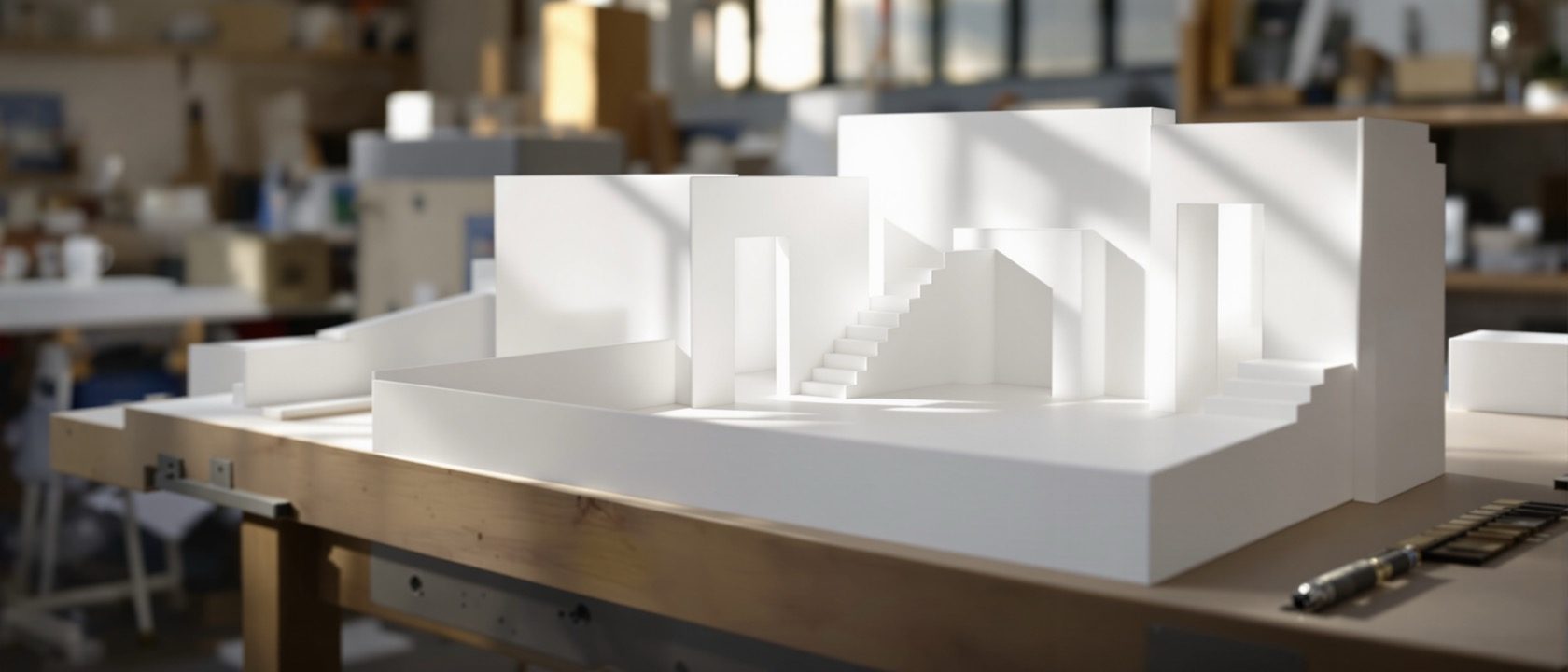
A concept must translate into a buildable set: research and thumbnails, then a white model that studies form, space and sightlines before colour, then a colour model, then working drawings the workshop builds from. A design that cannot be built, moved or afforded is not finished.[3]
From idea to actual set
A concept must TRANSLATE into an actual, buildable set. The classic path: research and thumbnails, then a WHITE MODEL (a plain scale model that studies FORM, space and sightlines before colour), then a COLOUR MODEL (adding colour, texture and finish), then WORKING DRAWINGS (ground plan, elevations and details the workshop builds from). Each step tests the idea against reality — will it fit the stage, the budget, the sightlines, the scene changes? A design that cannot be built, moved or afforded is not finished. Translating vision into buildable drawings is the discipline of the craft.[3]
At a glance
| Aspect | The fact | The folklore |
|---|---|---|
| A set begins with | The SCRIPT — the given circumstances and what each scene needs | Whatever looks good |
| Research is | Knowing the real period, place and world so it rings true | Optional — invent it |
| A concept is | One controlling idea that gives the design unity and meaning | A collection of nice things |
| Designers think by | Drawing, storyboarding and modelling — visual thinking | Talking it through only |
| The white model tests | FORM, space and sightlines before colour | Nothing — skip to colour |
| A finished design is | Buildable — fits stage, budget, sightlines, changes | A beautiful render that can't be built |
Key terms
The place, period, time, weather, social world and mood a script requires (Stanislavski's term) — what the designer reads a script for, alongside what each scene's action needs.
Reading a script closely for what the scenery must SHOW and DO — the first real design act, which the whole design then serves; not inventing whatever looks good.
The single controlling idea — a metaphor, mood or spatial idea — that gives a design unity and meaning, and 'wraps' every choice so they pull one way.
Designing by sketching, storyboarding and modelling — the hand and eye discover what the mind alone misses, and a weak idea is exposed the moment it is drawn.
A plain white scale model that studies form, space, scale and sightlines before any colour or texture — fixing the hardest decisions first.
The colour model adds colour, texture and finish; working drawings (ground plan, elevations, details) are what the workshop builds the set from.
Study task
Choose a short scene from a play or film and design its set. Start with script analysis: list the given circumstances (place, period, time, mood) and what the action needs (a door, a level, a window). Research the real world of the scene. Find a concept — one controlling idea — and test it in quick thumbnails. Then translate it: build a rough white model (card is fine) to judge form, space and sightlines with no colour; only then add colour and texture, and sketch a ground plan and elevation. Finish with an honest check — does it fit the stage, the budget and the scene changes, and can it actually be built? The test is a concept carried all the way to a buildable design.
Self-assessment
1. Where does a set design begin?
2. What is a design 'concept'?
3. How do scenic designers think?
4. What is the white model for?
Recap
References & further reading
- [1]Script analysis for the scenic designer — given circumstances and reading a play for its scenery (Darwin Reid Payne, The Scenographic Imagination; scene-design texts). https://www.routledge.com/
- [2]The scenic design process and visual thinking — concept, thumbnails, storyboards and models (J. Michael Gillette, Theatrical Design and Production). https://www.mheducation.com/
- [3]From concept to buildable set — white model, colour model and working drawings (scene-design and production texts; Pamela Howard, What is Scenography?). https://www.bloomsbury.com/
Further reading
- Darwin Reid Payne, The Scenographic Imagination.
- J. Michael Gillette, Theatrical Design and Production.
- Pamela Howard, What is Scenography?
Sources gathered and fact-checked June 2026. Published values vary by source, sample and method — treat as indicative and confirm against the cited standard before structural use.
The author
Amogh N P
Architect, interior designer, and creative polymath. Studio Matrx began in his notebooks — his vision of design made honest, useful, and open to everyone. Its Academy is written and taught in his memory, and free, forever.
More about Amogh →