
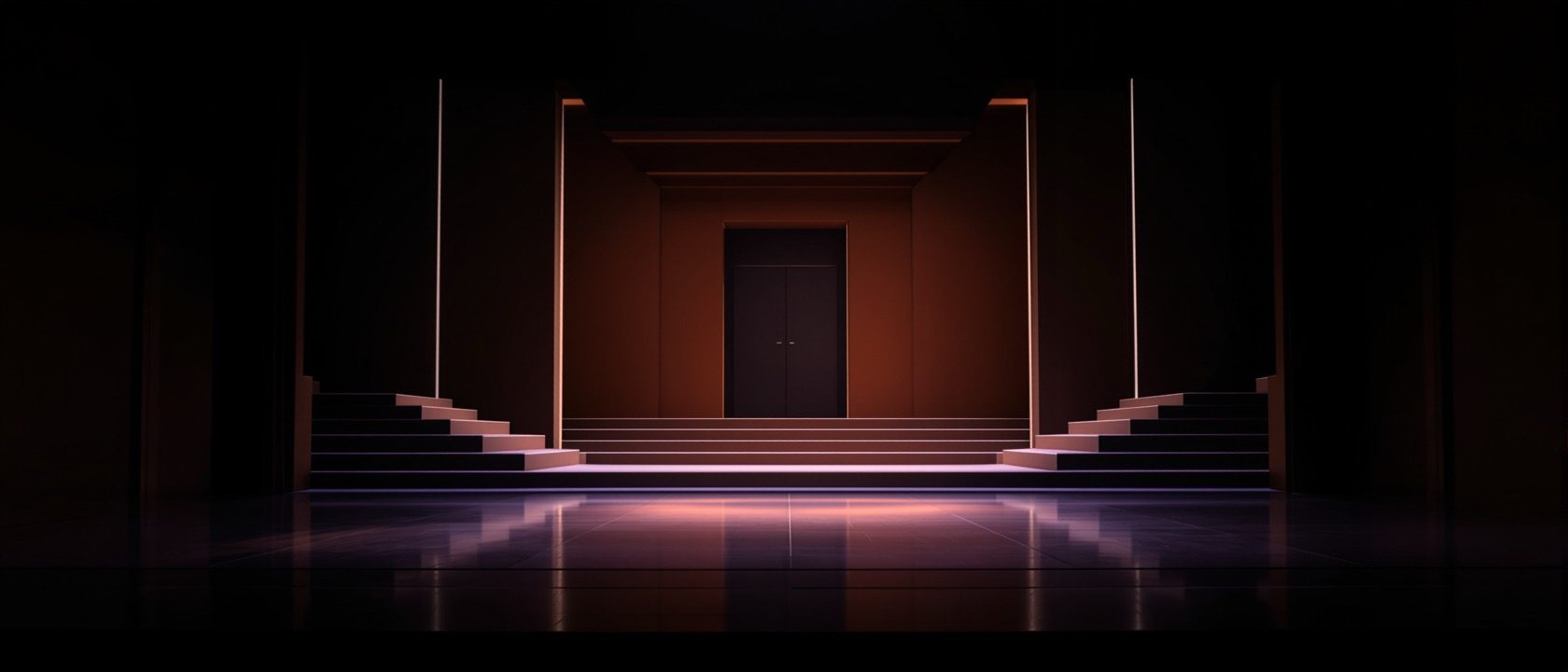
Stage Design
From inception to performance — colour, light and space
Stage design is a process from inception to performance — and, unlike film, it must work live, every night, only truly finished on opening night. The designer analyses on three fronts — language, visual arts and architecture — and applies the same elements and principles of design at the scale of a lived-in room, composed for a moving actor and audience. Colour and light set the mood: the same set warm reads intimate, cold reads hostile; light is scenery. And a set succeeds when it serves the story and is well seen — not when it is spectacular.
Learning objectives
By the end of this lesson, you will be able to — mapped to the course outcomes for Set Design:
Describe the stage-design process from inception to performance.
Apply the principles and elements of design, and an architectural analysis, to the stage.
Use colour and light to set a production's mood and meaning.
From inception to performance
Stage design runs from the first reading and concept, through analysis and research, models and drawings, to build, rehearsal and the live performance — adjusting under stage light to the end. The designer analyses on three fronts: language (the text), visual arts (images and palette) and architecture (the real and theatre space).[1, 2]
The whole arc
STAGE DESIGN is a process from INCEPTION to PERFORMANCE. It runs from the first reading and the director's concept, through script and visual-arts analysis and research, into thumbnails, models and working drawings, then build, technical rehearsals and the LIVE performance — where, unlike film, the design must work in real time, every night, with actors moving through it. The designer stays involved to the end, adjusting under stage light and in rehearsal. Stage design is not a drawing handed over; it is a world made to be inhabited and performed in, and it is only finished on opening night.[1, 2]
Stage-form explorer · where the audience sits changes everything
Crimson = stage · gold dots = audience
Proscenium
Audience on one side, through an arch
- Intimacy:
- Most formal and distant
- Scenery:
- Full scenery possible — painted vistas, tall built walls, flown pieces and machinery hidden behind the arch
- Sightlines:
- Simple: everyone looks the same way, so nothing blocks the view
- Best for:
- Grand illusion, elaborate scenery, opera, classic drama
The design lesson · The stage form is chosen first — it decides what scenery is even possible, before a wall is drawn.
Design principles on the stage
The same elements and principles of design — line, colour, texture, space and light, ordered by balance, emphasis and unity — are applied at the scale of a room a story lives in. But a stage composition is inhabited and moving: space itself is a material, and the design shapes how the actor moves and the eye is led.[3]
Design made scenic
The ELEMENTS and PRINCIPLES of design — the same LINE, SHAPE, COLOUR, TEXTURE, SPACE and LIGHT, ordered by BALANCE, RHYTHM, EMPHASIS, PROPORTION and UNITY from the foundation course — are applied to the stage. A strong diagonal drives the eye; a dominant mass gives emphasis; proportion sets grandeur or intimacy; unity holds the picture together. Stage design is not a separate art with its own rules — it is the principles of design used at the scale of a room a story lives in, and composed for a moving audience and a moving performer.[3]
Colour, light and mood
Colour and light carry a production’s mood: the same set lit warm reads intimate, lit cold reads stark, and light is scenery that changes the world without moving a wall (Appia’s lesson). And a set serves — the measure is how well the story is told and seen, not how spectacular it looks.[3, 4]
The same set, transformed
COLOUR and LIGHT carry a production's MOOD and meaning. The same set lit warm and low reads intimate and safe; lit cold and hard, stark and hostile; and colour — in walls, cloth and light — sets a whole emotional key, as the colour course taught. On stage, LIGHT is scenery (Appia's lesson): it sculpts form, directs the eye, marks time and place, and changes the world without moving a wall. Designing colour and light is designing feeling — the most powerful, and most reversible, tool the stage designer has.[3, 4]
At a glance
| Aspect | The fact | The folklore |
|---|---|---|
| Stage design is | A process from inception to PERFORMANCE — finished on opening night | A drawing handed over |
| The designer analyses | Language, visual arts AND architecture | Only the script |
| Its rules are | The same elements and principles of design, at room scale | A separate art with its own rules |
| A stage composition is | Inhabited and moving — designed for actor and audience | A static picture |
| Colour and light | Set the mood and meaning; light IS scenery | Just make it visible |
| A set succeeds when | It serves the story and is well seen | It looks spectacular in a photo |
Key terms
The arc from inception to performance — first reading and concept, analysis and research, thumbnails, models and working drawings, build, technical rehearsals and the live performance.
The stage designer's three fronts — reading the text for its world, mining images for palette and atmosphere, and understanding the real and theatre architecture and sightlines.
Line, shape, colour, texture, space and light ordered by balance, rhythm, emphasis, proportion and unity — the foundation principles used at the scale of a lived-in room.
Levels, staircases, doorways and open expanse used to do dramatic work and shape how the actor moves and the audience's eye is led — a moving, inhabited composition.
The tools that set a production's mood and meaning — the same set warm or cold reads intimate or hostile; light sculpts form and changes the world without moving a wall (Appia).
The measure of a set is not spectacle but how well it lets the story be told and seen — sightlines, flow, mood and a livable space; a set that upstages the play has failed.
Study task
Design a full stage set for a scene, from inception toward performance. Analyse it on three fronts: language (read the text for its world and demands), visual arts (gather images for palette and atmosphere) and architecture (the real space and a chosen staging form — use the stage-form explorer to pick one and see what scenery it allows). Apply the elements and principles of design to compose the space for a moving actor and audience, using levels, doorways and openness to give the action places to happen. Then design its colour and light to set the mood — show the same set in two lighting states, warm and cold. Close with an honest verdict: does your set serve the story and let it be seen, or does it upstage the play? The test is a designed world that serves.
Self-assessment
1. What is stage design, as a process?
2. On what three fronts does the stage designer analyse?
3. What rules govern stage design?
4. What do colour and light do on stage?
5. When does a set succeed?
Recap
References & further reading
- [1]Stage design as process from inception to performance — the designer's role through build and rehearsal (Pamela Howard, What is Scenography?; J. Michael Gillette, Theatrical Design and Production). https://www.bloomsbury.com/
- [2]Analysing a play for design — language, visual arts and architectural analysis (Darwin Reid Payne, The Scenographic Imagination; scene-design texts). https://www.routledge.com/
- [3]Elements and principles of design applied to the stage, and space, colour and composition for the moving audience (design-fundamentals and scene-design references). https://www.mheducation.com/
- [4]Light and colour as scenery — Adolphe Appia and stage lighting design (scenography and stage-lighting references). https://www.routledge.com/
Further reading
- Pamela Howard, What is Scenography?
- J. Michael Gillette, Theatrical Design and Production.
- Darwin Reid Payne, The Scenographic Imagination.
- Time-Saver Standards for Building Types (DeChiara & Callender); Neufert, Architects' Data.
Sources gathered and fact-checked June 2026. Published values vary by source, sample and method — treat as indicative and confirm against the cited standard before structural use.
The author
Amogh N P
Architect, interior designer, and creative polymath. Studio Matrx began in his notebooks — his vision of design made honest, useful, and open to everyone. Its Academy is written and taught in his memory, and free, forever.
More about Amogh →