
Form, Material & Making
Chosen for function and end-of-life — and it must be makeable
These are the choices that give a product its body. Form and colour carry meaning and emotion — real value — but they serve function, never replace it. Material and technology are chosen for the job, and for recyclability, repair and end-of-life together, because a product that can’t be repaired or recycled is a design failure — design for disassembly. And a product must be designed to be made: feasibility for production and design for manufacture decide whether a good idea becomes a real, affordable object.
Learning objectives
By the end of this lesson, you will be able to — mapped to the course outcomes for Product Design:
Use form, colour and symbols to carry meaning and emotion while serving function.
Choose material and technology for function together with recyclability, repair and end-of-life.
Design for manufacture — feasibility for production and mass production — so a good idea can be made.
Form, colour, meaning
Form and colour carry meaning, emotion and brand — a product people love is kept longer — but they serve function. The honest order is function first, then form to express it; a gorgeous object that works badly is still a bad product.[1]
Carries meaning, serves function
A product's FORM and COLOUR carry MEANING and EMOTION — a soft rounded form reads as friendly, a heavy squared one as sturdy, a colour as playful or serious — and they carry BRAND and cultural association too. This is real value, not decoration: a product people find beautiful is used and kept longer. But form and colour SERVE function; they never replace it. The honest order is function first, then form and colour chosen to express and support it — a gorgeous object that works badly is still a bad product.[1]
Material & recyclability
Material and technology are chosen for the job — function, feel, cost, life. And a product’s end of life is a design decision: design for disassembly and recyclability, because ‘a product’s job ends at the sale’ is a myth — a glued-shut, mixed-material product is landfill by default.[1, 2]
A functional choice
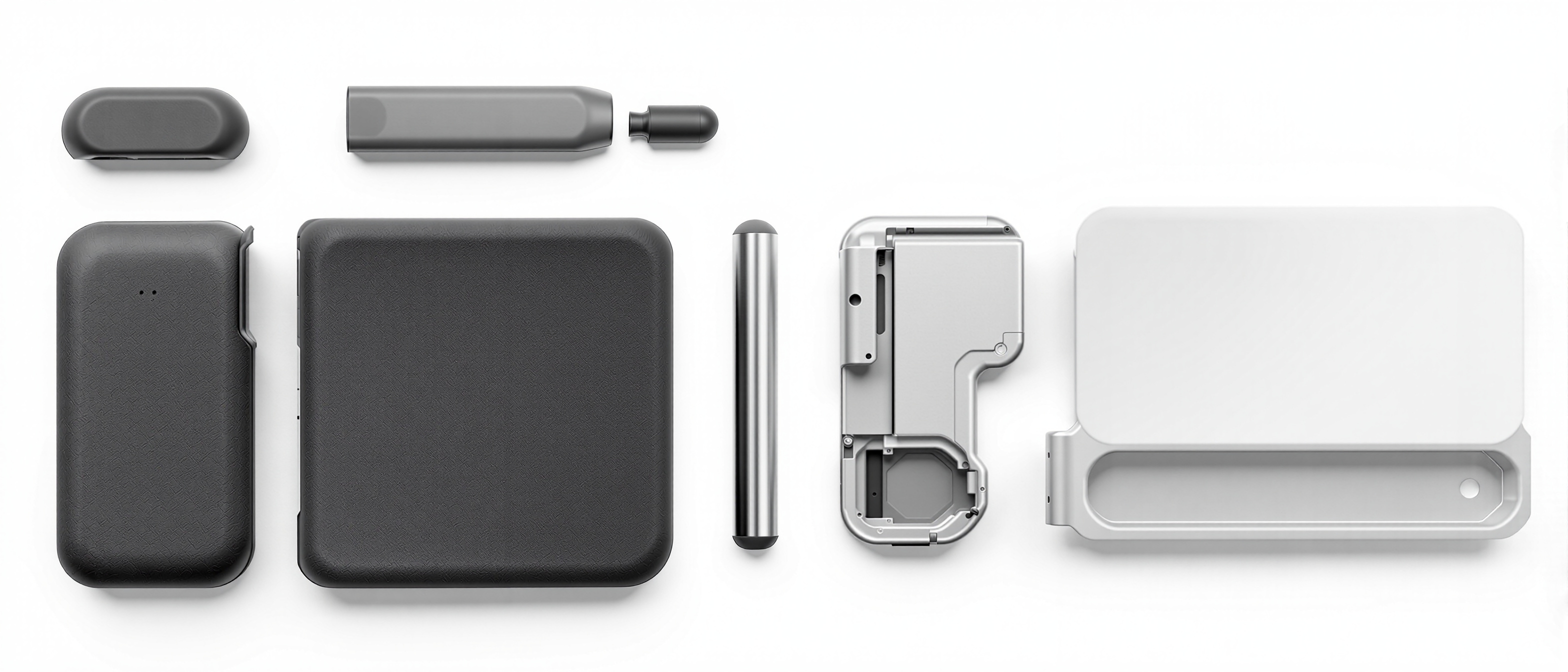
MATERIAL and production TECHNOLOGY are chosen for the JOB — function, use, feel, cost and life — not just appearance. The grip's rubber, the frame's steel, the casing's polymer each earn their place by what they must do; the wrong material feels wrong, fails early or costs too much. Choosing material and technology well is the engineering heart of product design, and it is inseparable from the form: a shape that cannot be made in the chosen material, or a material that cannot take the shape, is no design at all.[1, 2]
Design for making
A product must be designed to be made: feasibility for production and design for manufacture decide whether an idea becomes a real, affordable object. And packaging is part of the design — protect and inform with minimal, truthful material.[1, 3]
It must be makeable
A product must be designed to be MADE. 'A beautiful design is enough' is a MYTH: FEASIBILITY FOR PRODUCTION and DESIGN FOR MANUFACTURE (DFM) decide whether an idea becomes a real, affordable object. A design must suit its production process (moulding, machining, assembly), its VOLUME (a one-off differs from a mass-produced piece), its tolerances and its cost. Considering manufacture from the START — not bolting it on at the end — is what separates a producible product from a pretty prototype that can never be sold.[1]
At a glance
| Aspect | The fact | The folklore |
|---|---|---|
| Form and colour | Carry meaning and emotion — but SERVE function | Are the whole design |
| The order is | Function first, then form to express it | A shape, then make it work |
| Material & technology | Chosen for the JOB — function, feel, cost, life | Chosen for looks only |
| A product's end of life | A design decision — repair, disassembly, recyclability | Not the designer's problem |
| A design that can't be made economically | Is a wish, not a design — design for manufacture | Fine if it's beautiful |
| Packaging | Protects and informs with minimal material — part of the design | An afterthought / a marketing box |
Key terms
The look and feel of a product, carrying meaning, emotion and brand — real value, but serving function; function first, then form chosen to express and support it.
Designing to who actually uses a product, in what context, with what constraints — a tool for a child, a professional or an older user differs in size, force and feel.
One well-designed product honestly serving several needs (a stool that's also a step) — real multi-use, not gimmickry that does each job badly.
Selecting material and production process for function, use, feel, cost and life — the engineering heart of a product, inseparable from its form.
Designing a product to come apart and separate cleanly by material, so it can be repaired and recycled — end of life as a design decision, not landfill by default.
Designing a product so it can be made economically, repeatably and at the intended volume — feasibility for production decides whether an idea becomes a real object.
Study task
Take one product you designed or analysed earlier and resolve its body. Choose its form and colour to express its function, and justify each as serving use, not just looks. Specify its materials and technology, saying why each earns its place (the grip’s rubber, the frame’s metal). Then design for its end of life: show how the parts come apart and separate by material for repair and recycling, rather than being glued shut. Confirm it can be made — name its production process and whether it suits mass production — and design its packaging minimal, protective and truthful. The test is a product designed for function, for making, and for its whole life.
Self-assessment
1. What is the honest order of form and function?
2. How is a product's material chosen?
3. Why is 'a product's job is over once it's sold' a myth?
4. Why is 'a beautiful design is enough' a myth?
5. How should packaging be designed?
Recap
References & further reading
- [1]Form, colour, material, technology and manufacture in product design — user criteria, multiple utility and design for manufacture (product-design texts; Helen Marie Evans, An Invitation to Design). https://www.moma.org/
- [2]Materials selection and design for disassembly / recyclability — end-of-life as a design decision (sustainable-design and materials references). https://www.bis.gov.in/
- [3]Recyclability, repair and packaging — designing for the whole life of a product (cradle-to-cradle and sustainable-product design). https://www.moma.org/
Further reading
- Helen Marie Evans, An Invitation to Design.
- Andrew Alpern, Handbook of Specialty Elements in Architecture.
- Francis D.K. Ching, Interior Design Illustrated.
Sources gathered and fact-checked June 2026. Published values vary by source, sample and method — treat as indicative and confirm against the cited standard before structural use.
The author
Amogh N P
Architect, interior designer, and creative polymath. Studio Matrx began in his notebooks — his vision of design made honest, useful, and open to everyone. Its Academy is written and taught in his memory, and free, forever.
More about Amogh →