
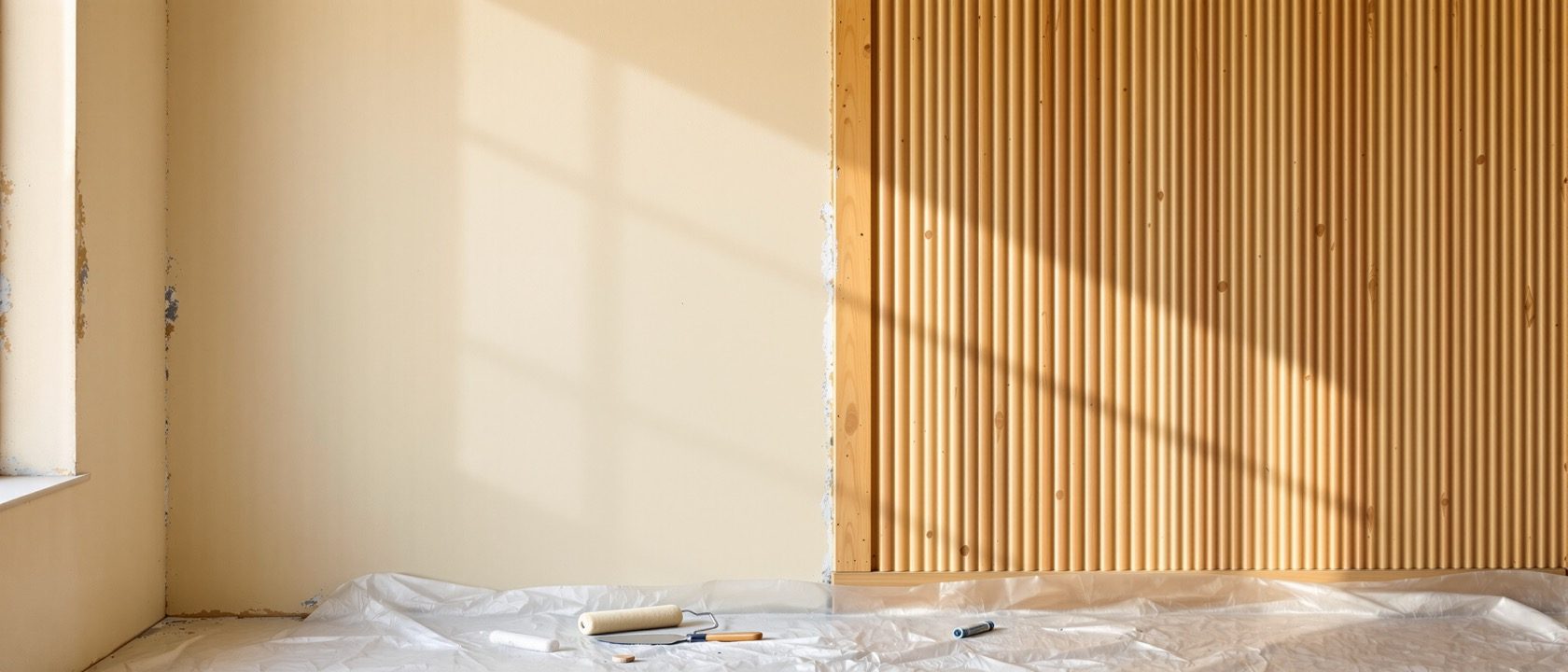
Wall Finishes & Cladding
The substrate discipline — plaster, the paint system, and cladding.
A finish is only as good as the plaster under it. Learn plasters and renders (cement plaster the hard base, gypsum plaster the fast interior surface, POP punning) and that wall putty is a leveller, not a primer; paint taught as a SYSTEM — prep, primer, putty, primer, two coats — with the binder families and the sheen ladder; and cladding and panelling, including the mechanical fixing large stone slabs need for safety, all as substrate decisions.
Learning objectives
By the end of this lesson, you will be able to — mapped to the course outcomes for Interior Materials & Construction II:
Distinguish cement plaster, gypsum plaster and POP, and the role of wall putty.
Explain the paint system, the binder families and the sheen ladder.
Describe wallpaper and the substrate a finish needs.
Detail stone, tile and panel cladding, including safe mechanical fixing.
Plaster, putty & the paint system
Cement versus gypsum plaster, wall putty as a leveller, and paint as a system with binders and sheen — and why new plaster must cure.[1, 2, 3]
The substrate discipline
A finish is only as good as its plaster. CEMENT PLASTER (1:4–1:6 sand-cement, ~12 mm smooth or 15–20 mm two-coat, water-cured) is the hard base for tiles, texture and wet work. GYPSUM PLASTER (a factory-blended 6–13 mm single coat, no curing) gives a smooth, ready-to-paint interior surface — faster, less cracking, warmer — but NOT for permanently wet or external walls. POP PUNNING is a thin skim over cement plaster for a glass-smooth base (the traditional Indian route). WALL PUTTY (white-cement or acrylic, ~1–1.5 mm, 1–2 coats) fills fine pores — it is a LEVELLER, not a primer; you still prime after putty.[1, 2]
Cladding & panelling
Stone and tile cladding (with the mechanical fixing large slabs need), panelling on a batten framework, and feature and back-lit panels.[1, 4]
Adhesive, or anchored
STONE CLADDING (10–30 mm) is fixed either by adhesive/thin-set for small format on sound plaster, OR by MECHANICAL fixing — stainless-steel brackets, pins, angles and dowels on a backing — which is MANDATORY for large or heavy slabs and all significant heights. Large stone glued alone at height is a safety failure; falling cladding is a real hazard. TILE CLADDING on walls uses thin-set adhesive on plaster, with C2/waterproof adhesive plus waterproofing behind in wet areas.[1, 4]
At a glance
| Aspect | One side | The other |
|---|---|---|
| Wall putty | Myth: it is a primer | Reality: a filler/leveller — prime after it |
| Painting new plaster | Myth: paint as soon as dry to touch | Reality: cure ~3–4 weeks and de-alkalise first |
| Big stone slabs | Myth: just glue them to the wall | Reality: mechanically anchor large/heavy cladding at height |
| Higher gloss | Myth: hides a bad wall | Reality: reveals undulation — matt hides more |
| Acoustic panels | Myth: soundproof a room | Reality: absorb within a room; don't block between rooms |
Key terms
Cement is the hard, cured base (and wet-area); gypsum is a fast single-coat smooth interior surface (dry only).
A fine-pore filler and leveller — NOT a primer; you still prime after putty.
Prep, primer, putty, primer, two finish coats — the sequence and drying times decide quality.
Matt → eggshell → satin → semi-gloss → gloss; higher sheen is washable but reveals defects.
SS brackets/pins/dowels — mandatory for large or heavy cladding at height (adhesive alone is unsafe).
Slat-on-felt panels that absorb sound within a room — they do not block it between rooms.
Detailing task
Write the full paint specification for a plastered interior wall — every layer in sequence (prep, primer, putty, sand, primer, two coats), the emulsion tier and sheen you would choose, and the curing time before painting a new cement-plastered wall. Then draw a sectional detail of veneer panelling fixed to battens (showing the ventilated cavity and a shadow-gap joint) and a detail of large stone cladding, marking the mechanical anchor that makes it safe at height.
Self-assessment
1. Wall putty in the paint system is —
2. Large, heavy stone wall cladding at height must be —
3. New cement plaster should be painted —
Recap
References & further reading
- [1]Francis D.K. Ching, Interior Design Illustrated / Building Construction Illustrated (wall finishes, plaster, cladding assemblies).
- [2]B.S. Rangwala, Building Construction, Charotar (plastering, pointing and cladding in Indian practice).
- [3]Asian Paints / Berger technical and painting-system manuals; Saint-Gobain Gyproc plaster and Birla White putty literature (application data).
- [4]BIS: IS 2547 (gypsum plaster), IS 2395 (painting of plaster surfaces), IS 2338 (finishing of wood), IS 4101 Part 1 (stone facing/cladding).
Further reading
- Francis D.K. Ching — Interior Design Illustrated.
- B.S. Rangwala — Building Construction.
- Asian Paints / Gyproc technical manuals.
Sources gathered and fact-checked June 2026. Published values vary by source, sample and method — treat as indicative and confirm against the cited standard before structural use.
The author
Amogh N P
Architect, interior designer, and creative polymath. Studio Matrx began in his notebooks — his vision of design made honest, useful, and open to everyone. Its Academy is written and taught in his memory, and free, forever.
More about Amogh →