
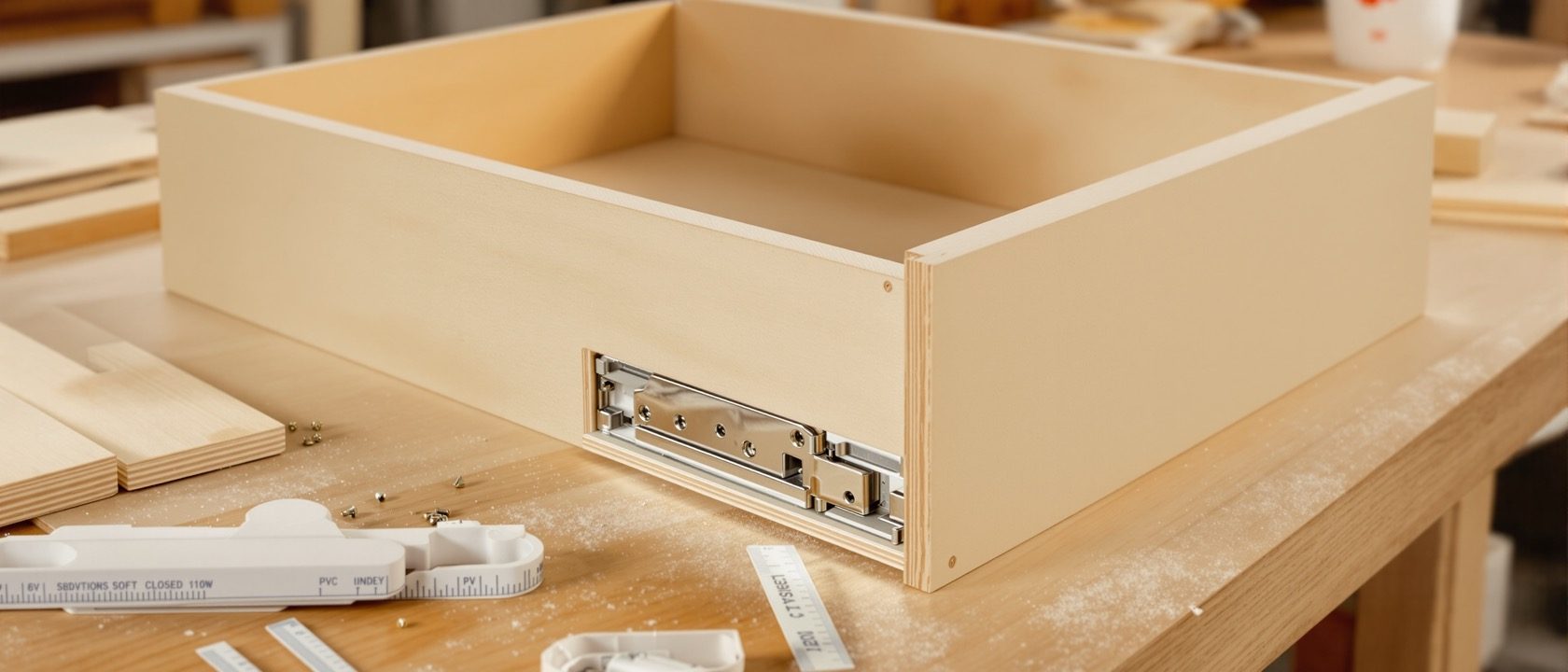
Joinery & Millwork
The carcass, the hardware ecosystem, and how furniture is made.
How built-in and loose furniture is actually made. Learn carcass (box) construction and the right board for each zone; the board-hardware ecosystem that runs Indian joinery — the 35 mm cup hinge, drawer runners, the knock-down fittings that make modular furniture demountable, and edge-banding; modular versus carpenter-built furniture and shutter finishes; and traditional timber joints versus modern KD joinery, with worktops and the standard dimensions.
Learning objectives
By the end of this lesson, you will be able to — mapped to the course outcomes for Interior Materials & Construction II:
Describe carcass construction and choose the right board for each zone.
Identify the joinery-hardware ecosystem — hinges, runners, KD fittings, edge-banding.
Compare modular and carpenter-built furniture, and shutter finishes.
Compare traditional joints with KD joinery, and specify worktops.
Carcass & the hardware ecosystem
Carcass construction and board choice, and the hardware families — cup hinges, drawer runners, KD fittings, edge-banding.[1, 2, 4]
The box of boards
Almost all built-in Indian furniture is a CARCASS — a box of boards: 18 mm ply/MDF sides, top and bottom, a 6–8 mm back and a toe-kick base, assembled into modules and then fitted with shutters, drawers and hardware. Understand the CARCASS + SHUTTER + HARDWARE trinity and you understand modern joinery. Board choice by zone: BWP/marine ply (IS 710) for wet zones and quality work; MR-MDF for painted and membrane shutters (a superb smooth face); pre-laminated particleboard for economical modular — and never commercial MR ply or raw MDF where it will get wet.[1, 2]
Try it — the joinery-hardware explorer
Pick a hardware family to see what it is and what it is used for.
Joinery-hardware explorer · the board ecosystem
Concealed cup hinge
HingeWhat: The 35 mm-cup-bored European hinge — clip-on, adjustable in three axes, with integrated soft-close; specified by overlay / half-overlay / inset and crank.
Used for: Every carcass shutter (cabinet door).
Boards are governed by IS codes; the hardware is a catalogue-and-load world — Hettich, Hafele, Ebco, Blum.
Modular, joints & worktops
Modular versus carpenter-built furniture and shutter finishes, traditional joints versus KD joinery, and worktops with standard dimensions.[1, 3]
Interlock vs clamp
TRADITIONAL timber joints resist load through interlocking geometry plus glue: the MORTISE-AND-TENON (frames and doors), the DOVETAIL (drawer boxes — the hallmark of fine drawers), the DADO/housing (a shelf into a side), TONGUE-AND-GROOVE (panels, flooring, cladding), and finger, halving and mitre joints — strong and permanent. MODERN KD joinery resists load through mechanical CLAMPING — cam-and-dowel (minifix), confirmat screws, dowels and biscuits — fast, demountable and machine-repeatable, and it is what enables flat-pack manufacture.[1, 2]
At a glance
| Aspect | One side | The other |
|---|---|---|
| MDF vs plywood | MDF: smooth face, poor edge-screw hold, swells wet | Ply: cross-laminated, holds edge screws, better for wet/structure |
| Modular assembly | Myth: glued like site carpentry | Reality: KD (cam-and-dowel) — demountable, flat-packed |
| Soft-close | Myth: a hinge brand | Reality: a damping mechanism across brands |
| Quartz worktop | Myth: seal it like granite | Reality: engineered quartz is non-porous — no sealing |
| Edge-banding | Myth: cosmetic | Reality: seals the edge against moisture and chipping |
Key terms
The box of boards (18 mm sides/top/bottom, thin back, toe-kick) that is the body of built-in furniture.
The 35 mm-cup European hinge — clip-on, 3-axis adjustable, soft-close; the modern default.
Knock-down cam-and-dowel/minifix connectors that bolt flat-pack boards into a rigid box without glue.
A PVC/ABS band sealing exposed board edges against moisture and chipping — a mark of quality.
An interlocking traditional joint — the hallmark of a well-made drawer box.
Engineered quartz is non-porous (no sealing); natural granite/marble need periodic sealing.
Detailing task
Detail a base kitchen cabinet module (say 600 mm wide) as a carcass drawing — name the board for each part (side, top, bottom, back, shutter) and its thickness, mark the concealed cup hinge and a soft-close drawer runner, and show the toe-kick and worktop with the standard heights. State whether you would make it modular (KD) or carpenter-built and why. Then, for a drawer, compare a traditional dovetail joint with a modern KD assembly in a sentence each.
Self-assessment
1. Modern modular furniture is held together with —
2. Engineered quartz worktops differ from granite because quartz is —
3. Edge-banding on a board is —
Recap
References & further reading
- [1]David Kent Ballast, Interior Detailing: Concept to Construction, Wiley (casework/millwork detailing, cabinet and drawer sections).
- [2]Francis D.K. Ching, Interior Design Illustrated (furniture construction, joints, standard dimensions).
- [3]Time-Saver Standards for Interior Design and Space Planning (De Chiara, Panero & Zelnik) — dimensions and standard details.
- [4]Hettich, Hafele and Ebco technical hardware catalogues — hinge/runner/KD-fitting selection, boring dimensions and load ratings; BIS IS 303, IS 710, IS 2046, IS 12406.
Further reading
- David Kent Ballast — Interior Detailing: Concept to Construction.
- Francis D.K. Ching — Interior Design Illustrated.
- Hettich / Hafele / Ebco hardware catalogues.
Sources gathered and fact-checked June 2026. Published values vary by source, sample and method — treat as indicative and confirm against the cited standard before structural use.
The author
Amogh N P
Architect, interior designer, and creative polymath. Studio Matrx began in his notebooks — his vision of design made honest, useful, and open to everyone. Its Academy is written and taught in his memory, and free, forever.
More about Amogh →