
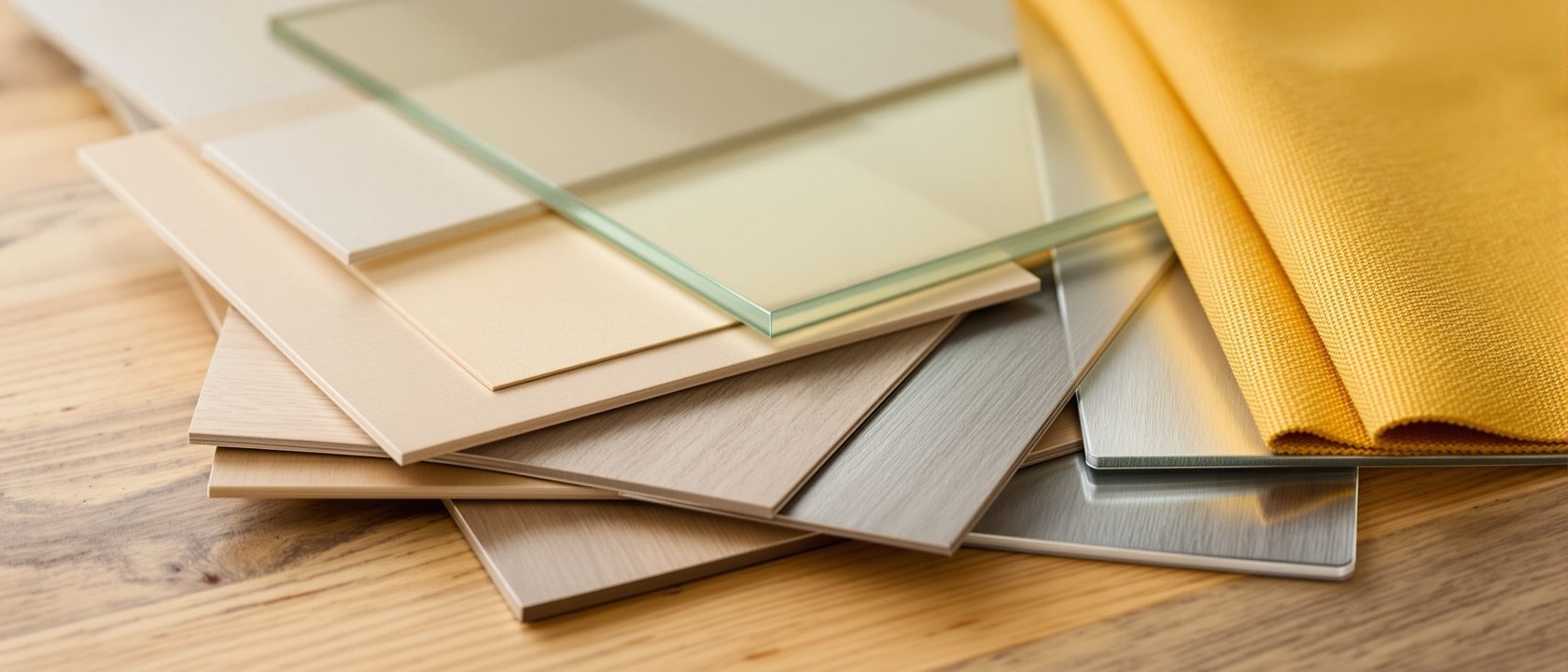
Materials in the Interior
The palette an interior designer specifies — boards to fabrics.
The core unit — the palette a designer specifies. Softwood versus hardwood is botanical, not hardness; learn the board family (ply > blockboard > MDF > particleboard) and its grades, glass (float, toughened, laminated), metals (304 vs 316), laminate versus veneer, gypsum versus cement board, and fabrics — with the specification traps flagged.
Learning objectives
By the end of this lesson, you will be able to — mapped to the course outcomes for Interior Materials & Construction I:
Distinguish softwood/hardwood and the wood boards by strength, screw-hold and moisture.
Explain timber defects, seasoning and the plywood grades (MR, BWR, marine).
Specify glass, plastics, gypsum and metals (304 vs 316) correctly.
Distinguish laminate from veneer, and choose fabrics for interiors.
Wood and the board family
Good timber, its defects and seasoning; and the boards ranked by strength and screw-hold, with MR versus marine.[1, 4]
Botanical, not 'hard'
SOFTWOOD (conifer/gymnosperm — deodar, pine) versus HARDWOOD (broad-leaved/angiosperm — teak, sal, sheesham) describes the TREE, not the wood's hardness — balsa is a hardwood yet very soft. Good timber is straight, close, uniform-grained, hard, durable, well-seasoned and free of defects. DEFECTS: knots (branch bases), shakes (heart/cup/ring separations), checks (cracks across rings) and warping (bow, cup, twist).[1, 3]
Compare the boards
Pick a board and compare its strength, screw-holding, water behaviour and use.
Board explorer · what to specify
Solid timber
- Strength
- High
- Screw-holding
- Excellent
- Water behaviour
- Moves with humidity; rots if unseasoned
- Typical use
- Frames, doors, quality furniture
Real wood — must be seasoned (~10–12% MC) or it warps and checks.
Strength & screw-hold rank plywood > blockboard > MDF > particleboard — they are not interchangeable.
Glass, metals, laminates & fabrics
Float, toughened and laminated glass; stainless 304 versus 316 and finishing; laminate versus veneer; and fabrics for interiors.[2, 5, 6]
Float, toughened, laminated
Almost all flat glass starts as FLOAT glass — molten glass floated over a bath of molten TIN for a perfectly flat surface. TOUGHENED / tempered glass is reheated and rapidly quenched (4–5× stronger, shatters into blunt granules — safety glass, IS 2553). LAMINATED glass bonds panes with a PVB interlayer so fragments stay stuck (safety + acoustic). CRUCIAL: toughened glass must be cut, drilled and edged BEFORE tempering — it cannot be trimmed on site.[5]
What would you specify?
Pick an application and see the right material — and why.
Spec-check · what would you specify?
Bathroom / wet-area ceiling or partition
→ Cement / fibre-cement board (not gypsum); marine (BWP) ply where timber is needed
Gypsum board degrades when wet — wet areas need a cement board.
Specify by application — wet-area, coastal, paint-grade or load-bearing all point to a different material.
At a glance
| Aspect | One side | The other |
|---|---|---|
| Board hierarchy | Strength/screw-hold: ply > blockboard | > MDF > particleboard |
| MR plywood | Myth: waterproof | Reality: humidity only — use BWR/marine for wet |
| Laminate vs veneer | Laminate: printed plastic sheet | Veneer: a slice of real wood |
| Toughened glass | Myth: cut to size on site | Reality: cut & drill BEFORE tempering |
| Stainless steel | 304: general interior | 316: coastal/wet (molybdenum) |
| Gypsum vs cement board | Gypsum: dry areas only | Cement board: wet areas |
Key terms
MR (moisture resistant, dry), BWR (boiling-water resistant), marine (IS 710, 72-h boil).
Fine-fibre board — very smooth, ideal for paint, but swells with water.
Drying timber to ~10–12% moisture — air (slow) or kiln (fast) — to stop warping and decay.
Heat-treated safety glass, 4–5× stronger — must be cut before tempering.
304 = general interior; 316 adds molybdenum for coastal/wet chloride resistance.
Laminate = printed plastic sheet; veneer = a thin slice of real wood.
Studio task
Collect real offcuts or swatches of plywood (MR and BWR), MDF, a laminate and a veneer. Label each with its grade/IS, thickness and use, then write a 150-word comparison of strength, screw-holding and water behaviour. For a coastal bathroom, name the metal, the board and the glass you would specify — and why.
Self-assessment
1. Ranked by strength and screw-holding, the order is —
2. 'MR' plywood is —
3. For a coastal balcony railing, specify stainless steel grade —
Recap
References & further reading
- [1]S.C. Rangwala, Engineering Materials, Charotar (timber, defects, seasoning, boards — India).
- [2]Jim Postell & Nancy Gesimondo, Materiality and Interior Construction, Wiley (boards, metals, laminates, fabrics).
- [3]S.K. Duggal, Building Materials, New Age (timber, glass, plastics, metals).
- [4]BIS: IS 303 & IS 710 (plywood/marine), IS 1659 (blockboard), IS 3087 (particleboard), IS 12406 (MDF), IS 5509 (FR ply).
- [5]BIS: IS 2553 (safety glass) and IS 2835 / IS 14900 (sheet / float glass); AIS Code of Practice for Use of Glass.
- [6]J. Rosemary Riggs, Materials and Components of Interior Architecture, Pearson (textiles and leather).
Further reading
- S.C. Rangwala — Engineering Materials.
- Postell & Gesimondo — Materiality and Interior Construction.
- S.K. Duggal — Building Materials.
Sources gathered and fact-checked June 2026. Published values vary by source, sample and method — treat as indicative and confirm against the cited standard before structural use.
The author
Amogh N P
Architect, interior designer, and creative polymath. Studio Matrx began in his notebooks — his vision of design made honest, useful, and open to everyone. Its Academy is written and taught in his memory, and free, forever.
More about Amogh →