
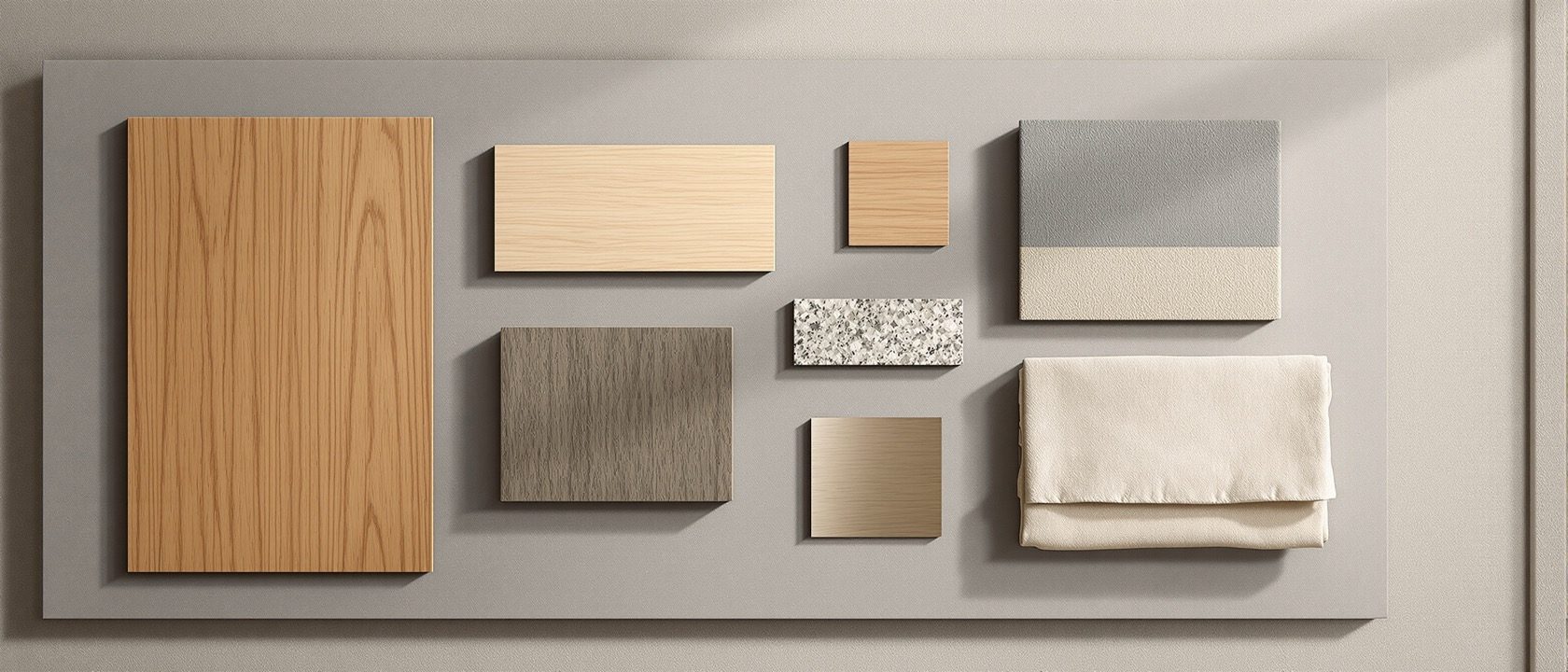
Material Board Workshop
Assembling and labelling a real materials palette.
A material board is not a mood collage — it is a technical specification tool made of real, labelled, sourced samples. Learn to source from the market, compose a coherent dominant/secondary/accent palette, label every sample fully, and present it with a rationale. Craft, nomenclature and reasoning are what is graded.
Learning objectives
By the end of this lesson, you will be able to — mapped to the course outcomes for Interior Materials & Construction I:
Source real, market-available material samples for a brief.
Compose a coherent dominant/secondary/accent materials palette.
Label each sample fully and present a specification rationale.
Distinguish a material board from a mood board.
Building the board
Source real samples, compose a palette not a grid, label each sample fully, and present it with a specification rationale.[1]
Real, market samples
Collect REAL, market-available samples — dealer swatches, laminate and veneer chip sets, tile and stone offcuts, fabric swatch books, hardware samples and board offcuts. Name the brand and grade of each; the board is a specification, so the samples must be things a contractor could actually buy.[1]
Models, and mood vs material
Small-scale models to test a detail, the difference between a mood board and a material board, and what the board is graded on.[1, 2]
Test a detail
Build small-scale models from market materials (board offcuts, acrylic, foam-board, wire, fabric) to test a detail, a joint, a partition build-up or a furniture piece at scale — the tactile complement to the sample board, and a rehearsal of how the material is actually assembled.[1]
At a glance
| Aspect | One side | The other |
|---|---|---|
| Purpose | Mood board: conveys feeling | Material board: a technical spec tool |
| Content | Mood: images, colours, atmosphere | Material: real, labelled, sourced samples |
| Composition | Myth: more samples = better | Reality: coherent dominant/secondary/accent |
| Each sample | Just a swatch? | Labelled: material, brand/grade, size, IS, use |
| Graded on | Not quantity | Nomenclature, fit, craft, reasoning |
Key terms
A technical palette of real, labelled, sourced samples with a rationale.
A board conveying feeling and atmosphere — not a technical specification.
The balance of a coherent materials palette.
Material, brand/grade, size, finish, IS reference and application per sample.
The written reason a palette suits the brief (durability, maintenance, mood).
A physical, tactile presentation of a materials palette.
Studio task
For a given room brief (say, a coastal apartment living room), assemble a coherent dominant/secondary/accent materials palette from real market samples — a board, a laminate or veneer, a flooring, a fabric, a metal finish and a glass — mounted neatly and each fully labelled (material, brand/grade, size, finish, IS, use), with a written rationale. Justify 316 stainless for the coastal context.
Self-assessment
1. A material (sample) board differs from a mood board because it —
2. Each sample on a material board should be labelled with —
3. A good material board is composed as —
Recap
References & further reading
- [1]Drew Plunkett, Construction and Detailing for Interior Design / Drawing for Interior Design, Laurence King (sampling & presentation).
- [2]Jim Postell & Nancy Gesimondo, Materiality and Interior Construction, Wiley (materials palette).
- [3]J. Rosemary Riggs, Materials and Components of Interior Architecture, Pearson (specification).
Further reading
- Drew Plunkett — Construction and Detailing for Interior Design.
- Postell & Gesimondo — Materiality and Interior Construction.
- J. Rosemary Riggs — Materials and Components of Interior Architecture.
Sources gathered and fact-checked June 2026. Published values vary by source, sample and method — treat as indicative and confirm against the cited standard before structural use.
The author
Amogh N P
Architect, interior designer, and creative polymath. Studio Matrx began in his notebooks — his vision of design made honest, useful, and open to everyone. Its Academy is written and taught in his memory, and free, forever.
More about Amogh →