
Site Visit & Practice
Seeing past the photograph to the maintenance behind a living interior landscape
This short closing unit puts the course together in the flesh. A site visit to real interior landscapes — a commercial atrium, a residential courtyard, a specialised indoor garden — teaches what a photograph cannot: the hidden maintenance regime behind a thriving planting, and, in a browning wall or a rotting planter, the requirement that was ignored. And the synthesis is a single honest idea — an interior landscape survives only when light, water, drainage, load and upkeep are all provided for, and its real gift is biophilic wellbeing.
Learning objectives
By the end of this lesson, you will be able to — mapped to the course outcomes for Interior Landscape:
Read a real interior landscape for how it is lit, watered and maintained.
Diagnose a failing green wall or planting from the requirement it lacks.
See past the photograph to the maintenance regime behind a thriving interior landscape.
Synthesise the course: a designed composition that survives only if light, water, drainage, load and upkeep are all provided for.
The site visit
Walk a real interior landscape and read it: where the light and water come from, how a feature is kept clean, where a green wall is failing and what that failure reveals about the requirement it lacks.[1]
The maintenance behind the beauty
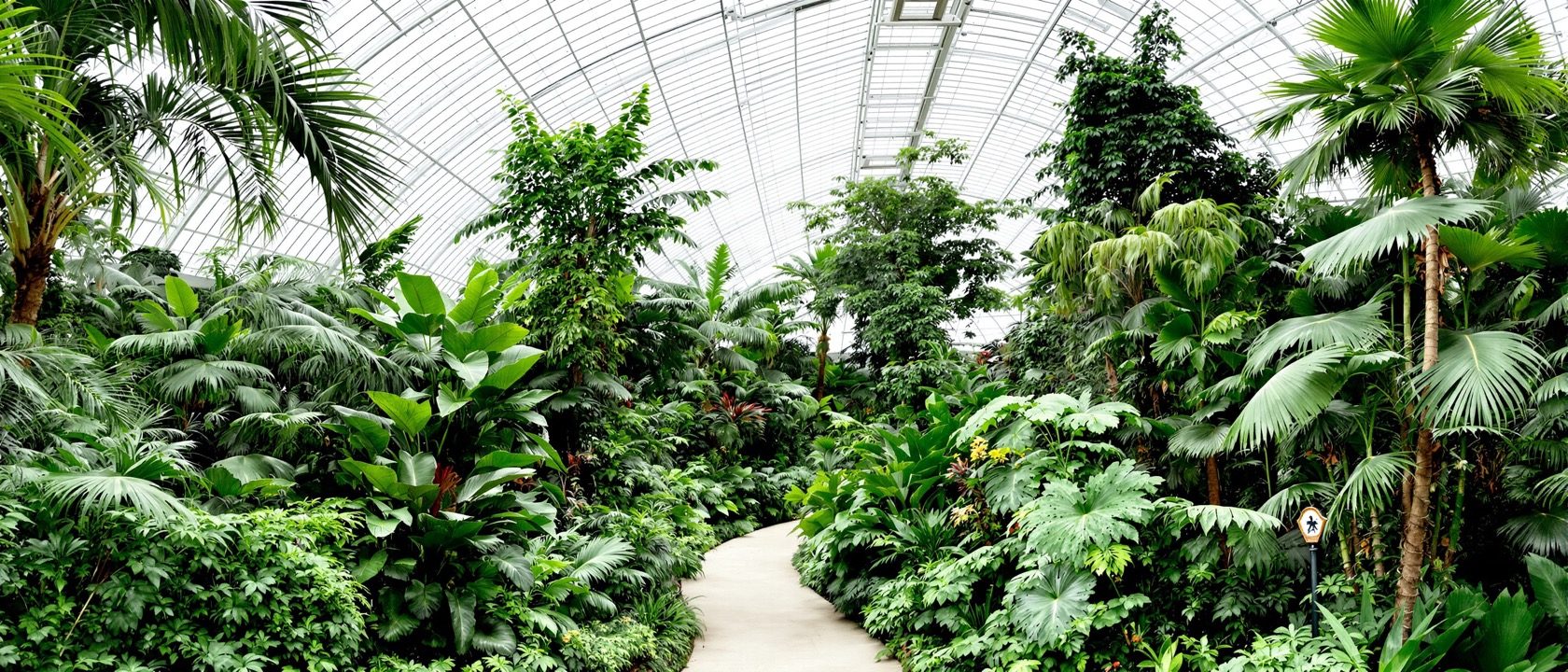
A site visit to real interior landscapes — a commercial ATRIUM, a residential COURTYARD, a public interior, a specialised indoor garden or CONSERVATORY — teaches what no photograph can: the maintenance regime behind a thriving planting. Walk one and read it honestly. Where does the light come from, and is it real daylight or grow-lighting? How is the planting watered and drained — and can you find the irrigation? How is a water feature kept clean? Where is a green wall thriving and where is it browning, and what does the failing patch tell you about the irrigation or light it lacks? Every healthy interior landscape you admire is backed by a maintenance contract and a person who tends it; learning to SEE that hidden regime is the point of the visit.[1]
The synthesis
An interior landscape is a designed composition of living and non-living elements that survives only when the fundamentals are all provided for — and its honest gift is biophilic wellbeing, not the cleaner air of the myth.[1, 2]
A composition that must be kept alive
The synthesis of Interior Landscape is a single, honest idea: an interior landscape is a designed COMPOSITION of living and non-living elements — plants, water, rock, paving, light and furniture — that gives real BIOPHILIC value to the people who use the space, and that survives only when the fundamentals are all genuinely provided for. Light matched to the plants, water and drainage that neither starve nor drown them, a growing medium and load the structure can carry, and a maintenance regime that keeps it going. Skip any of these and the beautiful render becomes a dead planting, a leaking roof or a browning wall. The designer's job is to compose the landscape AND to be honest about what it will take to keep it alive.[1]
At a glance
| Aspect | The fact | The folklore |
|---|---|---|
| A thriving interior landscape | Is backed by a hidden MAINTENANCE regime — read it on a visit | MYTH: it looks after itself because it looks lush in the photo |
| A browning green wall | Tells you which requirement it LACKS — light, water, drainage | MYTH: it's just 'past its best' and needs replacing wholesale |
| A specialised indoor garden | Succeeds on the fundamentals at scale — light, water, load, upkeep | MYTH: scale and budget alone make it work |
| The course's core idea | A composition that must be kept ALIVE — provide for every fundamental | MYTH: design the look and the plants sort themselves out |
| The honest gift | BIOPHILIC wellbeing — real and evidenced | MYTH: cleaner air — a promise a pot of leaves can't keep |
Key terms
The hidden watering, feeding, cleaning, pruning and replacement that keeps an interior landscape alive. Every thriving one has it; learning to see it is the point of a site visit.
A specialised indoor garden at ambitious scale — where the course's fundamentals (light, water, drainage, load, upkeep) are all tested at once.
Diagnosing a browning wall or a dying planting from the requirement it lacks — light, irrigation, drainage or care. The designer's honest eye.
The real, evidenced wellbeing an interior landscape gives its users — restoration, calm, focus. The honest reason to design one, as opposed to the air-cleaning myth.
The synthesis: an interior landscape is living and non-living elements designed together, surviving only if light, water, drainage, load and upkeep are all provided for.
Study task
Visit one real interior landscape you can reach — a mall atrium, a hotel lobby, an office green wall, a planted restaurant — and read it honestly. Note where its light comes from, how it is watered and drained, and one spot where it is thriving and one where it is tired or failing, and say which requirement the failing spot lacks. Then write the one-paragraph synthesis of this course in your own words: what an interior landscape is, the fundamentals it needs to survive, and the real, honest benefit it gives the people who use the space. Learning to see the maintenance behind the beauty, and to state the honest case for plants, is the whole point of the closing unit.
Self-assessment
1. What is the real point of a site visit to an interior landscape?
2. What single idea does the Interior Landscape course add up to?
Recap
References & further reading
- [1]Hammer, Nelson & Green, Mel (1991). Interior Landscape Design. McGraw-Hill; and Manaker, George H. — Interior Plantscapes: Installation, Maintenance and Management. On the maintenance and management that keeps an interior landscape alive.
- [2]Ulrich, R. S. (1984), Science 224; and Cummings & Waring (2020), J. Exposure Science & Environmental Epidemiology 30 — the evidence that the real benefit of interior plants is biophilic wellbeing, not air purification. (See Unit I references.)
Further reading
- Hammer, Nelson & Green, Mel — Interior Landscape Design. McGraw-Hill.
- Manaker, George H. — Interior Plantscapes: Installation, Maintenance and Management. Prentice Hall.
- Vizenor, Gerald Robert — A Guide to Interior Landscapes. Univ. of Minnesota Press.
Sources gathered and fact-checked June 2026. Published values vary by source, sample and method — treat as indicative and confirm against the cited standard before structural use.
The author
Amogh N P
Architect, interior designer, and creative polymath. Studio Matrx began in his notebooks — his vision of design made honest, useful, and open to everyone. Its Academy is written and taught in his memory, and free, forever.
More about Amogh →