
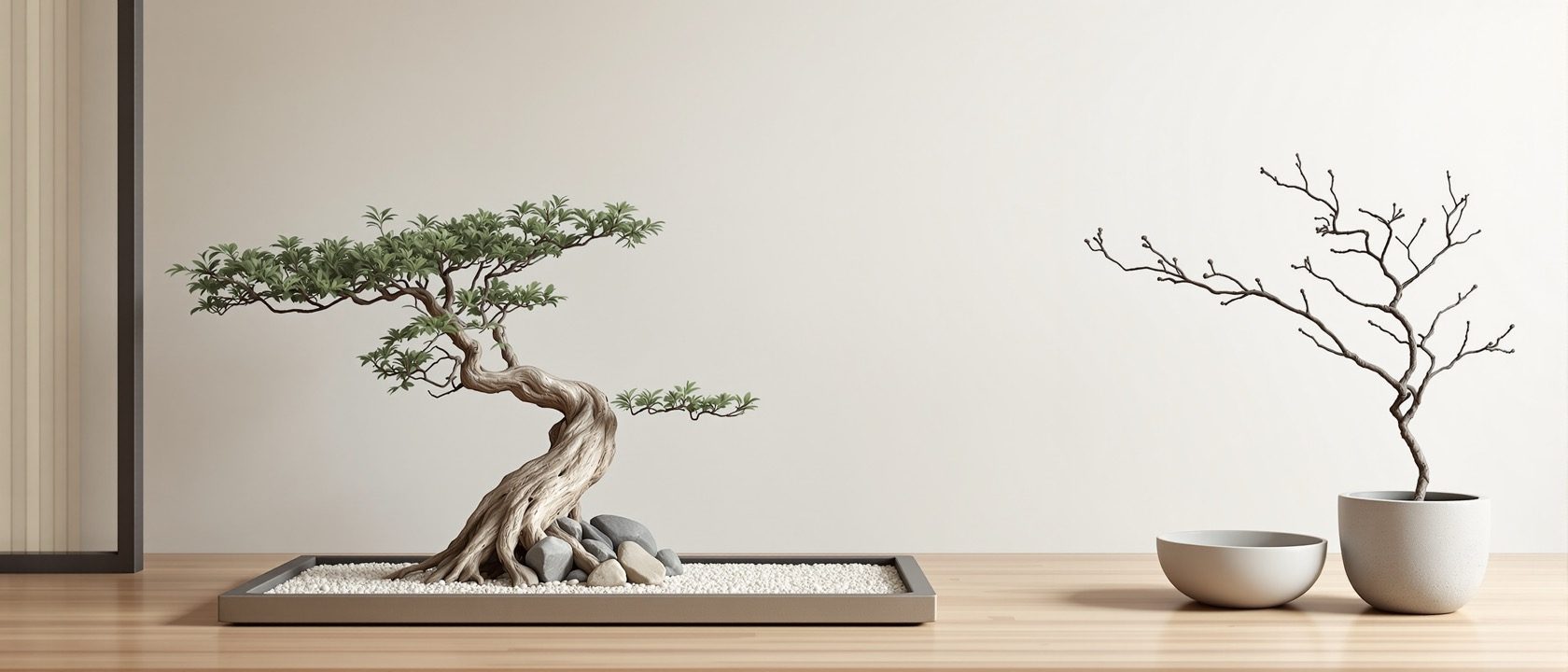
Elements, Principles & the Japanese Arts
Green walls aren't low-maintenance, bonsai isn't a dwarf species, and ikebana isn't a bouquet
An interior landscape is composed, not scattered — built from plant texture, colour, height and spacing toward a focal point. This unit covers those elements, the honest cautions of indoor water features and green walls (whose ‘low-maintenance’ reputation is a myth), and the three Japanese arts so often misunderstood: the Zen garden that is dry rock, not a flower bed; bonsai that is a training technique, not a dwarf species; and ikebana that is a disciplined art of line and space, not a Western bouquet.
Learning objectives
By the end of this lesson, you will be able to — mapped to the course outcomes for Interior Landscape:
Compose planting using texture, colour, height and spacing, with a focal point.
Weigh indoor water features honestly — humidity, maintenance and stagnant-water risk.
Refute the 'green walls are low-maintenance' claim and state their real demands.
Explain the Zen garden and Japanese garden principles correctly.
Correct the bonsai-is-a-dwarf-species and ikebana-is-a-bouquet myths.
Elements & principles
Compose with texture, colour, height and spacing; treat indoor water features and green walls honestly, because neither is carefree — a living wall is a demanding system, not a fit-and-forget decoration.[1, 2, 3]
Texture, colour, height, spacing
An interior landscape is composed, not scattered. The designer works with the physical attributes of plants — TEXTURE (fine ferns against bold monstera leaves), COLOUR (the greens, variegation, the occasional flower or foliage colour), HEIGHT (layering floor plants, mid-height and trailing or hanging), and SPACING (mass for impact, air for elegance) — to build a composition with repetition, contrast, rhythm and a clear focal point. The same design principles that govern a room govern its planting: unity and variety, balance, proportion and emphasis. A dozen different plants in a dozen different pots dotted about reads as clutter; the same plants arranged as layered masses with one specimen as the focus reads as a designed interior landscape.[1]
The Japanese arts
A Zen garden is dry raked gravel and rock; bonsai is a technique of keeping an ordinary tree small; and ikebana is a discipline of line, asymmetry and negative space — each a world away from its popular misreading.[4, 5]
Dry rock, not a flower bed
The Japanese garden is widely borrowed and widely misunderstood. A ZEN garden (karesansui, literally 'dry mountain-water') is exactly that — raked GRAVEL or sand standing for water, and carefully placed ROCKS standing for mountains and islands, usually with little or NO planting beyond moss; it is a space for seated contemplation, not a bed of flowers, and calling any planter of pebbles (or a desktop sand-and-rake toy) a 'Zen garden' misses its whole point. The canonical example, Ryoan-ji in Kyoto, is fifteen stones in five groups on raked gravel, famously composed so that no more than fourteen are visible from any single seated vantage. The broader Japanese garden works by principles an interior designer can genuinely use: asymmetry and irregularity over symmetry, borrowed scenery (shakkei) that pulls a distant view into the composition, restraint and negative space (ma), and a designed sequence of framed views. It is a discipline of subtraction and suggestion, and its interior version is quiet, spare and considered — the opposite of a crowded display.[4]
At a glance
| Aspect | The fact | The folklore |
|---|---|---|
| Composing planting | By texture, colour, height and spacing, with a focal point | MYTH: scatter a dozen different pots and call it landscaped |
| Indoor water feature | Lovely but needs maintenance, drainage and safe (non-stagnant) water | MYTH: an indoor fountain is carefree |
| Green / living wall | MYTH-BUSTED: a demanding system — irrigation, light, feeding, replacement | MYTH: living walls are low-maintenance, fit-and-forget |
| Zen garden | Dry raked gravel and rocks, symbolic, usually plant-less | MYTH: a bed of plants and pebbles 'for a Zen vibe' |
| Bonsai | A TECHNIQUE keeping an ordinary tree small — years of skilled care | MYTH: a naturally dwarf/miniature species you buy and forget |
| Ikebana | A disciplined art of line, asymmetry and negative space, few stems | MYTH: a full Western flower bouquet by another name |
Key terms
The physical attributes of plants a designer composes with — fine vs bold, green vs variegated, layered heights, mass vs air.
A pool, fountain or cascade — lovely, but needs maintenance, splash/drainage control and safe (non-stagnant) water. Not carefree.
A vertical horticultural system. NOT low-maintenance — it needs irrigation, light, feeding and plant replacement, or it browns in patches.
A 'dry landscape' of raked gravel and rocks, symbolic and usually plant-less — a space for contemplation, not a flower bed.
'Borrowed scenery' — composing so a distant view is pulled into the garden. A Japanese principle an interior can use through framed views.
Negative space — the considered emptiness that gives Japanese garden and ikebana compositions their calm and power.
A TECHNIQUE of keeping an ordinary tree miniature by pruning, wiring and root confinement — NOT a naturally dwarf species. A high-maintenance living art.
The Japanese art of arrangement — line, minimalism, asymmetry and negative space with few stems; schools include Ikenobo, Sogetsu, Ohara. Not a Western bouquet.
Study task
Compose a small interior planting for a real spot, on paper: choose plants for their texture, colour and height, arrange them as layered masses with one focal specimen, and say why it reads as designed rather than scattered. Then take a stance honestly on one feature: if you would use an indoor water feature or a green wall, write the maintenance regime it truly needs (and who will do it); if you would use a Japanese element, say what it actually is — a dry Zen composition, a bonsai as a tended living art, or an ikebana of line and space — and not its cliche. Composing with intent and understanding the styles for what they truly are is the design literacy this unit builds.
Self-assessment
1. A client wants a green wall because 'they're low-maintenance.' What's the honest correction?
2. What is bonsai?
3. How does ikebana differ from a Western flower bouquet?
Recap
References & further reading
- [1]Hammer, Nelson & Green, Mel (1991). Interior Landscape Design. McGraw-Hill. Design principles for interior planting, elements and water features.
- [2]On indoor water features and Legionella: US CDC, 'Controlling Legionella in Decorative Fountains' — all decorative fountains produce aerosols (droplets ≤5 microns can carry Legionella deep into the lungs); routine cleaning and disinfection are mandatory, and CDC advises against fountains where people at higher risk gather. Documented outbreaks trace to hotel and hospital fountains. https://www.cdc.gov/control-legionella/php/toolkit/decorative-fountain-module.html
- [3]On living walls being maintenance-intensive: Architects' Journal, 'The Paradise Park fallout: Are living walls worth it?' — a £100,000 living wall (installed 2006) died by 2009 after its irrigation failed; industry attributes ~90% of green-wall deaths to irrigation faults; Fionn Stevenson: 'unlike a natural eco-system it has no redundancy, so if one thing goes wrong, it all goes wrong.' Peer-reviewed survival data: only ~70.8% of plants survived 18 months in a monitored trial (Environments 10(2):26, 2023). https://www.architectsjournal.co.uk/archive/the-paradise-park-fallout-are-living-walls-worth-it
- [4]On the Zen (karesansui) garden and Japanese garden principles (shakkei = borrowed scenery, ma = negative space, asymmetry, miniaturization): North American Japanese Garden Association and standard references. A karesansui is dry raked gravel and rock, symbolic, usually without planting; Ryoan-ji has 15 stones in five groups, no more than 14 visible from any seated vantage. https://najga.org/the-dry-landscape-garden/
- [5]On bonsai as a horticultural TECHNIQUE (盆栽 = 'planted in a tray/pot') applied to ordinary full-size woody species — kept small by crown/branch pruning, wiring and root confinement, not genetics: National Bonsai Foundation (US National Arboretum). On ikebana as a disciplined art of line, minimalism, asymmetry and negative space with historical schools — Ikenobo (oldest, traced to a 1462 record), Ohara (moribana), Sogetsu (1927): Ikenobo official history / Britannica. https://www.bonsai-nbf.org/about-us
Further reading
- Hammer, Nelson & Green, Mel — Interior Landscape Design. McGraw-Hill.
- References on Japanese gardens (karesansui, shakkei, ma), bonsai technique, and ikebana (Ikenobo / Sogetsu / Ohara schools).
- Vizenor, Gerald Robert — A Guide to Interior Landscapes. Univ. of Minnesota Press.
Sources gathered and fact-checked June 2026. Published values vary by source, sample and method — treat as indicative and confirm against the cited standard before structural use.
The author
Amogh N P
Architect, interior designer, and creative polymath. Studio Matrx began in his notebooks — his vision of design made honest, useful, and open to everyone. Its Academy is written and taught in his memory, and free, forever.
More about Amogh →