
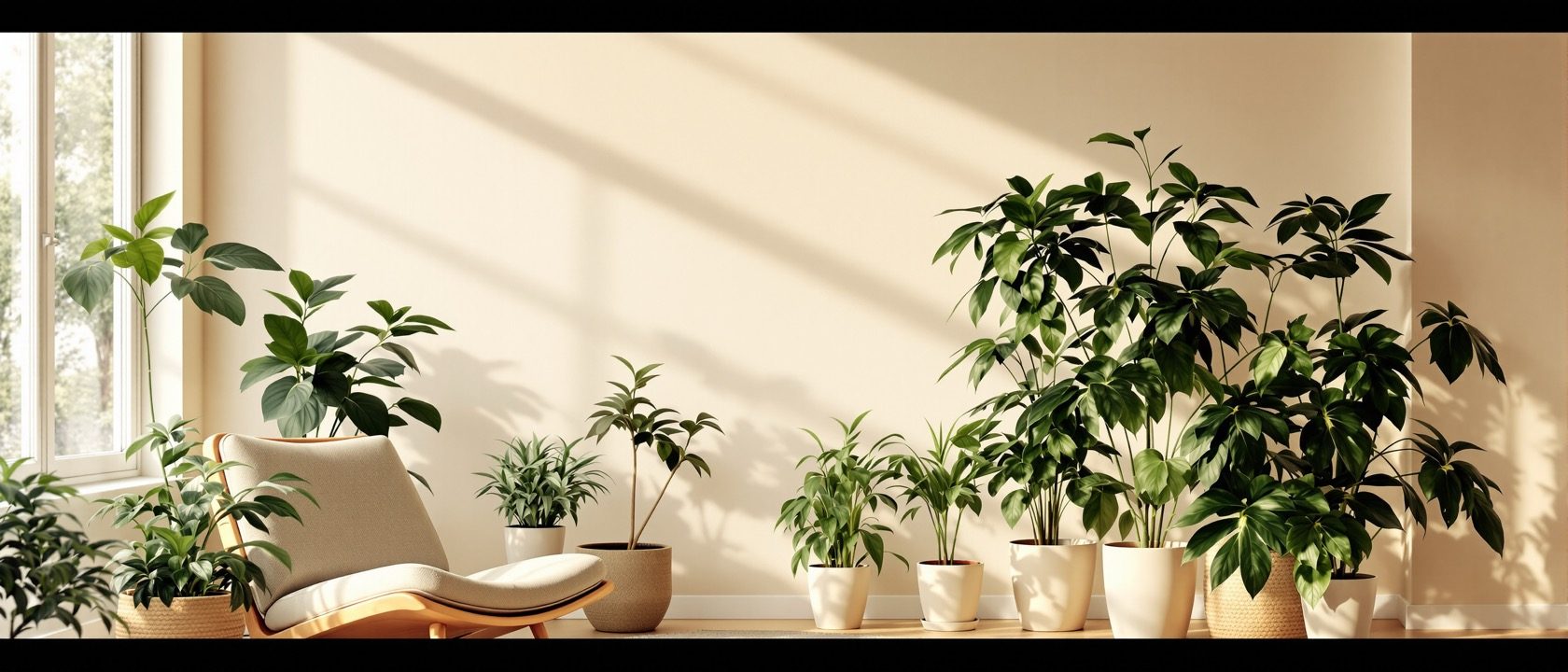
Landscape & the Built Interior
Houseplants don't clean your air — but the biophilic benefit is real
Interior landscape begins with a correction that reframes the whole subject. The belief that houseplants meaningfully purify your air is a myth — the famous NASA study was sealed chambers, and to match ordinary ventilation you would need an impossible number of plants. The real, evidenced reason to bring plants indoors is biophilic: the wellbeing, restoration and calm that genuine research supports. Teach that distinction straight, and then learn to classify, choose and keep the plants a designer actually uses.
Learning objectives
By the end of this lesson, you will be able to — mapped to the course outcomes for Interior Landscape:
Explain the functions of plants in the built interior.
Grade the 'houseplants purify the air' claim against the NASA study and the 2019 review.
State the real, evidenced biophilic benefit of interior plants.
Classify indoor plants by light tolerance, form and function.
Select reliable species for a real indoor condition, and plan honest pest control.
The role of plants, honestly
Kill the air-purification myth, state the real biophilic benefit, and then think about plants as the designer does — by function and by the light and care they need.[1, 2, 3, 4]
Plants do not clean your room's air
Start by killing the biggest myth in the subject: houseplants do NOT meaningfully purify indoor air. The claim traces to the NASA Clean Air Study (Wolverton, 1989), which tested single plants in small SEALED plexiglass chambers (well under a cubic metre, with no air exchange), dosed them with one of three compounds — benzene, trichloroethylene or formaldehyde — and found the plant-and-soil system removed some of it. A real lab result, but one that does not translate to a ventilated room, where ordinary air exchange removes those compounds far faster than any plant. In 2020 Cummings and Waring reviewed the whole literature on a common footing (clean-air delivery rate, the same metric that rates air purifiers) and were blunt: a single plant's median CADR was about 0.023 cubic metres an hour, and to match the air cleaning that ordinary ventilation ALREADY provides you would need on the order of 10 to 1,000 plants per square metre of floor — a small forest packed into the room. So 'buy a plant to detox your air' is folklore. Say it plainly to clients, because designing around a benefit that isn't there wastes money and trust.[1, 2]
Select a plant
Pick the condition you must plant into — a dim corner, a bright spot, a humid bathroom, a home with pets — and see the reliable species that suit it, each with its honest note. The recurring lesson: match the plant to the real light and care, and expect to keep it alive, not to purify the air with it.
Plant selector · match the species to the real condition
Every reliable indoor plant. Pick a condition to see what suits it.
Money plant / Pothos
Epipremnum aureum
Mildly toxic (oxalates)
Use: Trailing shelves, hanging, screens — the beginner's plant
Almost unkillable and tolerates low light, which is why it is everywhere in India. It does NOT meaningfully clean your air; keep it because it is handsome and easy.
Snake plant
Dracaena trifasciata (Sansevieria)
Mildly toxic
Use: Sculptural upright accent, low-light corners
A CAM plant that exchanges gas at night — but the oxygen it releases is negligible, so 'put one in the bedroom for oxygen' is a myth. Loved because it survives neglect and low light. Overwatering is the only way to kill it.
ZZ plant
Zamioculcas zamiifolia
Mildly toxic
Use: Glossy low-light accent, offices
The toughest of the low-light plants — its rhizomes store water, so it forgives the forgetful. Slow-growing. Not an air purifier; a reliable green form for a dim corner.
Peace lily
Spathiphyllum
Toxic (oxalates) — keep from pets/children
Use: Flowering low-light accent
One of the few low-light plants that flowers, and it dramatically wilts when thirsty — a helpful signal. Toxic to pets and children if chewed. A NASA-study favourite, but that lab result does not clean a real room.
Areca palm
Dypsis lutescens
Non-toxic (pet-safe)
Use: Soft green statement, room divider
A large, soft, pet-safe palm for a bright spot — a genuine room-scale statement. Needs the light and hates cold draughts and soggy roots. Wellbeing, not air-cleaning, is the real benefit.
Monstera
Monstera deliciosa
Toxic (oxalates)
Use: Architectural statement, big leaves
The photogenic big-leaf statement plant; easy in bright indirect light and happy to climb a moss pole. Toxic to pets. Its appeal is entirely visual and biophilic.
Boston fern
Nephrolepis exaltata
Non-toxic (pet-safe)
Use: Lush texture, bathrooms, hanging
Lush and pet-safe but genuinely fussy — it demands humidity and consistent moisture and browns the moment a room is dry, so it belongs in a bathroom or a humid, bright spot, not a dry AC office.
Spider plant
Chlorophytum comosum
Non-toxic (pet-safe)
Use: Hanging, pups, forgiving beginner plant
Pet-safe, forgiving, and it makes 'pups' you can propagate — a great teaching plant. Another NASA-list name, and another one that will not clean your air; keep it for its easy charm.
Succulents & cacti
various (Echeveria, Haworthia…)
Mostly non-toxic (spines aside)
Use: Sunny sills, desktops, arid look
For a BRIGHT, sunny sill only — indoors away from strong light they etiolate (stretch) and rot. The commonest mistake is treating them as low-light desk plants; they are sun plants that forgive drought.
Rubber plant
Ficus elastica
Mildly toxic (latex)
Use: Glossy upright statement tree
A glossy, upright indoor tree for a bright spot — a strong, easy statement. Ficus dislike being MOVED (they drop leaves to protest), so acclimatise it and then leave it put.
Honest note: none of these meaningfully purifies your air — keep them for their biophilic wellbeing and their looks. Light is the binding constraint, and overwatering kills more of them than neglect.
At a glance
| Aspect | The fact | The folklore |
|---|---|---|
| 'Houseplants purify air' | MYTH: a potted plant's air-cleaning is negligible vs ventilation (2019 review) | The NASA 1989 result was SEALED chambers, not rooms |
| 'Snake plant = bedroom oxygen' | MYTH: the CAM night-effect is real but negligible in oxygen terms | Keep it because it survives low light and neglect |
| The real benefit | BIOPHILIC wellbeing, restoration, stress reduction (Ulrich, Kaplan) | Not air-cleaning — a truer, stronger case for plants |
| Plant classification | By USE and tolerance (light, form, care) — the designer's frame | MYTH: botany alone tells you where a plant belongs |
| Selecting a plant | Match the species to the real LIGHT and condition of the spot | MYTH: any plant works anywhere you like the look of it |
| Pests indoors | Expected — inspect, quarantine, IPM; a plant brings its pests | MYTH: a healthy-looking new plant carries no pests |
Key terms
The human affinity for nature. The real, evidenced benefit of interior plants — psychological wellbeing, restoration, stress reduction — as opposed to the air-cleaning myth.
Wolverton's test of plants in SEALED chambers. Real in the lab, but it does NOT translate to a ventilated room — the root of the air-purification myth.
How fast a device (or plant) removes pollutants. A potted plant's CADR is tiny next to ordinary ventilation — the 2019 finding that debunks the myth.
Kaplan & Kaplan's account of how natural scenes rest a fatigued, directed-attention mind. Part of the real, evidenced case for interior plants.
Design roles for plants: a focal specimen, a unified mass, a dividing screen — how a designer thinks about planting, beyond botany.
A plant (e.g. snake plant, succulents) that exchanges gas at night. Real, but the oxygen involved is negligible — the 'bedroom oxygen' claim is a myth.
Controlling pests by inspection, quarantine, plant health and targeted treatment rather than reflexive spraying. The honest approach indoors.
Study task
Choose a real room you know and plant it honestly. Pick three plants matched to its actual light and to how often they will really be watered, and give each a function (a focal specimen, a soft mass, a screen, a trailing softener). Then write the one-line honest pitch you would give the client for WHY the plants are there — the biophilic wellbeing they bring — and explicitly note that you are NOT claiming cleaner air. Finally, name the pest you would watch for and how you would catch it early. Matching plants to the real condition and selling the true benefit — not the myth — is the judgement this unit builds.
Self-assessment
1. A client wants a wall of plants 'to purify the office air.' What's the honest response?
2. What is the real, evidenced benefit of bringing plants into an interior?
3. How should a designer classify plants for interior use?
Recap
References & further reading
- [1]Wolverton, B. C., Douglas, W. L. & Bounds, K. (1989). A Study of Interior Landscape Plants for Indoor Air Pollution Abatement (NASA/ALCA). The 'NASA Clean Air Study' — plants tested in SEALED chambers; the origin of the air-purification claim. https://ntrs.nasa.gov/citations/19930073077
- [2]Cummings, B. E. & Waring, M. S. (2020). 'Potted plants do not improve indoor air quality: a review and analysis of reported VOC removal efficiencies.' Journal of Exposure Science & Environmental Epidemiology, 30, 253–261. Shows a plant's clean-air delivery rate is negligible vs building ventilation. https://doi.org/10.1038/s41370-019-0175-9
- [3]Ulrich, R. S. (1984). 'View through a window may influence recovery from surgery.' Science, 224(4647), 420–421. Patients with a view of trees recovered faster and needed less pain medication — foundational biophilic evidence. https://www.science.org/doi/10.1126/science.6143402
- [4]Kaplan, S. (1995). 'The restorative benefits of nature: toward an integrative framework.' Journal of Environmental Psychology, 15(3), 169–182 (Attention Restoration Theory; see also Kaplan & Kaplan, 1989). Wilson, E. O. (1984). Biophilia. Harvard University Press — biophilia = 'the innate tendency to focus on life and lifelike processes.' Nieuwenhuis, M. et al. (2014). 'The relative benefits of green versus lean office space.' Journal of Experimental Psychology: Applied, 20(3), 199–214 — ~15% productivity gain from plants (DOI 10.1037/xap0000024). https://doi.org/10.1037/xap0000024
- [7]Real biophilic/interior-landscape anchors: the Infosys campus, Nagpur (Morphogenesis, 2023) — an IGBC-Platinum passive-design campus with integrated landscape; and the Amazon Spheres, Seattle (NBBJ, 2018) — three glass domes built around biophilia, housing ~40,000 plants and a multi-storey living wall. https://www.archdaily.com/1024179/infosys-campus-morphogenesis
- [5]Hammer, Nelson & Green, Mel (1991). Interior Landscape Design. McGraw-Hill; and Manaker, George H. — Interior Plantscapes: Installation, Maintenance and Management. The interior-landscape practice references for functions, selection and components.
- [6]On integrated pest management for interior plants (spider mites, mealybugs, scale, fungus gnats): university extension horticulture guidance (e.g. RHS / US extension services). Inspect, quarantine, keep plants healthy, treat the specific pest.
Further reading
- Hammer, Nelson & Green, Mel — Interior Landscape Design. McGraw-Hill, 1991.
- Vizenor, Gerald Robert — A Guide to Interior Landscapes. Univ. of Minnesota Press, 1990.
- Wilson, E. O. — Biophilia. Harvard University Press, 1984.
- Kaplan, R. & Kaplan, S. — The Experience of Nature. Cambridge University Press, 1989.
- Manaker, George H. — Interior Plantscapes: Installation, Maintenance and Management. Prentice Hall.
Sources gathered and fact-checked June 2026. Published values vary by source, sample and method — treat as indicative and confirm against the cited standard before structural use.
The author
Amogh N P
Architect, interior designer, and creative polymath. Studio Matrx began in his notebooks — his vision of design made honest, useful, and open to everyone. Its Academy is written and taught in his memory, and free, forever.
More about Amogh →