
 Lesson 5.1
Lesson 5.1 · Environmental Systems
Thermal Comfort and Air-Conditioning
Why a room at 24°C can still feel sticky and wrong — and how to fix it without freezing your electricity bill.
The 24°C room that nobody could sit in
A family in Chennai sets their split AC to 24°C, yet the living room still feels like a warm towel pressed against the skin. The number on the remote is right. The comfort is missing. The problem is that thermal comfort was never about temperature alone — it was about four things at once, and three of them were being ignored.
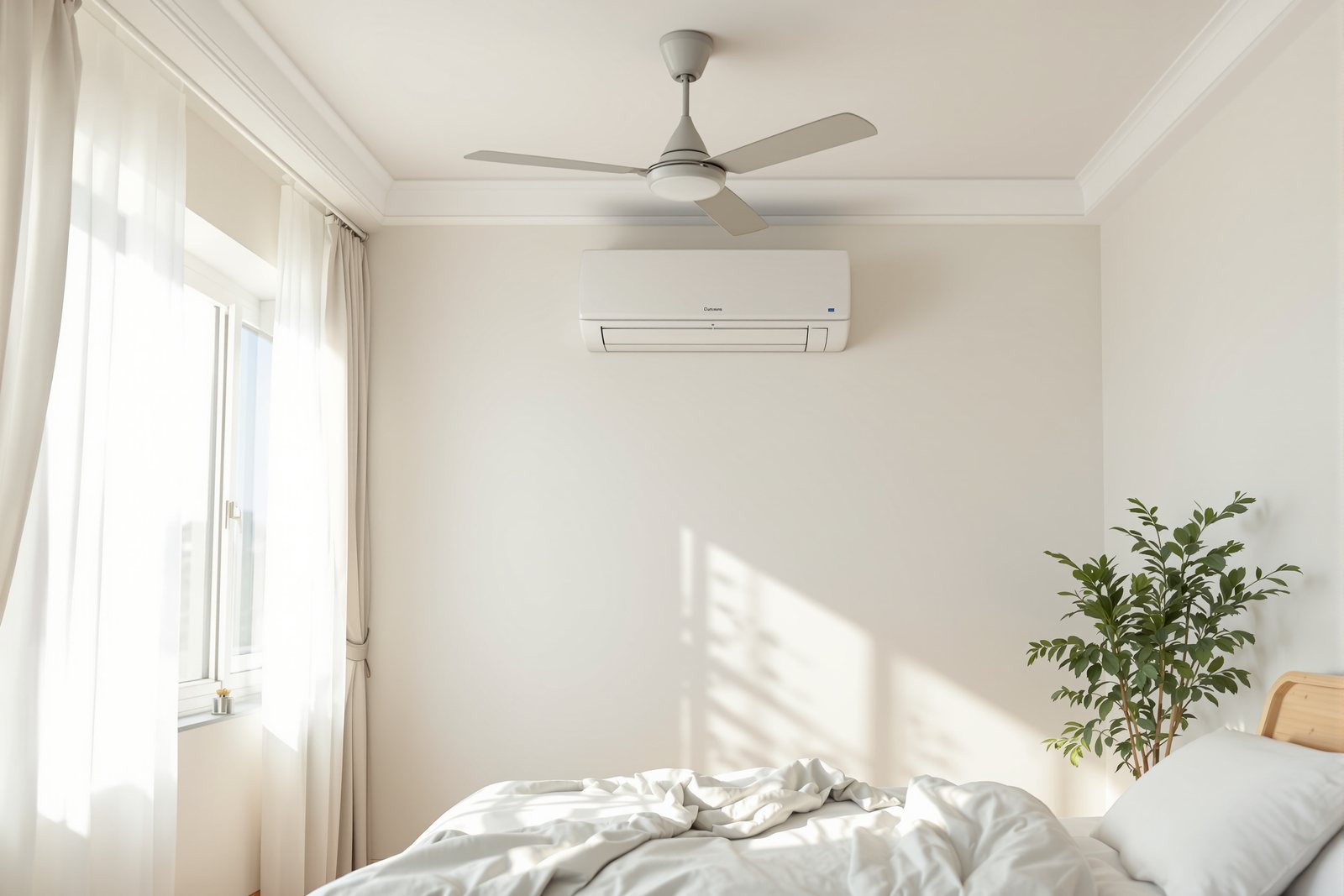
A little stick figure under a ceiling fan with four arrows labelled air-temp, radiant, humidity, breeze pointing at it; a thumbs-up at `27°C` with the fan on, a sweaty frown at `24°C` with the fan off.
What thermal comfort actually is
When your body feels comfortable, it is quietly winning a heat-balance game. You generate heat constantly; the room either lets that heat escape at a comfortable rate or it doesn't. Four things decide the outcome, and a thermostat measures only the first.
Air temperature is the obvious one — the number on your AC remote. Mean radiant temperature is the heat radiating off surfaces around you: a west wall baked all afternoon, or a flat RCC roof, can be 4–6°C hotter than the air, and your skin feels that glow even when the air is cool. Relative humidity decides whether your sweat can evaporate — at 75% humidity in coastal India, sweat just sits on your skin and you feel sticky at the very same 26°C that feels pleasant in dry Pune. Air movement sweeps that humid film away and carries body heat off, which is why a fan transforms a room without changing its temperature by a single degree.
Get all four right and a room feels effortless. Get only the thermostat right and you end up like that Chennai family — correct number, wrong feeling.
How heat gets into an Indian room
Before you cool a room, understand how it is being heated — because every watt of heat sneaking in is a watt your AC must remove, and you pay for each one.
The roof is usually the worst offender. A flat RCC terrace under the Indian sun can reach 60°C on its surface and radiate that heat downward all evening; top-floor rooms are notoriously hot for exactly this reason. The west wall is next — it takes the full force of the afternoon sun and stores it, releasing heat into the room well after sunset, just as you sit down for dinner. Glazing is sunshine let straight in: an unshaded window behaves like a small heater, and west or south glass is the costliest. Then come the heat sources inside the room itself — people (each adult sheds roughly 100 W, like a small bulb), lighting, the refrigerator, the television, and a busy kitchen.
This is why interior decisions are climate decisions. A light roof finish, an insulated terrace, a shaded or curtained west window, and warm-running equipment kept out of a small bedroom all reduce the heat your cooling system will ever have to fight.
The comfort band, and the fan that widens it
There is no single perfect temperature — there is a band. For most Indians in light clothing, comfort sits roughly between 24°C and 28°C, paired with humidity below about 60%. Push humidity higher and the top of that band collapses; the same 28°C that felt fine at 50% humidity feels oppressive at 80%.
Here is the trick that pays for itself: air movement raises the top of the comfort band. A ceiling fan running at a gentle breeze makes 28°C feel like roughly 25°C to your skin, because moving air strips away body heat and helps sweat evaporate. In practice this means you can set your AC about 3°C higher with a fan running and feel exactly as comfortable — and since an AC works noticeably less hard at 27°C than at 24°C, that single habit can cut cooling energy by a meaningful slice every month. The fan costs a few rupees a day to run; the AC it relaxes costs far more.
Use our comfort-zone explorer here: drag temperature and humidity around and watch the dot move in and out of the comfort band, then switch the fan on and see the whole band stretch upward and to the right. It makes the 3°C gift visible in a way words can't.
Choosing a cooling system
Cooling is not one product but a ladder, and the right rung depends on climate and rooms.
A ceiling fan is the first and cheapest tool — always specify one even in air-conditioned rooms, because it lets the AC run gentler. In genuinely dry climates (inland north and central India before the monsoon), an evaporative or desert cooler cools by evaporating water into the air; it sips electricity, but it adds humidity, so it is useless and even counterproductive in coastal Chennai or Mumbai. A window AC is one box wedged in a window — cheap, simple, a little noisy. A split AC separates the noisy compressor outside from a quiet indoor unit, looks neater, and is the default for Indian bedrooms; an inverter split varies its speed and saves energy by not constantly switching off and on.
For a home or office with many rooms, a VRF (variable refrigerant flow) system runs several indoor units off one outdoor unit, cooling rooms independently and efficiently — but it is a designed, ducted installation, not a weekend purchase. One number ties them together: capacity is measured in tons. A 1.5 ton AC does not weigh 1.5 tons — a ton of refrigeration is a historical measure of cooling power (the heat to melt a ton of ice in a day), and 1.5 ton is the everyday size for a typical Indian bedroom of 12–16 m².
Fresh air, sizing, and the coastal damp
A sealed, cooled room slowly goes stale — carbon dioxide and odours build up. The fix is fresh-air ventilation, measured in air changes per hour (ACH): how many times the room's full volume of air is replaced in an hour. A bedroom is comfortable at a gentle 0.5 ACH; a kitchen or bathroom needs far more, which is why NBC asks for mechanical exhaust there. Good design brings in just enough fresh air to keep the room healthy without dumping out all the coolness you paid for.
For sizing, you don't need a heat-load spreadsheet to build intuition. A larger floor area, lots of glazing, a west or top-floor exposure, more people, and a warm kitchen all push the cooling load up; shading, insulation, and a fan push it down. As a rough Indian rule of thumb, a normal 12–16 m² bedroom suits a 1.5 ton unit, while a sun-facing top-floor room of the same size may want 2 ton. Oversizing is a real mistake: too big an AC cools the air fast but switches off before it removes the humidity, leaving you cold and clammy.
Finally, humidity and mould — the quiet enemy of coastal India. Where warm humid air meets a cold surface (an AC-chilled wall, a metal window frame), water condenses, and persistent damp breeds black mould on ceilings and behind wardrobes. The cures are ventilation, gentle continuous air movement, avoiding oversized ACs that never dehumidify, and not sealing furniture tight against an outside wall.
Hands-on
A fan changes no temperature, yet it widens the band by about 3 °C — set the AC warmer with it running and the room feels identical for a smaller bill. Above ~65% humidity, even the right temperature feels sticky until the air moves.
Three altitudes on the same idea
Read the band that fits you — or all three.
When someone proposes cooling for your home, ask three plain questions. First: "Is there a ceiling fan in every room, even the ones with AC?" — a fan lets you sit comfortably with the AC set warmer and your bill lower. Second: "Is my west window shaded?" — an unshaded west window heats the room every afternoon no matter how strong the AC. Third: "Is the AC sized right, not oversized?" An AC that's too powerful makes the room cold but leaves it damp and sticky. For a normal bedroom, a 1.5 ton split is usually right; trust comfort, not bigness.
Specify with numbers. Note the room's area, orientation, glazing area and occupancy on the drawing, and flag west/top-floor rooms for an extra 0.5 ton. Default a 12–16 m² bedroom to 1.5 ton inverter split; living/dining at 18–25 m² to 2 ton; reserve VRF for 4+ zones where independent control and façade tidiness justify the ducting. Always draw the ceiling fan in even in conditioned rooms and call out the 3°C setback it enables. Show split indoor-unit and drain-pipe routing, condensate fall, and the outdoor-unit location with airflow clearance. For wet rooms, specify mechanical exhaust to satisfy NBC ventilation; for bedrooms target around 0.5 ACH of controlled fresh air.
The physics is a heat balance. Your body and the room exchange heat four ways — convection (to surrounding air), radiation (to and from surfaces, governed by mean radiant temperature), evaporation (sweat, governed by relative humidity), and conduction. Comfort is the state where heat leaves your skin at the rate your metabolism produces it. A fan boosts the convective and evaporative terms by forcing air movement, which is why it raises the tolerable air temperature without changing it. An AC removes both sensible heat (temperature) and latent heat (moisture); oversize it and it satisfies the thermostat on sensible load before it has run long enough to strip latent load — hence cold-but-clammy. A 'ton' is 3.5 kW of heat removal, rooted in the latent heat of melting ice.
“"A bigger, more powerful AC will cool my room better."”
Run the method yourself
Spend twenty minutes feeling your own home as a heat system.
- 1Stand in your hottest room in the late afternoon and place a palm flat on the west wall and then on the ceiling below a flat roof — feel the radiant heat the thermostat never reports.
- 2Set your AC to its usual temperature with the fan off; sit for five minutes. Now turn the ceiling fan on low and raise the AC by
3°C. Notice you feel the same or better, while the AC works less. - 3Open the comfort-zone explorer and drag the dot to your city's typical summer evening — say
30°Cand 75% humidity for coastal, or34°Cand 30% for dry inland — then switch the fan on and watch the comfort band stretch to swallow conditions that were uncomfortable a moment ago. - 4Walk your home and list every internal heat source — fridge, TV, lights, the kitchen — and note which sit inside small rooms you also try to cool.
- 5Check the corners of your ceilings and the wall behind a wardrobe for any black mould spotting, the tell-tale sign of trapped humidity, and plan where more air movement or ventilation is needed.
Tuning a room, not just chilling it
Cool, fresh air is one invisible service a room depends on. Next we turn to another that hides inside the walls and under the floor — water arriving clean and leaving safely. In Water and Plumbing Fixtures, we trace supply, drainage, and the fittings that make a kitchen and bathroom work.
The author
Amogh N P
Architect, interior designer, and creative polymath. Studio Matrx began in his notebooks — his vision of design made honest, useful, and open to everyone. Its Academy is written and taught in his memory, and free, forever.
More about Amogh →