
 Lesson 4.5
Lesson 4.5 · Interior Building Elements
Stairs and Railings
The most dangerous element in the house, made safe by a few numbers
The element you climb without thinking is the one most likely to hurt you
Most of us never look at a stair. We just go up and down, phone in one hand, child or laundry basket in the other. Yet of every element in your home, the stair is the one that puts people in hospital - and almost always because a few millimetres were wrong. The good news: a comfortable, safe stair is not a matter of taste. It is a matter of about four numbers.
One step in side view: the L-shape, the vertical face labelled 'riser', the horizontal top labelled 'tread', the small overhang marked 'nosing', and '2R + T ~ 600-640mm' written beside it.
The anatomy of a single step
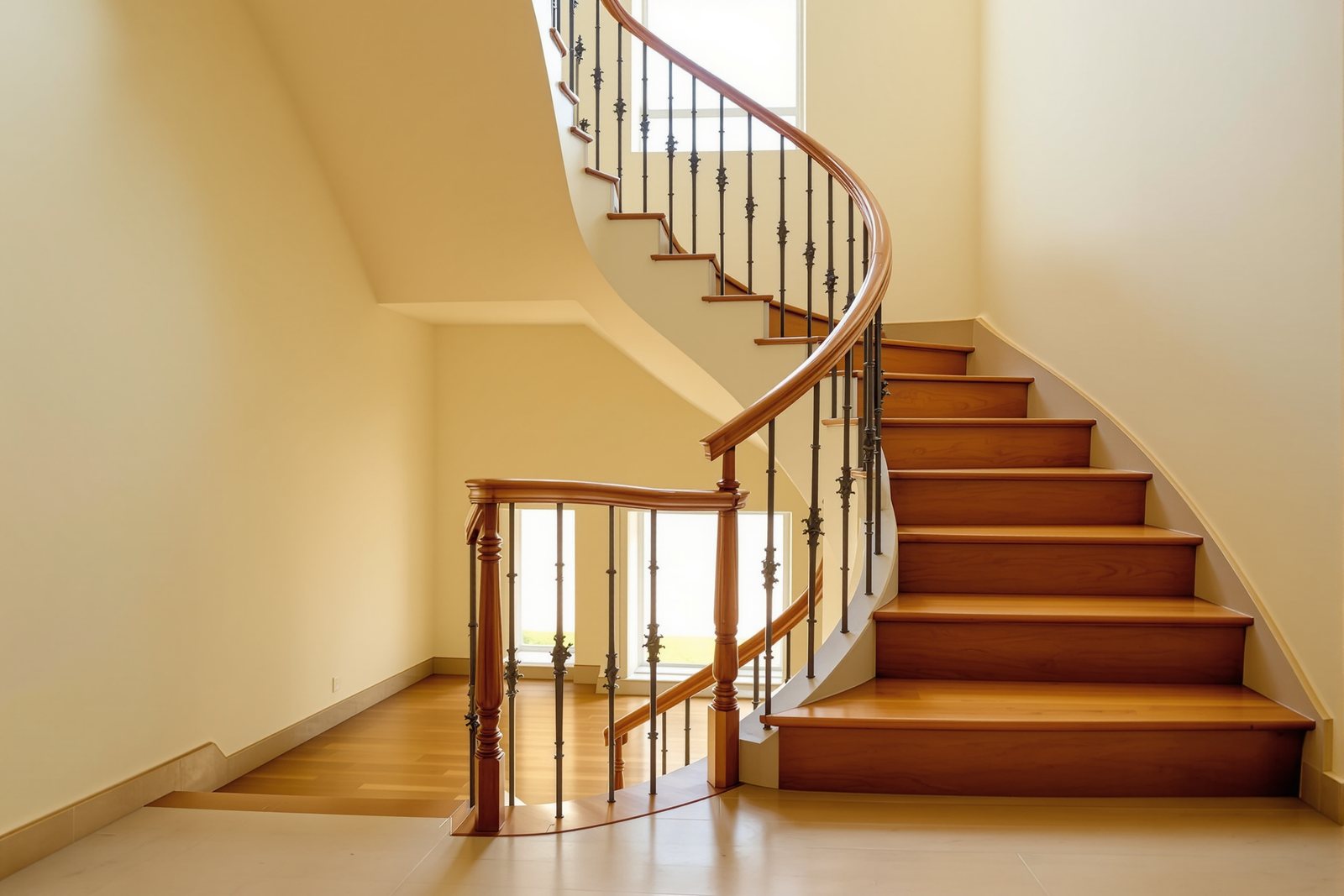
Stand at the bottom of any staircase and look closely. Each step is made of two surfaces. The riser is the vertical face - the height you have to lift your foot to clear the next step. The tread is the horizontal surface you actually plant your foot on, and the going is the useful horizontal distance one step carries you forward (the tread minus any overlap).
The front edge of the tread usually sticks out a little past the riser below it - that overhang is the nosing. A nosing gives your foot a few extra millimetres of landing room without making the whole stair longer, and a rounded or grippy nosing is far kinder on bare Indian feet than a sharp granite edge.
Where a stair changes direction or gets too long to climb in one go, you put a landing - a flat platform to turn on and to catch your breath. And above your head, you need headroom: roughly 2.0 to 2.1 metres of clear height so a tall member of the family climbing the spiral to the terrace doesn't crack his head on the slab above.
The numbers that make a stair comfortable
Climbing feels effortless only when each step matches the natural length of a human stride. Get that wrong and your body knows instantly - you either mince up in tiny tiring hops or stretch awkwardly and miss your footing.
Three ranges do the work. A comfortable riser is about 150-190mm. Steeper than ~190mm and the climb becomes a tiring scramble - and the National Building Code caps residential risers for exactly this reason. The tread / going wants to be about 250-300mm, enough that your whole foot, not just your toes, lands on each step.
The classic check tying them together is the 2R + T rule: twice the riser plus the going should land around 600-640mm. That number is roughly the length of a comfortable pace, so a stair that satisfies it feels like walking rather than struggling. One non-negotiable: every step in a flight must be identical. A single odd step - one riser 25mm taller than the rest - is invisible to the eye but lethal to the foot, because your brain has already memorised the rhythm. This is also why winders (pie-shaped turning steps) are risky: the tread narrows to almost nothing at the inner edge, so the going changes across a single step.
Types of stairs, and choosing for your home
The shape of a stair follows the space you can spare. A straight flight is simplest and easiest to furnish-move up, but it eats a long strip of floor. A quarter-turn (L-shaped) stair turns ninety degrees on a landing and tucks neatly into a corner. A half-turn (U-shaped or dog-leg) stair doubles back on itself, fitting a tall climb into a compact footprint - common in duplex flats.
The winder replaces the landing with turning steps to save space, but inherits the narrow-tread danger above. The spiral wraps around a central post: wonderfully compact and the classic answer for reaching a terrace, but it is steep, tiring, and you will discover the hard way that a mattress or a fridge simply will not go up one.
Whatever the shape, the balustrade keeps people from falling off the side. Plan it together with the stair, never as an afterthought bolted on later.
Railings: the safety line you grip without thinking
A railing is two things at once: a handrail to hold, and a balustrade to stop a fall. The handrail should sit at about 900mm above the line of the nosings, run continuously without painful breaks, and be graspable - a slim profile your hand can actually wrap around, not a fat decorative slab you can only pat.
The vertical members are balusters, and their spacing is a child-safety rule, not a style choice: keep every gap under ~100mm so a toddler's head cannot pass through and get trapped. This single number quietly rules out many fashionable wide-bar designs in homes with small children.
The current trend for open-riser and floating stairs - treads seeming to hover with nothing behind them - looks stunning in photos and terrible in practice for families: small children climb through the open backs, and elders find the visual gaps unnerving. If you love the look, add backing or close the gaps where the very young and very old will use it.
Putting it together with the stair calculator
You rarely get to choose the riser freely, because the floor-to-floor height is fixed by the building. The real design move is dividing that height into equal steps that each land in the comfortable range.
Say your floor-to-floor is 3000mm. Seventeen risers give 176mm each - comfortable. Sixteen risers give 188mm - at the steep end. Fifteen give 200mm - too steep, and over the NBC cap. The number of steps is the lever; the riser falls out of it.
That is exactly what the stair-calculator interactive in this lesson does: you enter the floor-to-floor height, and it returns the number of risers, the resulting riser height, a suggested matching tread, and a green-or-red check on the 2R + T comfort rule. Try a few heights and watch how adding one riser turns a steep, tiring stair into a gentle one - the whole craft of stair design, in one slider.
Hands-on
The number of steps is the lever; the riser falls out of it. Add one riser to a too-steep stair and watch it drop into the comfortable range — every step stays identical, which is the safety rule that matters most.
Three altitudes on the same idea
Read the band that fits you — or all three.
You can judge a stair with your own body in thirty seconds. Walk up it at normal speed: if you find yourself lifting your knees high or hurrying in short hops, the risers are too steep. If your heel hangs off the back of each step, the treads are too shallow. A good stair feels like walking, not climbing.
Then check the rails. Grip the handrail - your hand should wrap around it, and it should run the whole way without stopping. If you have small children, slide your fist between the balusters: if your fist (roughly 100mm) passes through easily, the gaps are dangerously wide. For elders, look for a graspable rail on both sides and a non-slip nosing on every step.
Design to these ranges and document them. Riser 150-190mm (keep residential to ~175mm and within the NBC cap); going 250-300mm; satisfy 2R + G ~ 600-640mm. Hold all risers and goings identical to within a couple of millimetres across a flight - the first and last risers are where slab thicknesses sneak in error, so check them explicitly.
Provide landings at least the stair-width deep after roughly 12-15 risers, and clear headroom of 2.0-2.1m measured vertically from each nosing. Handrail at ~900mm above the nosing line; balustrade infill with gaps under 100mm; graspable profile, continuous, returned to the wall at ends. Avoid winders where you can; if forced, dimension the going at the walking line (~300mm in), not the inner edge. Flag open-riser and floating designs in child- or elder-occupied homes.
The geometry is a model of the human stride. A level walking pace is roughly 600-640mm. Climbing, you spend stride on both horizontal motion (the going, T) and vertical lift (the riser, R), and lifting costs about twice as much stride-equivalent as moving forward - hence 2R + T ~ 600-640mm.
Derive a stair from a fixed floor-to-floor height H. Number of risers n = round(H / R_ideal), where R_ideal ~ 175mm. Actual riser R = H / n - and because n must be a whole number, R jumps in discrete steps as n changes, which is why one extra riser can rescue a too-steep stair. Then pick T to satisfy the 2R + T rule. Note n risers always give n-1 treads in a straight flight (the top tread is the upper floor). Build this logic and you have essentially written the stair-calculator yourself.
“A steeper stair just saves a bit of floor space - no real harm in it.”
Run the method yourself
Find any staircase you can reach right now - your home, the building's common stair, an office. Bring a tape measure and your own fist.
- 1Measure one riser (floor of one step up to the floor of the next) and one going (front edge of one tread to the front edge of the next). Note both in millimetres.
- 2Apply the 2R + T rule: double your riser and add the going. Is the total between 600 and 640mm? If it's far off, notice whether the stair felt tiring or comfortable when you climbed it - your body already knew.
- 3Check that every step is identical: measure the riser at the top, middle, and bottom of the flight. Any step that's even 15-20mm off is a real trip hazard - see if you can feel it as you walk.
- 4Test child safety: push your fist (about 100mm) between two balusters. If it passes through easily, a toddler's head could too. Then measure the handrail height from the nosing - it should be near 900mm.
- 5Open the stair-calculator for this lesson, enter the floor-to-floor height of a stair at home, and compare its suggested riser to what you actually measured. Add or remove one riser and watch the comfort check flip.
What a stair really asks of you
You've now walked through every element you can see and touch - floors, walls, openings, and the stair that ties the levels together. Next we move to the systems you _don't_ see but feel constantly: the next module is about environmental systems - keeping a room thermally comfortable, getting water in and out, wiring it safely, and meeting the codes that quietly govern all of it.
The author
Amogh N P
Architect, interior designer, and creative polymath. Studio Matrx began in his notebooks — his vision of design made honest, useful, and open to everyone. Its Academy is written and taught in his memory, and free, forever.
More about Amogh →