
 Lesson 8.2
Lesson 8.2 · Furnishings
Textiles and Upholstery
The soft layer that makes a hard room livable — and quietly does your acoustic work.
A bare room is a hard room
Walls, floor, a sofa frame, a window. Everything in it is firm, flat and faintly echoey — sound bounces, light glares, nothing invites you to sit. Then you add a rug, dress the sofa, hang curtains and toss two cushions. Suddenly the room is warm, quiet and yours. That transformation is textiles, and it is doing far more work than it looks.
A sofa with a cushion and a throw, a layered curtain falling in deep folds beside it, a rug underneath — with a little arrow labelled '2.5x' stretching the curtain fabric wider than the window.
Two families of fibre
Every fabric in your home starts as a fibre, and fibres come in two broad families.
Natural fibres grow from plants and animals. Cotton is the workhorse of the Indian home — it breathes, it washes, it takes block-print and ikat beautifully, and on a 40 degree afternoon it does not glue itself to your skin. Linen breathes even harder and ages into a relaxed, crumpled elegance, though it creases freely. Silk brings sheen and luxury but wants gentle handling and shade. Wool holds warmth and is unbeatable underfoot as a rug. Jute and other plant fibres give rough, earthy texture for matting and rugs.
Synthetic fibres are spun from petrochemicals. Polyester, acrylic and nylon are tough, cheap, colour-fast and shrug off stains — but they can feel hot against the skin and trap odour in a humid climate. Blends try to marry the two: a cotton-polyester mix breathes more than pure poly yet creases less than pure cotton.
Fibre is only half the story. The weave and the weight matter just as much — a loose, open weave snags and stretches, while a tight, dense weave wears for years and resists the dust that works its way into everything here.
Upholstery that survives the family
The fabric on a chair you sit in twice a year can be anything. The fabric on the sofa where three people, two kids and a visiting cousin land every evening must be chosen with cold honesty.
The key number is the rub count, measured by the Martindale test — literally how many times a machine rubs the fabric before it wears through. For light, occasional use, 15000 rubs is fine; for a daily family sofa, look for 40000+ rubs of heavy domestic rating. Pair a high rub count with a tight weave and, ideally, washable loose covers — in a home with children and ever-present dust, the ability to peel the cover off and put it in the machine is worth more than any showroom finish.
The materials trade off against each other. Leather wipes clean and ages well but feels warm in summer and dents the budget. Cotton is breathable and friendly but stains and fades. Performance fabrics — tightly woven synthetics treated to repel liquid — resist spills and sun, at the cost of that natural hand. And don't forget what's inside: cushion comfort is set by the fill. High-density foam holds its shape under daily use; feather and down are plush but need plumping; a foam core wrapped in a feather layer is the comfortable compromise.
Curtains, and the secret of fullness
Window treatments quietly do four jobs at once: they control light, give privacy, soften heat gain, and — recalling Module 6 — absorb sound. A heavy lined curtain is the cheapest acoustic fix most homes ever buy.
The mistake almost everyone makes is buying too little fabric. A curtain hung flat against its track looks mean and tells everyone you economised. The fix is curtain fullness: a curtain needs roughly 2x to 2.5x the window's width in fabric so it can gather into deep, generous folds. A 1.5 metre window wants 3 to 3.75 metres of fabric across.
Two more moves make ordinary windows look grander. Hang the rod high and wide — above the frame and past it on both sides — so the window reads taller and broader than it is. And layer: light sheers for daytime softness and glare control, with heavier drapes over them for night-time blackout, warmth and quiet. Where curtains don't suit, blinds step in — Roman blinds fold into soft pleats, roller blinds vanish into a neat roll, and Venetian blinds tilt their slats to aim the light.
Sizing your curtains without guesswork
Fullness is easy to get wrong by eye and easy to get right with a number. Before you order a single metre, reach for our curtain fabric calculator.
Enter your window width and choose a fullness factor — 2x for a clean, modern gather or 2.5x for a lush, traditional drape — and it returns the total fabric width you need and the number of fabric drops, or panels, to seam together for that width. That second figure matters: most furnishing fabric comes in fixed roll widths, so a wide window almost always needs several panels joined. Knowing the drop count before you reach the shop saves you from the classic disaster of a curtain that's a hand's-width too narrow to ever close properly.
Building the layers
No single textile makes a room. Comfort is built in layers, each adding something.
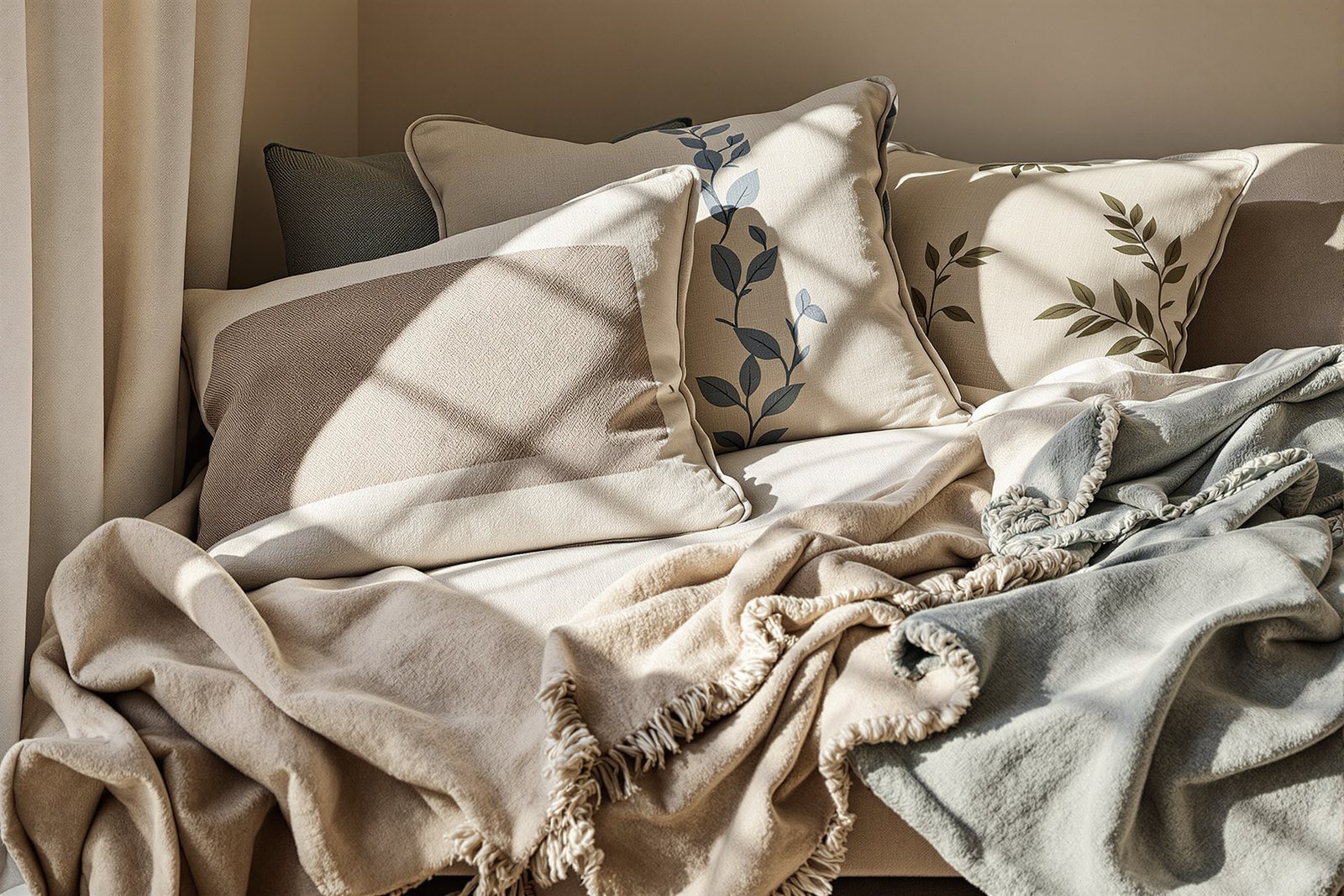
Start low. A rug anchors the seating, warms a hard floor underfoot, defines the zone and — like every soft surface — drinks up echo. Above it, the upholstery sets the room's largest block of colour and texture. On top of that, cushions add accent colour, pattern and a place to lean; mix sizes and a couple of prints against a plain sofa. A throw folded over an arm invites a nap and softens the silhouette. And framing it all, the curtains bring height, drape and the final layer of sound absorption.
The Indian wisdom running through every choice is the same: lean toward breathable fibres for the heat, washable covers for the dust, and layered pieces you can swap with the seasons — light cotton in summer, something warmer when the nights cool. A room dressed this way isn't just prettier. It's quieter, kinder to the skin, and genuinely easier to live in.
Hands-on
Furnishing fabric comes in fixed roll widths (~1.3 m usable), so a wide window almost always needs several drops seamed together. Knowing the drop count before the shop saves you from a curtain a hand’s-width too narrow to ever close.
Three altitudes on the same idea
Read the band that fits you — or all three.
If you do only two things, do these: buy upholstery with washable loose covers, and buy enough curtain fabric. A daily sofa in cotton or performance fabric with a removable cover will outlast and out-clean any fixed luxury weave once dust and small hands get to it. And never let a shopkeeper sell you flat curtains — insist on at least 2x the window width so they hang in proper folds. Layer a rug and a couple of cushions and your room is suddenly finished.
Specify rub counts on every upholstery selection — 40000+ Martindale for heavy-use seating — and note it on your schedule so the client and supplier can't substitute a prettier, weaker cloth. Calculate curtain fabric properly: window width times fullness, divided by usable roll width, rounded up to whole drops, plus hem and heading allowance and pattern repeat. Quote fabric in panels, not running metres, to avoid the join-too-narrow failure. Always present a layered scheme — rug, upholstery, cushions, drapery — as one coordinated story, not loose parts.
Train your hands as well as your eyes. Visit a furnishing shop and feel the difference between a 15000-rub upholstery and a 40000-rub one; rub them and you'll understand the test. Practise the fullness calculation until it's automatic, then check it against the curtain fabric calculator. Build a small physical palette — a cotton, a linen, a performance weave, a leather swatch — and learn to predict how each behaves in heat, dust and daily wear. Fibre, weave, weight, use: that's the whole logic of textile selection.
“A curtain just needs to be as wide as the window.”
2x to 2.5x the window's width in fabric. Buy the actual window width and you've bought a disappointment.Run the method yourself
Pick one window and one sofa in your own home and put this lesson to work.
- 1Rub-test the upholstery: press and drag your palm hard across your daily sofa fabric. Loose weave that shifts and pills is low rub count; tight, firm cloth is high. Decide whether it's built for the use it gets.
- 2Measure your chosen window's width, then open the curtain fabric calculator, enter that width with a
2.5xfullness factor, and read off the total fabric width and number of drops you'd actually need. - 3Check fullness on a curtain you already own: measure the fabric width and divide by the window width. If it's under
2x, you've found why it looks thin. - 4Count your layers in one room — rug, upholstery, cushions, throw, curtains. Note which are missing and which is doing the acoustic and warmth work.
- 5Do a fibre audit: feel which fabrics are breathable natural cotton or linen and which are hot synthetics, and flag anything you'd swap for the Indian summer.
The takeaway
2x-to-2.5x fullness they need, hang them high and wide, and layer sheers under drapes. Then build the room in layers — rug, upholstery, cushions, throw, curtains — each adding colour, comfort, warmth and quiet at once.Your room is now soft, warm and quiet. Next we add the finishing sparkle: how lighting fixtures, accessories and plants give a furnished room its character, glow and final breath of life.
The author
Amogh N P
Architect, interior designer, and creative polymath. Studio Matrx began in his notebooks — his vision of design made honest, useful, and open to everyone. Its Academy is written and taught in his memory, and free, forever.
More about Amogh →