
 Lesson 8.1
Lesson 8.1 · Furnishings
Furniture: Function, Construction, Arrangement
Where design finally meets the body — sizing pieces to fit you, judging how they are built, and floating them off the walls into a room that actually works.
The most expensive sofa in the world is uncomfortable if it is shoved against a wall ten feet from the next seat.
Walk into most Indian living rooms and you will see the same thing: every piece of furniture pinned flat to the walls, the centre of the room an empty parade ground, and everyone leaning forward and raising their voice to be heard. Furniture is where design finally touches the human body — and it works on three levels at once. It has to fit you, it has to be built well, and it has to be placed so the room brings people together. Get those three right and even a modest carpenter-made set in a 2 BHK will feel considered and generous.
A top-down sketch of a living room: a sofa and two chairs pulled off the walls into a circle on a rug, aimed at a TV, with a dashed `900 mm` walkway curving around them and a double-headed arrow labelled `1.8-2.7 m` between the seats.
Function and fit: furniture is sized to the body
Every good piece of furniture is secretly a record of human measurements. A chair seat sits around 450 mm off the floor because that is roughly the height of the back of an adult's knee — too high and your feet dangle, too low and your knees climb toward your chest. Seat depth runs about 400-450 mm so the edge does not dig behind your knees while your back still reaches the rest. A dining table lands near 750 mm high with at least 300 mm of knee clearance below the apron, and you allow roughly 600 mm of table edge per diner so elbows do not collide. A desk matches the dining height at about 720-750 mm. Beds follow standard mattress sizes — a single around 900 x 1900 mm, a queen near 1500 x 2000 mm, a king near 1800 x 2000 mm. Before furniture is beautiful, it must fit the activity and the body doing it. This is ergonomics applied: the piece either welcomes the body or quietly fights it.
Two great families: case goods and seating
Almost everything in a home falls into one of two families. Case goods are the hard, dry pieces — wardrobes, shelving, chests of drawers, dining and side tables, the TV unit. They store things or hold things up, and they are judged on structure and joinery. Upholstered furniture is the soft world — sofas, easy chairs, beds, the diwan, the dependable sofa-cum-bed. Here a hidden timber or ply frame carries webbing, foam, and fabric, so you are judging both the skeleton you cannot see and the comfort you can feel. The distinction matters because the two families fail differently: a case piece wobbles or sags, while an upholstered piece goes lumpy, creaky, or flat. Knowing which family you are buying tells you exactly what to inspect.
Construction and quality: how to judge what you cannot see
What furniture is made of decides how long it lasts. Solid wood (teak, sheesham) is strong and ages beautifully but is costly and moves a little with humidity. Plywood with a veneer or laminate face is the practical Indian workhorse — stable, strong, takes a fine finish, and is what most carpenter-made wardrobes and kitchens are built from. MDF and particle board are cheaper and dead-flat, but they swell and crumble the moment water reaches an unsealed edge, so keep them away from bathrooms and kitchen sinks. Above the material sits joinery — the way parts are joined. A mortise-and-tenon or dowelled joint, glued and snug, outlives a piece merely held by nails or staples. Open a drawer: dovetailed or grooved sides and a smooth glide signal care; stapled corners and a sticky runner signal a piece that will loosen within a year. This is the real fork between branded modular furniture (factory-precise, predictable, dearer) and the trusted local carpenter (bespoke sizes, your choice of ply, only as good as the hands and hardware).
Arrangement: float the seating off the walls
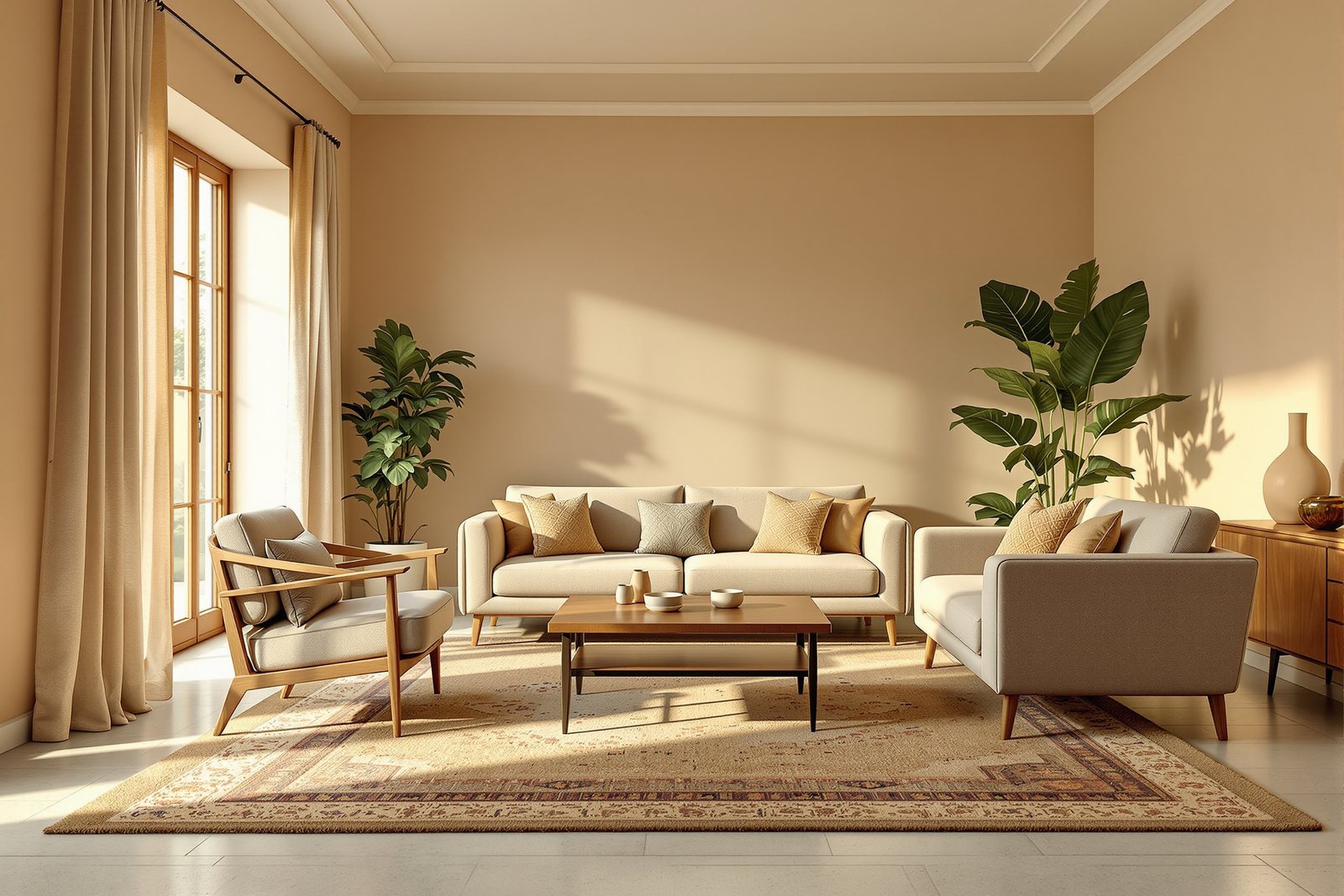
Here is the single most transformative free move available in an Indian home: stop pushing everything against the walls. Pull the seating inward and float it into a conversation group — sofas and chairs turned toward one another, gathered on a rug that visually anchors the cluster, all facing a clear focal point such as the TV, a window with a view, or a piece of art. Conversation works when seats sit roughly 1.8-2.7 m apart: closer feels crowded, farther and you are calling across the room. A coffee table lands about 400 mm in front of the sofa — near enough to set down a cup, far enough to walk past. Suddenly the empty parade ground in the centre becomes the warm heart of the room, and the walls are free for art and storage. Try this live in the conversation-zone interactive below: slide the seats nearer and farther and watch the moment the group slips from comfortable into cramped, or drifts out past easy talking range.
Circulation, modular pieces, and the small-flat squeeze
A floated arrangement only works if people can still move through it. Keep a main walkway — the route everyone uses to cross the room — at about 900 mm clear, and a secondary path (squeezing past one side of the sofa) at roughly 600 mm. Leave about 600 mm of standing room in front of a wardrobe so its doors open and you can step back to look. In a tight flat, geometry is unforgiving, so let furniture earn its footprint twice over: a sofa-cum-bed seats by day and sleeps a guest by night, nesting tables fan out for company and tuck away after, a storage bed swallows quilts and suitcases, and modular shelving grows with you. A small home is not a constraint on good arrangement — it is the place where good arrangement matters most. Multi-functional and modular furniture is how a 1 BHK quietly does the work of a much larger home.
Hands-on
This is exactly why pushing every seat against the walls fails — the gap blows past 3 m and people end up calling across an empty centre. Pull the seats onto a shared rug and the group falls into the comfortable range.
Three altitudes on the same idea
Read the band that fits you — or all three.
Before you buy, walk the route you will take through the room and protect a 900 mm main path. Then dare to pull your sofa 300-450 mm off the wall and angle a chair toward it — even that small float changes how the room feels. When choosing pieces, sit, open every drawer, and rock the frame. For anything near water, insist on plywood, not particle board, and ask the carpenter exactly which board grade you are paying for.
Specify furniture as a system, not a shopping list: fix circulation clearances and the conversation cluster on the plan first, then size pieces to fit both the body and the gaps. Call out board grade, edge-banding, and hardware brand in your schedule so the carpenter cannot quietly downgrade. When you present a layout, show the focal point and walkways explicitly — clients trust a plan that visibly lets them move and talk.
Train your eye on joinery. Visit a furniture shop and a carpenter's workshop and compare the same joint — a dovetailed drawer versus a stapled one — until you can feel the difference blind. Memorise the core dimensions (450 mm seat, 750 mm table, 900 mm walkway) so you can sketch a workable layout without a catalogue. Then redraw one room from your own home with the seating floated, and note what the move unlocks.
“Pushing all the furniture against the walls makes a room feel bigger and is the safe, correct way to arrange it.”
Run the method yourself
Take one real room — your living room is ideal — and run it through all three levels: fit, construction, arrangement.
- 1Measure your main seat height and dining table; compare them to
450 mmand750 mmand note where your body has been quietly fighting the furniture. - 2Inspect one case piece: open a drawer, check the joint at a corner, and identify whether it is solid wood, plywood, or particle board.
- 3Open the conversation-zone interactive and slide the seats until the group sits in the comfortable
1.8-2.7 mrange, then push them too far and feel the room go cold. - 4On a quick plan of the room, draw your
900 mmmain walkway and a600 mmsecondary path, and check nothing blocks them. - 5Physically float your sofa off the wall, angle one chair toward it, slide a rug underneath, and aim the whole group at a single focal point.
Fit, build, place — in that order
450 mm seat to the 750 mm table. Is it built to last? — the right board and honest joinery, not just a pretty face. Is it placed to bring people together? — floated off the walls into a conversation group on a rug, aimed at a focal point, with walkways kept clear. Master those three and a modest, well-chosen set will outperform an expensive one that is poorly judged and badly placed.450 mm seat and 750 mm table), be well built (plywood and honest joinery over particle board and staples), and be arranged by floating seating off the walls into a conversation group on a rug, with clear circulation and multi-functional pieces for small flats.You now know how to size, build, and place the furniture. Next we soften it: in **Textiles and Upholstery** we turn to the fabrics that cover the seating and dress the room — what they are made of, how they wear, and how they add the warmth and colour that hard pieces alone cannot.
The author
Amogh N P
Architect, interior designer, and creative polymath. Studio Matrx began in his notebooks — his vision of design made honest, useful, and open to everyone. Its Academy is written and taught in his memory, and free, forever.
More about Amogh →