
 Lesson 1.1
Lesson 1.1 · The Interior Space
How Buildings Stand Up: Structural Systems
Loads, the load path, and the difference between a wall you can remove and one you can't
Before you knock down a single wall, ask one question
Stand in any room and look at the walls around you. Some are quietly holding the building above your head; others are just dividing the air. Tell them apart wrongly and a weekend renovation can crack a flat two floors up. This lesson teaches you to read the bones of a building before you touch them.
Every wall is innocent until the framing plan proves it guilty.
Loads: what the building is actually carrying
Every building is in a quiet, permanent argument with gravity — and it has to win every second of every day. The forces it carries fall into three families.
Dead load is the building's own weight: the RCC slab over your head, the brickwork, the plaster, the marble or vitrified flooring, the false ceiling, the wardrobes screwed to the wall. It never changes and it never goes away. A 125 mm thick RCC slab alone weighs roughly 3 kN per square metre before you add finishes.
Live load is everything that comes and goes: you, your family, the furniture, the water tank being filled, twenty guests at a house-warming. For a residential floor, IS 875 (Part 2) asks the engineer to design for about 2 kN per square metre — a deliberately generous cushion for the unpredictable life of a home.
Lateral load is the sideways push: wind against the facade and, far more seriously in India, the shaking of an earthquake. Most of the country sits in seismic Zones III to V, so IS 1893 forces the structure to resist horizontal forces, not just downward ones. This is why a building cannot simply be a stack of heavy things — it must be tied together to sway as one and stay standing.
The load path: the unbroken road to the soil
Here is the single most important idea in this entire course: every load must find a continuous path down to the ground. Weight cannot disappear — it can only be passed on.
In a typical Indian RCC home the journey looks like this: the slab collects the load of the room and hands it to the beams at its edges; the beams carry it to the columns; the columns march it straight down to the foundation; and the foundation spreads it gently into the soil, which finally bears it. Trace that chain in the diagram — roof and slab, to beam, to column, to foundation, to soil — and you are tracing the life of every kilogram in the building.
The rule is brutal in its simplicity: break the path anywhere and the building fails there. Remove a column and the beam it supported has nothing to lean on. Cut a beam and the slab above begins to sag and crack. The load does not politely vanish; it crashes onto whatever is left, often something never designed to hold it. When we get to the load-path tracer later, you will follow a single load all the way down to the soil and watch what happens the moment you snap one link.
Two ways to stand: masonry that carries vs a frame that frees
Indian homes are built in one of two structural systems, and knowing which you are standing in changes everything you are allowed to do.
The older way is load-bearing masonry — common in independent houses up to two or three storeys, in many pre-2000 homes, and in villages. Here the brick walls themselves are the structure. They carry the slab directly down to the plinth and footing. There are no columns hiding inside them; the wall is the column, spread flat. The consequence for an interior designer is stark: almost nothing can be removed. A 230 mm thick external wall and most internal walls are load paths in disguise.
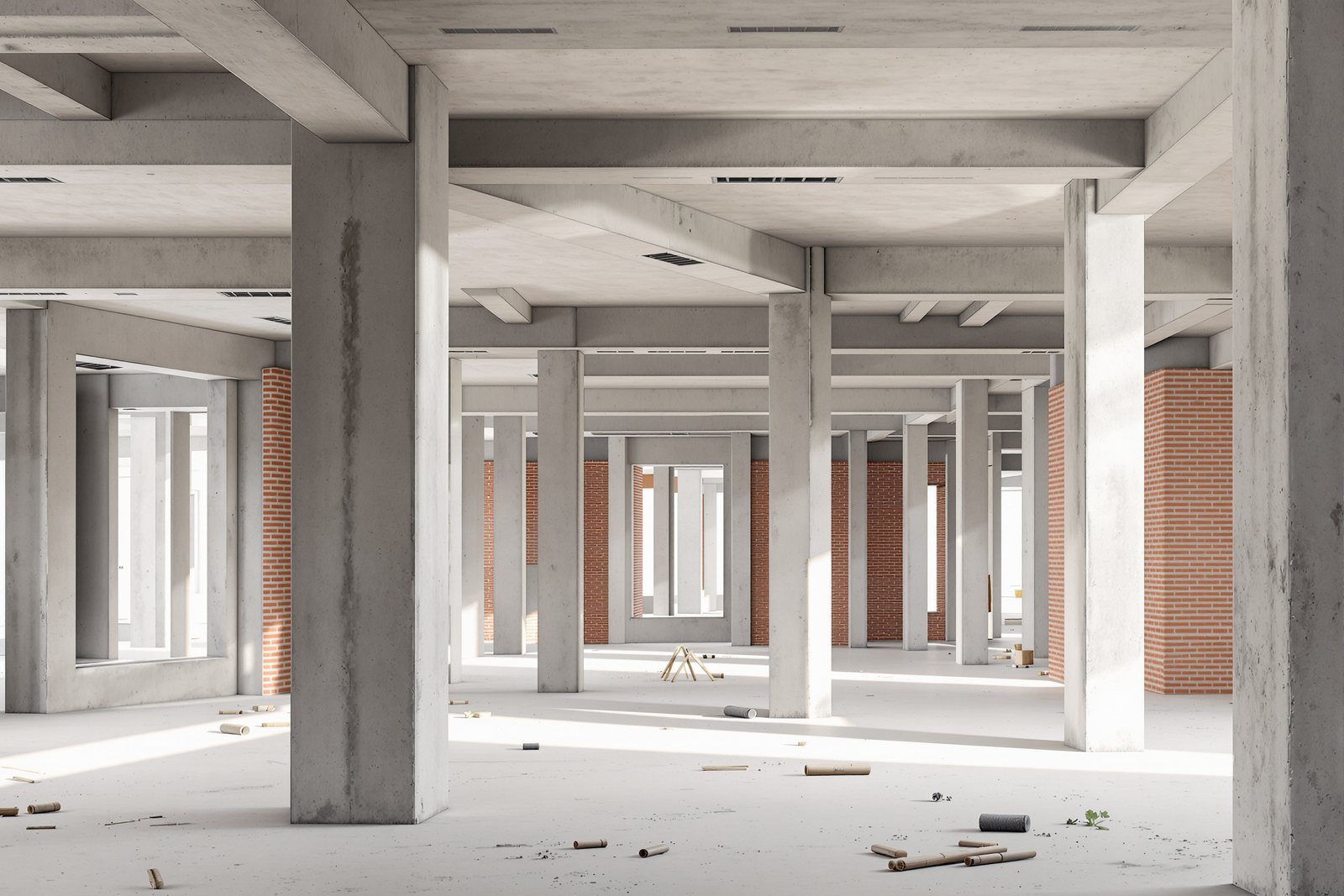
The modern way is the RCC framed structure — nearly every apartment, every G+3 and taller building, every new bungalow. A skeleton of columns and beams does all the carrying. The walls are merely infill — brick or block panels that fill the gaps between the frame to give you rooms and privacy. Because the frame holds the building up, the walls are free, and so is the plan. As the diagram shows, the frame lifts the load off the walls and lets the interior become open, flexible, and yours to rearrange. This single shift is why modern flats can have large halls, wide openings and movable partitions that a load-bearing house never could.
Which wall is structural? The designer's first question
Before you sketch a single open-plan dream, you must answer one question for every wall you want to touch: is this carrying load, or is it just dividing space? In a framed building the honest answer is usually that the walls are partitions — but "usually" is not "always," and the exceptions are exactly the ones that hurt.
Start with clues, then confirm with proof. Thickness is a hint: a 230 mm wall is more suspect than a 115 mm half-brick partition, though block walls blur this. Tap the wall — a solid, dull thud suggests masonry or RCC; a lighter, hollow ring suggests a gypsum or thin block partition. Look for a column swelling out of the wall line or a beam crossing the ceiling above it; walls sitting directly under beams are doing real work. In the marked-up plan in the figure, you can see structural walls and columns picked out in one weight and the freely removable partitions in another — that drawing is what you are trying to reconstruct in your own home.
But clues only narrow the field. The real proof lives in the building's structural drawings, and the final word belongs to a structural engineer. No interior designer in India should propose opening up a plan without that sign-off — your eyes can be fooled, but the framing plan cannot.
Grid, span, and the danger of cutting the frame
The freedom of a framed interior is real but not infinite — it is set by the column grid and the span, the clear distance a beam or slab crosses between supports. A typical residential grid places columns roughly 3 to 6 metres apart. Inside that grid you can do almost anything with partitions; you cannot change where the columns stand, and you cannot make a beam span further than it was designed to. Want a column-free 8 m living-dining? That had to be decided by the engineer before the building was cast, not by you afterward.
And the columns and beams themselves must be treated as untouchable. Chasing a deep groove for plumbing or wiring into an RCC column, notching a beam to run a duct, or drilling a forest of holes through structural concrete quietly cuts the steel and concrete that the load path depends on. The member may look fine for years — then crack under a full live load or the first real tremor. The rule is simple and non-negotiable: any change to a load-bearing element — masonry wall, column, beam or slab — needs a structural engineer's assessment and sign-off, in writing. Partitions are yours to move; the frame is not.
Hands-on
Send a load down to the soil
Three altitudes on the same idea
Read the band that fits you — or all three.
Before you agree to "let's just remove this wall to open up the living room," ask your contractor two things: is this a framed (RCC) building or a load-bearing one, and has a structural engineer looked at this specific wall? In an old independent house, assume almost every wall is holding the building and treat removal as off-limits without expert advice. In a flat, partitions can often go — but get it confirmed on paper, never on a confident "trust me, sir, it's fine."
Obtain the structural framing plan and column layout before any demolition proposal; overlay your interior layout on it and flag every wall sitting under a beam or aligned with a column. On your drawings, mark structural walls and columns with a distinct hatch and a DO NOT DISTURB note, and tag removable partitions separately. For any opening in or near a load path, route it through a structural engineer and carry their stamped sketch (lintel/needle-beam details, propping sequence) into the work. Specify no chasing deeper than the cover concrete into RCC members — full stop.
The whole subject reduces to one principle: load is conserved and must be conducted continuously to the soil. A structure is just the set of members forming that conductor — slab to beam to column to foundation. "Load-bearing" versus "framed" is simply which members are the conductors: in masonry the walls conduct, in a frame the columns and beams conduct and the walls are passengers. Every renovation question — can this go, can I open this — is really the question does this member lie on the load path?
“"It's a thin wall, so it's obviously not structural — I can take it out over the weekend."”
Run the method yourself
Spend twenty minutes turning your own home into a structures lesson.
- 1Find out which system you live in: ask whether your home is an RCC framed building or load-bearing masonry, and note its age and number of floors.
- 2Walk every room and tap each wall with your knuckles — mark on a rough sketch which sound solid and dull (likely structural or masonry) and which ring hollow (likely partition).
- 3Look up at the ceilings and locate the beams and columns: trace where the beams run and find the columns where they meet, then mark them on your sketch.
- 4Pick one wall you would love to remove and decide its verdict — is it under a beam, in line with a column, or standing free? Write down structural / partition / unsure.
- 5Open the load-path tracer and trace the load above that wall down slab to beam to column to foundation to soil — then list which professional you would call before touching anything.
What you now know how to see
Now that you can read the bones, the next lesson zooms in on the skin and flesh — how floors, walls and roofs are built up as layered assemblies, the building enclosure that keeps weather, sound and heat in their place.
The author
Amogh N P
Architect, interior designer, and creative polymath. Studio Matrx began in his notebooks — his vision of design made honest, useful, and open to everyone. Its Academy is written and taught in his memory, and free, forever.
More about Amogh →