
 Lesson 1.2
Lesson 1.2 · The Interior Space
The Enclosure: Floors, Walls and Roof
The six surfaces that turn structure into a room - read as layered assemblies
You are standing inside a box of six surfaces - and not one of them is a single thing.
Look up, look down, look around. A floor, a ceiling, and up to four walls hold you inside this room and keep the next room, the weather, and the street outside. They feel solid and final. But each of those six faces is a quiet stack of layers - and the smooth painted surface you see is only the last millimetre of a much thicker story.
You live against the last millimetre - but you must respect all the layers beneath it.
The six faces of the box you stand in
Stand in any room of an Indian flat and count the surfaces that hold you in. Under your feet, one floor. Over your head, one ceiling (the underside of the slab above, or a false ceiling hung below it). Around you, up to four walls - sometimes fewer, where an opening or a passage breaks the box. Together these are the enclosure: the set of surfaces that separates inside from outside, and one room from the next.
This is the difference between structure and a room. Columns, beams and a slab can stand in the open air and carry load perfectly well - but they do not make a space you can live in. It is the enclosing surfaces, wrapping the structure on all sides, that turn a frame into a bedroom, a kitchen, a pooja room. The enclosure is what you actually touch, see, lean on and decorate. It is the building, as far as the body is concerned.
A wall is not one thing - it is a sandwich
Knock on a wall in your home. The hollow, drum-like sound of a 115mm half-brick partition is nothing like the dull thud of a 230mm external brick wall or an RCC shear wall - and that difference is the first clue that a wall is assembled, not poured as one solid block.
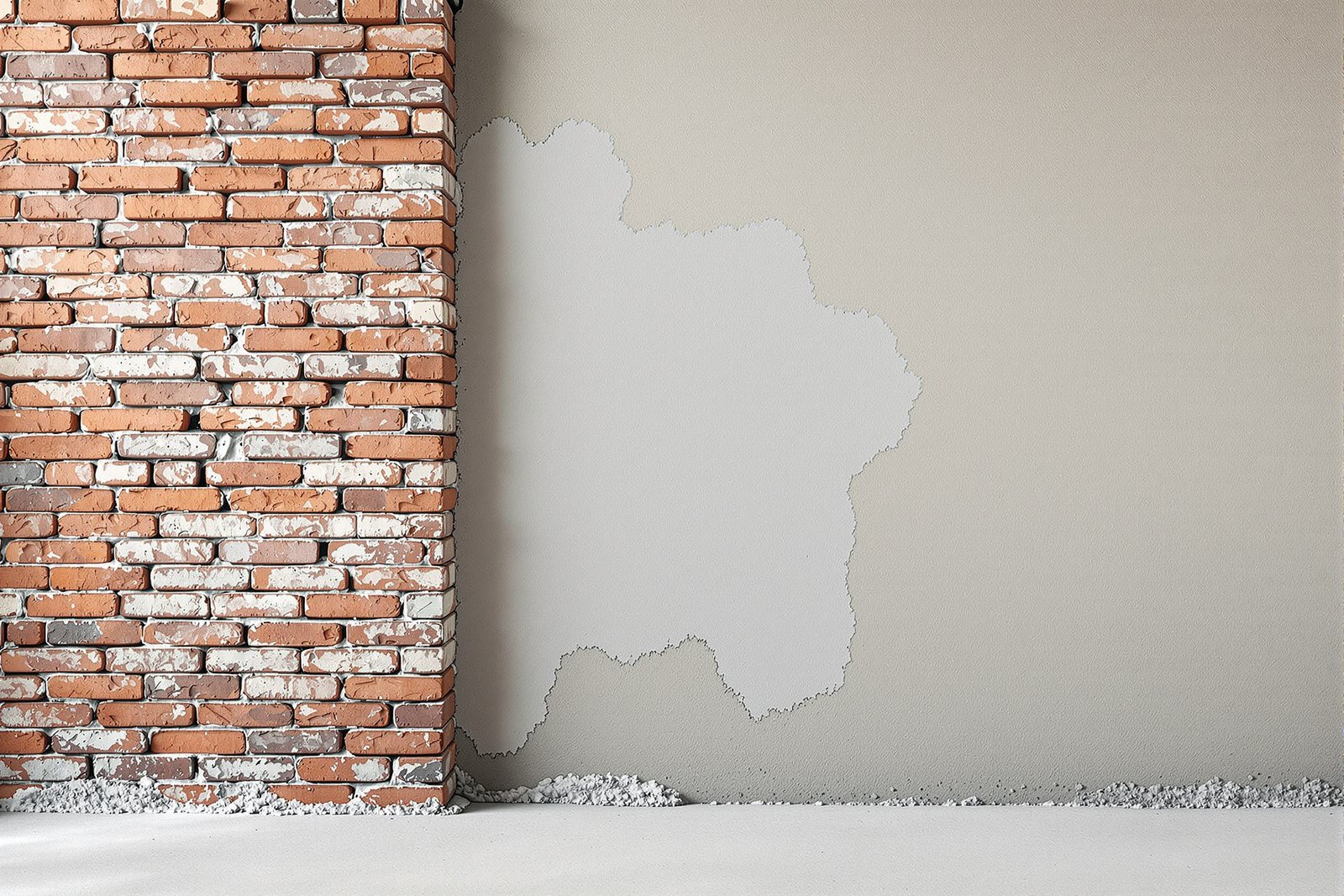
Read an external wall from the outside in and you find a stack: the structure (a 230mm burnt-clay brick wall, an AAC block wall, or an RCC member) carries the load and defines the line. At the base sits the damp-proof course - a thin waterproof band that stops ground moisture wicking up into the masonry. Buried in chases cut into the brick run the concealed services: electrical conduit, switchboard boxes, sometimes a water line. Over all of that goes plaster - typically 12mm to 20mm of cement-sand render that flattens the rough masonry into a true, smooth plane. And finally the finish: putty and emulsion paint, or tiles, or stone cladding, or wallpaper. The painted face you see is the last of five or six layers, each doing a separate job.
Floors and ceilings stack too
The floor follows the same logic. Below the tile your feet rest on lies a structural RCC slab carrying the load down to beams and columns. On top of the slab goes a screed or levelling course - a 40mm to 75mm bed of lean concrete or cement mortar that corrects the slab's slope and brings the floor to the right level. In wet areas - the bathroom, the balcony, the utility - a waterproofing membrane wraps in before the bed, turned up the walls 150mm or more so water cannot escape. Then the finish: vitrified tile, terrazzo (mosaic), Kota or granite, laid on a bonding mortar. A bathroom floor might run 100mm thick from slab top to tile top; remember that when you change a finish, because the levels of adjoining rooms have to agree.
The ceiling is the same slab read from below - its soffit - often plastered and painted directly. But in most modern Indian homes a false ceiling of gypsum board or PoP hangs 200mm to 450mm below the slab, on a steel or G.I. framework. That gap is not decoration: it hides AC ducts, drain lines, wiring and recessed lights, then presents one clean plane below.
Everything the enclosure must do at once
Why so many layers? Because the enclosure is asked to do many jobs simultaneously, and no single material does them all well. It must carry and transfer load - your weight, the furniture, the slab above. It must keep weather and water out - rain off the external face, ground moisture out of the base, splash off the bathroom wall. It must moderate heat and sound - a thick or insulated wall keeps the Indian summer at bay and the neighbour's TV out. It must resist fire and moisture over time. And it must present a finished face - a surface worth living against.
Brick carries load and stops weather but is rough and porous; plaster makes it smooth but is not the finish; paint is the finish but protects nothing structurally. Each layer is chosen for one or two of these jobs. Strip the enclosure to a single material and one of these duties always fails - which is exactly why a wall, a floor and a roof are built up in stages.
Why this matters to the interior designer
As an interior designer you mostly work the inner face - the last layer, the one people see and touch. But you can never treat it as if the rest of the assembly were not there. You cannot just "add a finish" and stop thinking. Add 18mm stone cladding to a wall and you have stolen 18mm of room width and changed how a door architrave meets it. Lay new tile over old without lifting it and your finished floor rises - now the door scrapes and the threshold to the next room is a trip hazard. Fix a heavy mirror to a 115mm partition and you may hit a buried conduit, or find the wall too thin to hold an anchor.
Every finish needs a substrate to sit on, allowance for the movement of materials, protection against moisture, and a thickness that someone has to find room for. Run the enclosure-layers interactive and peel a wall, a floor and a roof apart layer by layer - it is the single fastest way to start seeing the assembly behind every surface you design against.
Hands-on
Inner face at the top — click to peel
Finish
putty + emulsion paint
The face you see and touch.
You design against the top layer — but it rests on every one below it.
Three altitudes on the same idea
Read the band that fits you — or all three.
When you ask for a new finish, ask what is behind it and how thick it will be. Before drilling, check for concealed wiring near switches and points - a 115mm partition gives little to anchor into. And remember: laying new tile over old without removing it raises your floor, so doors may need trimming and the level may no longer match the next room.
Specify the full build-up, not just the finish: e.g. 230mm brick + 15mm internal plaster + acrylic putty + 2 coats emulsion; or RCC slab + 50mm PCC screed + APP waterproofing membrane (turned up 150mm in wet areas) + 8mm bonding mortar + 600x600 vitrified tile. Note finished-floor-levels (FFL) on every room and call out thresholds where finishes change. For false ceilings, give the drop, the G.I. framework spacing and the services running in the plenum.
The principle: an enclosure is a layered assembly resolving conflicting demands - load, weather, heat, sound, fire, moisture and appearance - because no one material satisfies all of them. From this you can derive why every surface stacks: structure for load, a barrier for moisture, a leveller for tolerance, and a finish for the eye. Read any wall, floor or roof as the sum of layers, each answering one demand.
“A wall is just one solid thing, and the finish you see _is_ the wall.”
Run the method yourself
Become an enclosure detective in your own home - fifteen minutes, no tools but your hands and a tape.
- 1Stand in one room and count the six surfaces - floor, ceiling, and each wall - noting where an opening leaves a face missing.
- 2Knock along a wall at knuckle height: find a spot that sounds hollow (a
115mmpartition) and one that thuds solid (230mmor RCC), and mark the difference. - 3In a bathroom, look for the line where the floor tile turns up the wall - that is your waterproofing telling you the wet zone.
- 4Look up for a false ceiling: tap it (gypsum sounds light and hollow) and find a vent or light cut into it, then guess what services hide in the gap.
- 5With a tape, measure the step from your room floor to the bathroom or balcony floor - that difference is the floor build-up made visible, then open the
enclosure-layersinteractive and peel the same assembly apart.
Pulling it together
enclosure-layers interactive to peel walls, floors and roofs apart until reading the assembly behind any surface becomes second nature.We have seen the box and its layers - next we go into the hollow chases and the false-ceiling plenum to follow the building services: the water, drainage, power and air hidden inside the enclosure.
The author
Amogh N P
Architect, interior designer, and creative polymath. Studio Matrx began in his notebooks — his vision of design made honest, useful, and open to everyone. Its Academy is written and taught in his memory, and free, forever.
More about Amogh →