
 Lesson 4.4
Lesson 4.4 · Interior Building Elements
Doors and Windows: Openings in the Enclosure
How you pass through and see out - door types, swings, window types and the sill
A wall is just a wall until you cut a hole in it
Stand in any room and notice this: the walls do one job - they hold the space in. But the moment you cut an opening, that wall starts doing something far more interesting. A door lets your body pass through. A window lets light, air and your eye pass through. Every opening is a deliberate decision about where the enclosure breaks - and a good one is chosen as carefully as the wall it sits in.
A plan view of a single hinged door: two short jamb lines, the leaf as a line at 45 degrees, and a faint quarter-circle arc tracing the sweep, lightly shaded - the floor no furniture may occupy.
The opening is two things at once
An opening is never just a gap. It is always doing two jobs at the same time.
The first job is function. A door is sized so a person - and a mattress, and a fridge - can pass through. A window is placed so light reaches the back of the room, so air crosses from one side to the other, so you can see the street or the garden. Get the function wrong and you feel it every day: a door that bangs into the cupboard, a window so high you can only see sky.
The second job is composition. The opening sits on a wall, and its size, shape and position change how that wall reads. A tall narrow window feels different from a low wide one. Two windows spaced evenly create rhythm; one shoved into a corner feels accidental. This is where the proportion idea from earlier in this module comes back - an opening is a rectangle on a surface, and its proportions are something you choose, not just inherit from the carpenter's habit.
Throughout this lesson, keep both jobs in your head. The best openings serve the body and please the eye at the same time.
Door types and where each one belongs
In Indian homes you will meet a small family of door types, and each suits a particular spot.
The hinged door is the default - a leaf swinging on hinges on one edge. It comes as a flush door (a flat plywood or laminate face, cheap and clean) or a panelled door (framed with raised panels, more decorative, common for main doors). Hinged doors are simple and reliable, but they need empty floor for the leaf to swing.
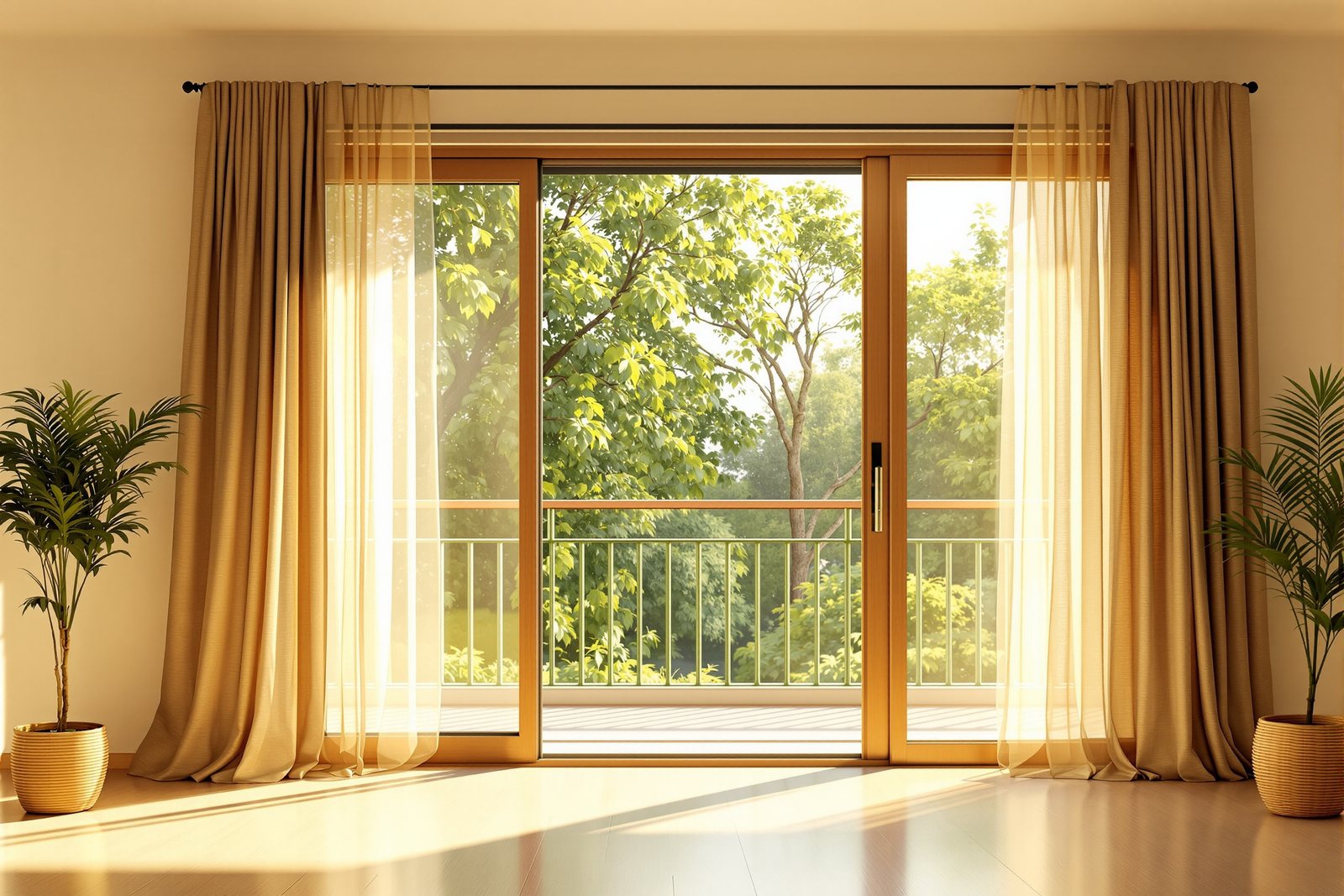
The sliding door runs sideways on a track and needs no swing space at all. This makes it the go-to for balconies (a glass sliding door to the balcony is almost standard in flats) and for wardrobes, where a swinging shutter would eat the walking space in front.
The pocket door is a sliding door that disappears into the wall when open. It is the most space-saving of all - the wall has to be built hollow to receive it - and it shines in tight spots like a small bathroom or a study off a narrow passage.
Folding and sliding-folding doors are made of several leaves hinged together that concertina to one side. Their party trick is opening up an entire wall - a living room flowing out onto a wide balcony - so the inside and outside become one space.
Choosing is mostly about the space you have around the opening: plenty of floor, hinged; no room to swing, sliding or pocket; a whole wall to dissolve, folding.
Sizes, handing and the swing it sweeps
A door has to fit the opening, but that is the easy part. The harder part is everything around it.
Sizes (India). A main entrance door is usually around 900mm wide so it feels generous and large items pass. Internal doors are narrower, about 750-800mm. Standard door height is about 2.1m, with the lintel - the beam that carries the wall load - sitting just above. A bathroom door can drop to 700mm where space is tight.
Handing. Every hinged door has a handing - which edge it is hinged on, and therefore which side it opens from. Get it wrong and the door blocks a light switch, or you have to reach awkwardly around the leaf to enter. Decide handing by where you want to stand and what the open leaf should hide or reveal.
Swing. A hinged door sweeps an arc as it opens - and that arc must be empty. The leaf should swing into the room and ideally lie flat against a wall when fully open. It must never swing into a passage where it blocks people, and never collide with another door swinging into the same corner. A door into a room is good; a door into a corridor is a hazard. Our door-swing-clearance interactive lets you set a door width and watch the arc and the floor it claims grow - try a 900mm leaf and see how much room it really wants.
Window types and the height of the sill
Windows are openings for light, air and view - and the type you pick decides how much of each you get.
A casement (openable) window is hinged on one side and swings open like a tiny door, giving you the full opening for ventilation. A sliding window runs on a track and projects nothing outward, which is why it dominates flats and balconies where a swinging shutter would foul a grille or a passage outside. An awning window is hinged at the top and pushes out at the bottom, so it can stay open in the rain without letting water in - useful in our monsoon. A fixed window does not open at all; it is pure light and view, often used as a large pane beside an openable one. A bay window projects out from the wall in a shallow box, gathering extra light and giving you a ledge to sit on.
The sill is the bottom edge of the window - and its height changes everything. A typical sill sits around 900mm off the floor. Drop it lower for a view or a window seat. Raise it to about 1200mm over a kitchen counter so the worktop runs beneath, or high in a bathroom so daylight enters but no one can see in. Above the window, the same lintel that crowns a door carries the wall.
Three India habits ride along with every window: a mosquito mesh shutter behind the glass, a security grille outside, and tight sealing so monsoon-driven rain does not creep in around the frame.
Openings as composition on the wall
Now step back from the single opening and look at the whole wall.
The openings you place form a pattern. Their proportions - tall and slim, or low and wide - set the mood. Their spacing sets a rhythm: three windows at equal centres feel calm and ordered; the same three bunched and then a gap feel restless. Their alignment matters too - when the heads of doors and windows line up at the same height (often the lintel line), the wall feels resolved; when they wander, it feels unplanned.
This is the proportion lesson coming home. A window is a rectangle, and you get to choose its ratio. A run of openings is a sequence, and you get to choose its beat. Designers who treat openings only as functional holes end up with walls that work but feel accidental. Designers who treat them as both function and composition get rooms that breathe correctly and look composed - the two jobs, served together.
Hands-on
Width 900 mm
is swept by the swing and must stay empty — no furniture, no clashing door, never into a passage. A wider leaf claims disproportionately more (it grows with the square of the width).
Three altitudes on the same idea
Read the band that fits you — or all three.
Your job is mostly choosing the right type and the right swing. For a balcony, a sliding or folding door almost always beats a hinged one - it saves the floor you would otherwise lose to the swing. For a wardrobe in a tight bedroom, sliding shutters keep the walking space free. Inside, before the carpenter fixes a hinged door, walk the swing: stand where the leaf will open and ask does it hit the bed, the cupboard, the switchboard, or someone walking past? Decide which side it hinges (the handing) so the open door tucks against a wall, not across the room. For windows, match the type to the spot - sliding for a balcony with a grille, awning where rain is a worry, a higher sill in the bathroom for privacy. And insist on a mosquito mesh shutter; you will thank yourself every evening.
Specify openings completely, not loosely. For each door note width, height, leaf type, handing and swing direction, and check the swing clearance against the furniture layout, adjacent door swings and circulation - a leaf must not sweep into a corridor or collide with another in a shared lobby. Mark handing on the drawing (which jamb is hinged, in/out swing) so site does not guess. Keep heads at a consistent lintel line across a wall for both function and composition. For windows, select type against ventilation need, projection constraint (grille, balcony, external passage) and weather - awnings or top-hung vents for monsoon faces, sliding where nothing may project. Set sill heights to use: ~900mm general, ~1200mm over counters, higher for bathroom privacy, lower for seats. Detail mesh shutters, grille fixing and frame sealing in the schedule. Use the swing-clearance study to validate tight plans before they reach site.
Train yourself to read every opening as both a function and a compositional element. Functionally, ask what passes through - a body, light, air, a view - and whether the type and size deliver it. Compositionally, ask how the opening sits on its wall: its proportion (the rectangle's ratio), its position, its rhythm with the openings beside it, the line its head shares with others. These are the same proportion and rhythm ideas from earlier in this module, now applied to holes instead of solids. In studio, sketch a wall elevation and try the same window at three proportions and three positions; watch how the wall's character flips while the function barely changes. That gap - same function, different feeling - is exactly the territory a designer works in. Hold both lenses at once and your openings will never be merely accidental.
“A door just needs to fit the opening - if the leaf matches the hole, the job is done.”
Run the method yourself
Five things you can check right now, where you are sitting, with nothing but a tape measure and your eyes.
- 1Pick the nearest hinged door and open it slowly. Watch the arc the leaf sweeps - what does it pass over or almost clash with (a bed, a cupboard, a switch, a passing person)?
- 2Decide that door's handing: which edge is hinged, and does it swing into the room and tuck against a wall, or awkwardly out into a passage?
- 3Measure that door's width and height in
mm. Compare it to the guides - main ~900mm, internal ~750-800mm, height ~2.1m. Where does yours land? - 4Walk to a window and measure its sill height off the floor. Is it around
900mm, lower for a view, or raised over a counter or for bathroom privacy? - 5Name the type of every window you can see - casement, sliding, awning, fixed or bay - and note which have a mosquito mesh shutter and a security grille. Then open the door-swing-clearance interactive, set your measured door width, and see how much floor its swing really claims.
Putting it together
You now know how to move _through_ a wall and see _out_ of one. Next we go _up_ - to the element that carries you between levels and guards the drop: stairs and railings, where comfort underfoot and safety at the edge become a single design problem.
The author
Amogh N P
Architect, interior designer, and creative polymath. Studio Matrx began in his notebooks — his vision of design made honest, useful, and open to everyone. Its Academy is written and taught in his memory, and free, forever.
More about Amogh →