
 Lesson 4.2
Lesson 4.2 · Interior Building Elements
Walls and Partitions
Dividing space - load-bearing, partition, and feature walls, and the finishes that face them
The plane you lean a sofa against is doing three jobs at once
You walk past a hundred walls a day and read them as one flat thing - paint, a corner, a switchboard. But every wall in your home is quietly answering three questions at the same time: am I holding the building up, am I splitting one space from another, or am I the surface you actually look at? Get those three roles straight and you will never knock, hang, or finish a wall blindly again.
A wall in cross-section split into three labelled stripes - a thick brick core marked 'structure / divider', a smooth plaster-and-putty layer marked 'surface', and a final finish stripe marked 'the face you see' - with arrows reading 1-structure, 2-divider, 3-surface.
Three jobs, one plane
A wall looks like a single object, but it is really doing up to three jobs - and the trouble starts when you forget which one matters at a given moment.
The first job is structure - carrying the weight of the floor or roof above and passing it down to the foundation. A wall doing this is load-bearing, and you do not touch it casually. The second job is division - chopping a large volume into rooms, giving you a bedroom that is not the living room. A wall doing only this is a partition; it holds up nothing but itself. The third job is surface - the face you see, paint, light, and lean furniture against.
In a typical RCC-frame Indian home, the columns and beams carry the load, and almost every wall you see between them is only a partition. But in older or smaller load-bearing brick houses, the walls are the structure. Before you open up, knock down, or even cut a deep chase into any wall, you must know which kind it is - and that is a question for the building's structure, not its decor. When in doubt, treat it as load-bearing and ask an engineer.
The partition menu
Once you know a wall is just a divider, you get to choose what it is made of - and Indian sites offer a clear menu, each with trade-offs.
230mm and 115mm burnt-clay brick is the default. The 230 (full brick) is for external and stronger internal walls; the 115 (half brick) is the common internal partition. Brick is solid, heavy, blocks sound well, and will hold any wall-hung load you throw at it - but it is a slow, wet trade (laying, curing, then plaster) that adds weight to the slab.
AAC block (autoclaved aerated concrete) is the modern middle path - much lighter than brick, faster to lay in big blocks, with better thermal insulation. It is kinder to the structure's weight budget and speeds up the job.
Gypsum drywall on a GI-stud frame is the lightweight, dry, fast option - a metal skeleton sheathed in gypsum board. It goes up in days, is hollow inside (perfect for running wiring and pipes), and is easy to dismantle. The catches: it is weaker for hanging a heavy TV or cabinet unless you fix into the studs, and standard board is not for wet areas.
Glass partitions divide a space without blocking light - ideal where you want separation but not darkness. MDF or ply joinery partitions double as storage or screens, blurring the line between wall and furniture. Choose by weighing weight, sound, cost, speed, wet-area fitness, and load-hanging - no single material wins on all six.
The feature wall
Not every wall should shout. The quiet trick of a good room is letting most walls recede into a calm neutral while one wall does the visual heavy lifting - the feature wall.
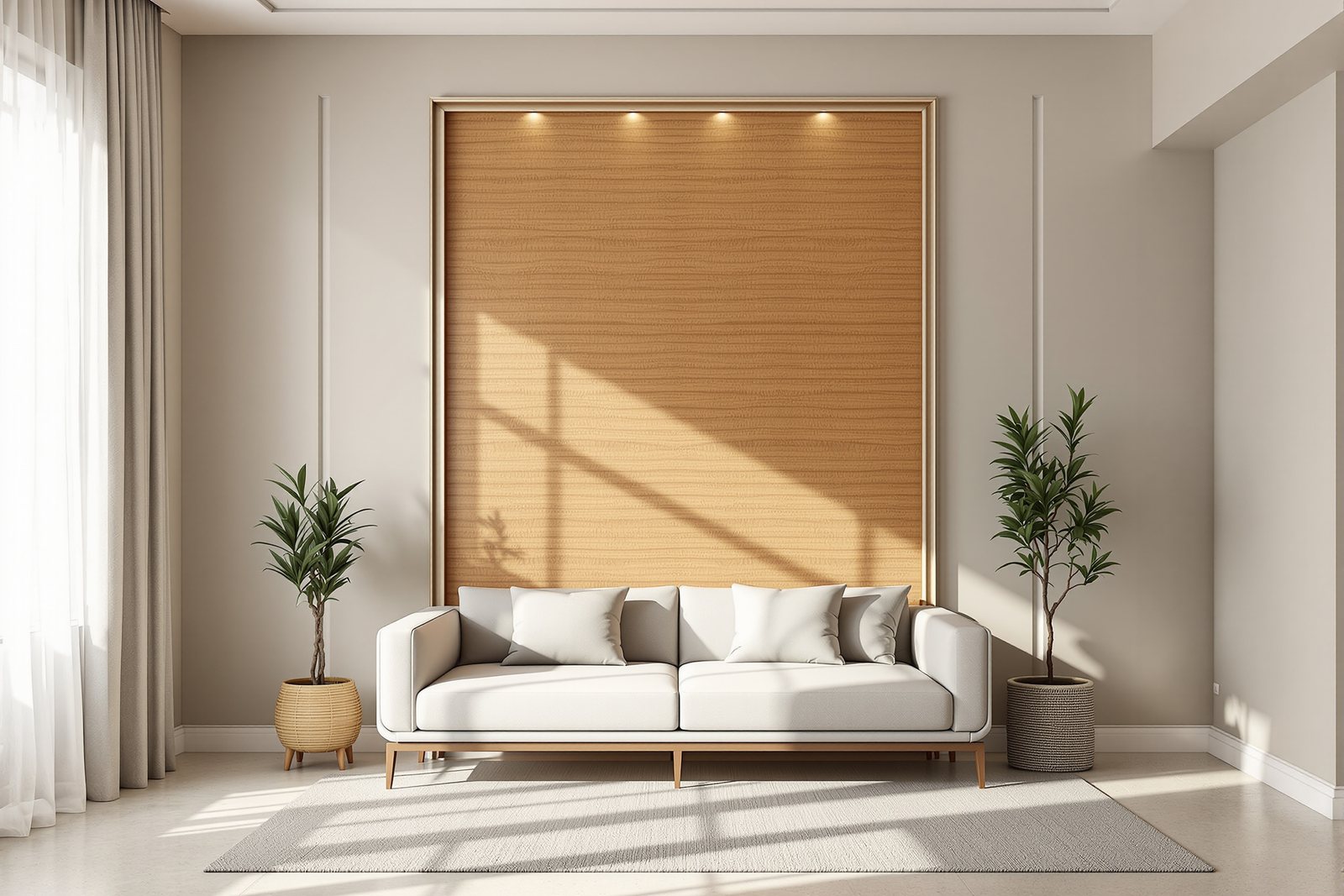
This is deliberate emphasis. You pick the wall the eye lands on first - the one behind the bed, behind the TV, at the end of a hallway - and give it a different treatment: a bold paint, a stone or veneer cladding, a textured plaster, a wallpaper. The other three walls stay plain on purpose, so the feature wall has something to be louder than.
The discipline is restraint. One feature wall per room reads as intentional; three feature walls read as noise and shrink the space. Think of it the way you think of a single statement light or one bold cushion - emphasis only works when most of the room is quiet around it.
Facing the wall
A finished wall is rarely raw material - it is a base wall plus a finish, and the finish is chosen for how that spot is used, not just how it looks.
Paint over putty is the workhorse - wall putty smooths the plaster, then emulsion paint goes on; cheap, repaintable, endlessly flexible. Textured paint adds depth and hides minor imperfections, good on a feature wall. Veneer and laminate cladding bring warmth and a furniture-like richness - real wood veneer for premium feel, laminate for durability and budget. Natural stone (granite, marble, slate cladding) reads luxurious and lasts, but is heavy and costly. Wallpaper delivers pattern fast and is a favourite for feature walls and bedrooms. Tile is the answer wherever water lives.
Match finish to use. Wet areas - bathrooms, the kitchen backsplash - want tile or stone that wipes clean and shrugs off water. High-touch zones - corridors, behind the dining table, anywhere small hands roam - want washable, scuff-tough finishes, not delicate matte wallpaper. Feature walls can carry the dramatic, expensive, or fragile finish precisely because they sit out of the splash and traffic.
India's wall reality
On most Indian sites, brick is still the default partition - masons know it, it is available everywhere, and clients trust its solidity and silence. But the picture is shifting.
In offices, commercial fit-outs, and increasingly in apartments, drywall is rising fast because speed and a dry trade matter when you are racing a handover date and cannot flood a site with water and curing time. A glass-and-drywall office cabin can go up in the time a brick wall would still be curing.
And two villains haunt Indian walls: external walls and bathroom-shared walls fight damp. A wall that backs onto the outside or shares a face with a wet bathroom can wick moisture, blister paint, and grow that tell-tale dark patch. The fix lives in the construction - waterproofing, the right finish (tile or damp-resistant paint), and never putting plain gypsum drywall where water can reach it. Read your walls for these weak spots before you choose a finish, not after the monsoon proves you wrong.
Three altitudes on the same idea
Read the band that fits you — or all three.
Your live decisions are two: how to choose a partition and when it is safe to open a wall.
For a new partition, ask what the spot needs. Want quiet for a bedroom? Lean brick or AAC. Need it fast, dry, and full of hidden wiring - a study carved out of a hall? Drywall. Want to split a space but keep the light flowing? Glass. Going to hang a heavy TV or a loaded bookshelf? Brick, AAC, or drywall fixed properly into its studs - never plain drywall between studs.
Before you remove a wall to open up the kitchen, stop. If it is load-bearing, knocking it out endangers the whole building. Tap it, check whether it lines up with structure above, and when there is any doubt, get an engineer to confirm before a single brick moves. Opening up a home is wonderful - opening up the wrong wall is catastrophic.
Specify partitions by performance, not habit. Call out 115mm brick or AAC block where acoustic separation and load-hanging matter (bedrooms, party walls); AAC where you are protecting the slab's weight budget or chasing programme. Reserve gypsum-on-GI-stud for fast, serviceable, dry partitions - and note on the drawing where stud spacing must tighten for heavy fixings, and where moisture-resistant or cement board replaces standard gypsum near wet zones.
For finishes, schedule them to exposure. Tile or stone to wet walls and backsplashes; washable emulsion to circulation and high-touch zones; veneer, laminate, textured plaster, or wallpaper to feature and low-traffic walls. Detail the substrate - putty grade, primer, waterproofing membrane on external and bathroom-shared walls - because a beautiful finish over an untreated damp-prone wall is a callback waiting to happen.
Train yourself to read every wall through three lenses: wall as structure, wall as divider, wall as surface.
As structure, a wall is a load path - it gathers weight and sends it down. This is structural logic, and it dictates what you may never remove or weaken. As divider, a wall is a spatial decision - it defines a room, controls privacy, sound, and sightlines, and here you have real freedom in material. As surface, a wall is a perceptual object - its finish, colour, and texture shape how big, warm, or calm the room feels.
The discipline is to keep these layers separate in your thinking. A novice argues about wallpaper on a wall that cannot structurally take a doorway being moved. A designer settles the structure question first, then the division question, then - last - the surface. Same plane, three orders of decision, in that sequence.
“A wall is just a divider you paint - so I can knock it out or hang whatever I like on it.”
Run the method yourself
Five minutes, your own home, no tools but your knuckles and your eyes.
- 1Tap and listen. Knock with your knuckles across a few walls. A dull, solid thud with no give is brick or block; a lighter, hollow drum-like sound is gypsum drywall over a hollow stud frame. You have just sorted your home's partitions by material.
- 2Hunt the structure. Find a wall that lines up with a beam or column above, or one that runs unbroken through the plan - likely load-bearing. Now find a thin internal wall between two rooms that holds up nothing - your partition. Notice the difference in feel.
- 3Spot the feature wall. Walk into your living room or bedroom and name the wall your eye lands on first. Is it given a different treatment from the others, or are all four the same? Decide which wall should be the feature.
- 4Audit a finish. Pick one wall and read its finish - plain paint, texture, tile, wallpaper, cladding? Ask whether that finish suits the wall's job. Is there washable paint where small hands roam? Tile where water splashes?
- 5Check for damp. Go to a bathroom-shared or external wall and look low and in the corners for dark patches, blistered paint, or a musty smell. You are finding where the wall is losing its fight with moisture - the spot a finish alone can never fix.
Reading walls in three orders
You have read the vertical plane in three orders. But look up - there is a whole surface most people never design at all. Next we tackle the ceiling, the forgotten plane overhead that quietly governs how tall, how calm, and how finished a room feels.
The author
Amogh N P
Architect, interior designer, and creative polymath. Studio Matrx began in his notebooks — his vision of design made honest, useful, and open to everyone. Its Academy is written and taught in his memory, and free, forever.
More about Amogh →