
 Lesson 4.1
Lesson 4.1 · Interior Building Elements
Floors: The Surface You Walk and Live On
The most-used plane in any home - its build-up, its finishes, and choosing the right one
You judge this surface with your feet before you ever judge it with your eyes
Walk into any room barefoot and your soles deliver a verdict in half a second - cold, warm, gritty, smooth, safe, slippery - long before your brain notices the colour. The floor is the one plane you are always touching. This lesson is about choosing it with the same care your feet already do.
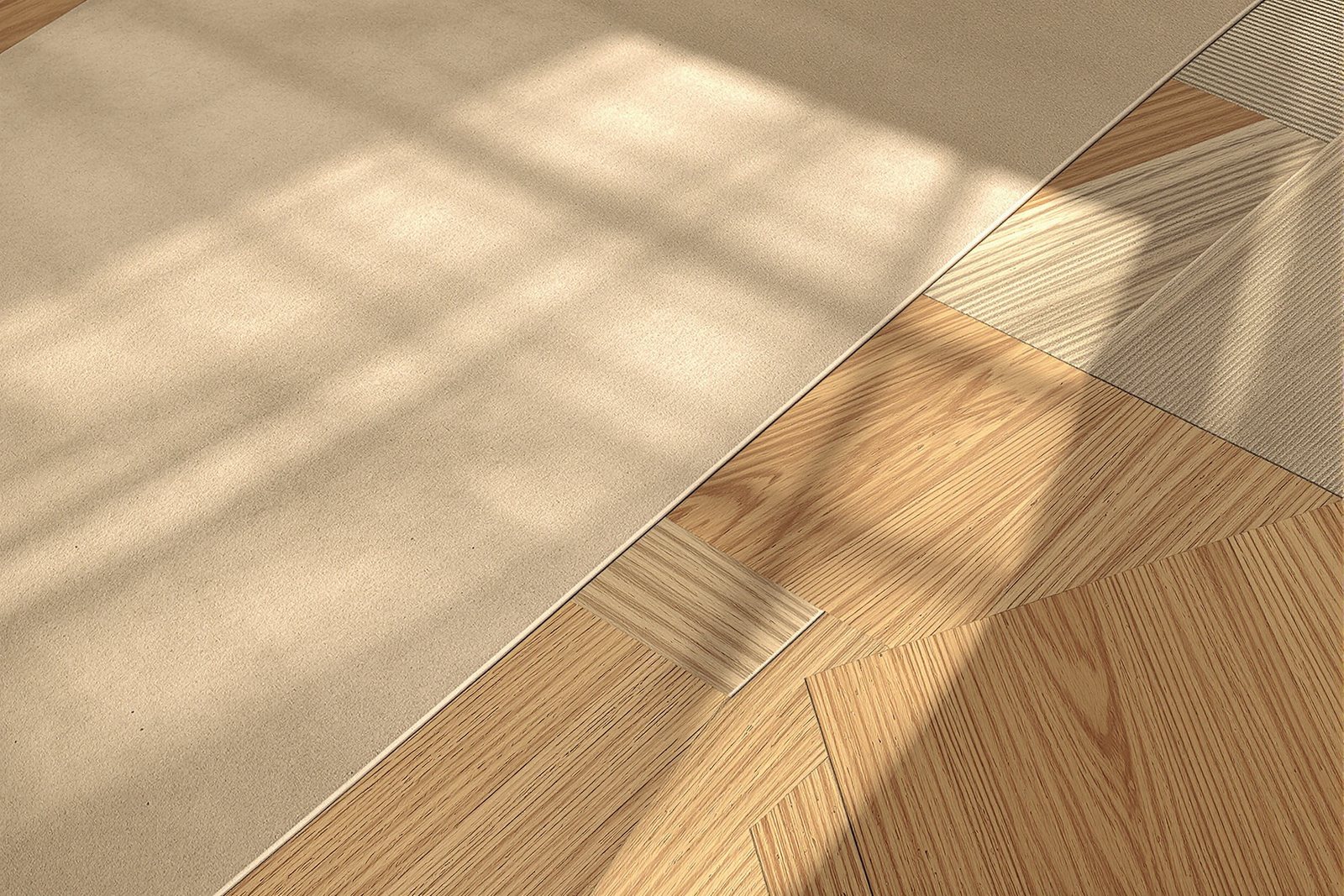
A floor section in four stacked bands - slab, screed, waterproofing, finish - with a little 100mm skirting turning up the wall and a stepped threshold where two floors meet.
The floor is the plane that takes the most punishment
Of every surface in your home, the floor works hardest. The ceiling is looked at; the wall is leaned on; the floor is walked on, dragged across, spilled on, dropped on, scrubbed, flooded during Holi, and tracked with monsoon mud - all day, every day, for decades.
It is also the plane your body reads most intimately. You touch a wall with a fingertip occasionally. You touch the floor with the full weight of your bare soles the moment you wake. A floor that is cool in a Chennai April is a mercy; a floor that is icy on a Shimla January morning is a small daily punishment.
So a floor is never just a colour you point to in a showroom. It is a decision about how a surface will feel, wear, and stay safe under years of real life. Get it wrong and you live with the regret underfoot every single day.
What is actually under your feet: the build-up
A finished floor is a layered sandwich, not a single thing. From the bottom up, a typical Indian build-up is:
1. Structural slab - the RCC deck or the compacted earth-and-PCC base that carries load.
2. Screed / levelling layer - a 40-75 mm cement-mortar bed that flattens the rough slab and sets the final level. This is also where slopes are built into wet areas.
3. Waterproofing - in bathrooms, kitchens, balconies and terraces, a membrane or coat (often above the slab, below the screed) that stops water reaching the structure below.
4. Bedding + the finish - the tile, stone or plank you actually see, laid on adhesive or a mortar bed.
The finish is the thinnest layer but the only one anyone notices. The lesson hiding here: changing the finish changes the finished floor level. A 10 mm tile and a 20 mm granite slab do not end up flush unless the screed below them is adjusted. Ignore this and you get an ugly lip at every doorway.
The main Indian floor finishes, and how to choose between them
Five families cover almost every Indian home. Each trades off cost, durability, maintenance, warmth underfoot, and slip resistance differently:
- Natural stone - Kota (₹40-90/sq ft, tough, slightly textured, great value), granite (₹120-250/sq ft, near-indestructible, excellent for kitchens), marble (₹150-600+/sq ft, luxurious but it stains and etches - one spilled lime juice leaves a dull mark). All feel cool and premium; all need periodic sealing. - Vitrified and ceramic tile - the Indian default. Cheap (₹40-120/sq ft), hard, near-zero maintenance, endless designs. The catch: a glossy tile is dangerously slippery wet - choose matt or anti-skid for bathrooms and entries. - Wood and laminate - warm and soft underfoot, the cosiest option. But engineered wood (₹250-500/sq ft) and laminate (₹90-200/sq ft) hate standing water and high humidity; keep them out of bathrooms and ground-floor coastal homes. - Terrazzo / mosaic - the old chips-in-cement floor, poured or in tiles. Extremely durable, seamless, and quietly back in fashion. Cool underfoot, moderate cost (₹120-300/sq ft cast in-situ). - Carpet and rugs - warmest and softest, lovely in hill-station bedrooms. But in dusty, allergen-heavy Indian air, wall-to-wall carpet is a maintenance trap; loose rugs over hard floors are the smarter compromise.
Use the floor-finish-compare tool to see these rated side by side on cost, durability, maintenance, warmth and slip before you commit.
Where the floor meets the wall and the next room
Two edge details decide whether a floor reads as finished or sloppy.
The skirting is the 75-150 mm band running along the wall base - tile, stone, or painted MDF. It is not decoration: it protects the vulnerable wall bottom from mop water, shoe scuffs and vacuum knocks, and it neatly hides the messy junction where floor meets plaster. Match it to the floor (stone skirting with a stone floor) or use a clean flush-set MDF band for a modern look.
The threshold is where two floors meet - room to room, or dry floor to wet bathroom. Here you manage level changes: a bathroom is often sunk 15-20 mm and sloped so water never crosses into the bedroom, marked by a stone patti at the door. Where a 10 mm tile meets a 20 mm stone, a metal or stone transition strip hides the step. Done well, you barely notice these joints; done badly, you stub a toe on them daily.
Choosing the right floor for the right room
There is no single best floor - only the right floor for this room, this climate, this household.
A bathroom wants anti-skid matt tile or honed Kota, properly sloped and waterproofed. A kitchen wants something that shrugs off oil and dropped vessels - granite or a tough vitrified tile. A living room can carry premium stone or a warm wood plank. A child's or elder's room prioritises slip safety and warmth over looks. A balcony in monsoon country needs rough, draining, anti-skid stone.
Match the finish to the abuse the room will deliver and the comfort the body needs there, and you will choose well every time.
Hands-on
Vitrified tile
Best for: living + bedrooms, budget
No finish wins on every axis — a glossy tile is cheap and tough but slippery wet; marble is beautiful but stains. Match the finish to the room’s abuse and the body’s comfort.
Three altitudes on the same idea
Read the band that fits you — or all three.
Choose your floor by how each room will be lived in, not by the prettiest sample. Walk through your day: the bathroom you step into wet (anti-skid matt tile or honed Kota - never glossy), the kitchen where vessels drop (granite or hard vitrified), the bedroom you want warm underfoot (wood, or a rug over tile).
A practical default for an Indian home: double-charged vitrified tile in living and bedrooms (cheap, durable, easy), granite in the kitchen, anti-skid tile or Kota in wet areas. Spend extra only where you'll feel it - a beautiful stone in the entrance you see daily beats marble you're terrified to spill on. Always ask for matt or anti-skid in any space that gets wet.
Draw the floor as a build-up, not a finish call-out. Specify each layer: structural slab -> screed (40-75 mm, with falls of 1:80 to 1:100 in wet areas) -> waterproofing system (above slab in toilets, balconies, terraces) -> adhesive bedding -> finish, with the finished floor level (FFL) noted.
Coordinate levels obsessively: a 10 mm tile and 18 mm stone need different screed thicknesses to land flush; a sunk slab (150 mm) keeps the toilet FFL 15-20 mm below the bedroom. Detail the skirting (100 mm typical) and every threshold strip on the drawing. Schedule slip resistance by room - specify anti-skid finishes for wet areas. The floor-finish-compare tool is a fast first cut when you're shortlisting finishes against a client brief and budget.
The principle: a floor is a horizontal assembly answering five forces at once - load, water, wear, comfort, and safety - and the visible finish is only the top 8-20 mm of that answer.
Learn to read any floor as a section: what carries the load, what sets the level, what stops the water, what you touch. Then learn the trade-off triangle - cost vs. durability vs. feel - and the fact that no finish wins on all axes (marble is beautiful and fragile; vitrified is cheap and slippery; wood is warm and water-hating). Mastery is matching the assembly's properties to the specific demands of the space, and remembering that a finish change always ripples into level, threshold and skirting details.
“The floor is just a finish you pick at the end - choose a colour you like and you're done.”
Run the method yourself
Become your own floor inspector - your home is a free lab full of finishes to test with nothing but your feet, a cup of water and a tape.
- 1Slip test, wet: drip a little water on your bathroom floor and on your living-room floor, then carefully press a bare foot and twist. Feel which grips and which glides - that difference is the monsoon-safety gap.
- 2Warmth test: early morning, step barefoot from a tiled or stone area onto wood, laminate or a rug. Notice how much colder the hard mineral surface reads - that's the comfort trade-off you choose at the showroom.
- 3Wear hunt: walk the most-used path (door to kitchen, bed to bathroom) and look for dullness, scratches or grout staining. The floor is telling you where it's most abused.
- 4Threshold measure: put a tape across a doorway where two floors meet, or at the bathroom door. Measure the level step in
mmand note whether it's a deliberate slope or an accidental lip you keep catching. - 5Compare and commit: open the floor-finish-compare tool, rate two finishes you're considering on cost, durability, maintenance, warmth and slip, and decide which room each truly belongs in.
Read the floor as a section, choose it as a system
Your floor sets the level and the feel; now we stand the room up. Next we turn to **walls and partitions** - the vertical planes that divide, enclose, carry, and quietly shape how every space is used.
The author
Amogh N P
Architect, interior designer, and creative polymath. Studio Matrx began in his notebooks — his vision of design made honest, useful, and open to everyone. Its Academy is written and taught in his memory, and free, forever.
More about Amogh →