
 Lesson 4.3
Lesson 4.3 · Interior Building Elements
Ceilings: The Forgotten Plane
The overhead plane that quietly sets height, light and calm
Look up. You almost never do - and that is exactly the point.
Walk into any room and your eyes sweep the floor, the walls, the furniture. The ceiling? It hangs there, ignored, doing the quietest and most underrated work in the room.
It is the one plane you cannot put a sofa against or lean a painting on. And precisely because nobody stares at it, the ceiling shapes how a room feels without ever announcing itself - it sets the height over your head, scatters or focuses the light, and decides whether a space feels lofty and calm or low and pressing.
A room in section: a heavy line for the slab, a lighter line 250mm below as the false ceiling, the void between shaded and labelled 'stolen height', a duct and a wiggly wire tucked in it, two downlights dropping through, a stepped cove at one corner, and a fan hanging in the high centre.
The fourth surface nobody notices
You have spent three lessons on floors and walls - the planes you touch and face. Now look up.
The ceiling is the overhead plane: the lid on the box of a room. Architects call its underside the soffit. In most Indian homes it is simply the underside of the RCC slab that is the floor of the flat above you - flat, grey concrete, then plastered and painted white so you forget it is there.
And forgetting is the point. A good ceiling is felt, not seen. It quietly governs three things at once: how high the room feels, how the light behaves, and how calm the space reads. Drop it, light it, or break it into panels, and the same four walls can feel like a hushed bedroom or a bright, busy kitchen.
Yet of all the surfaces, the ceiling gets the least thought from homeowners and the most over-treatment from contractors. The trick is knowing what it can do - and what it costs you to do it.
A field guide to ceilings
There is no single "ceiling." There is a small family of treatments, and naming them is half the battle:
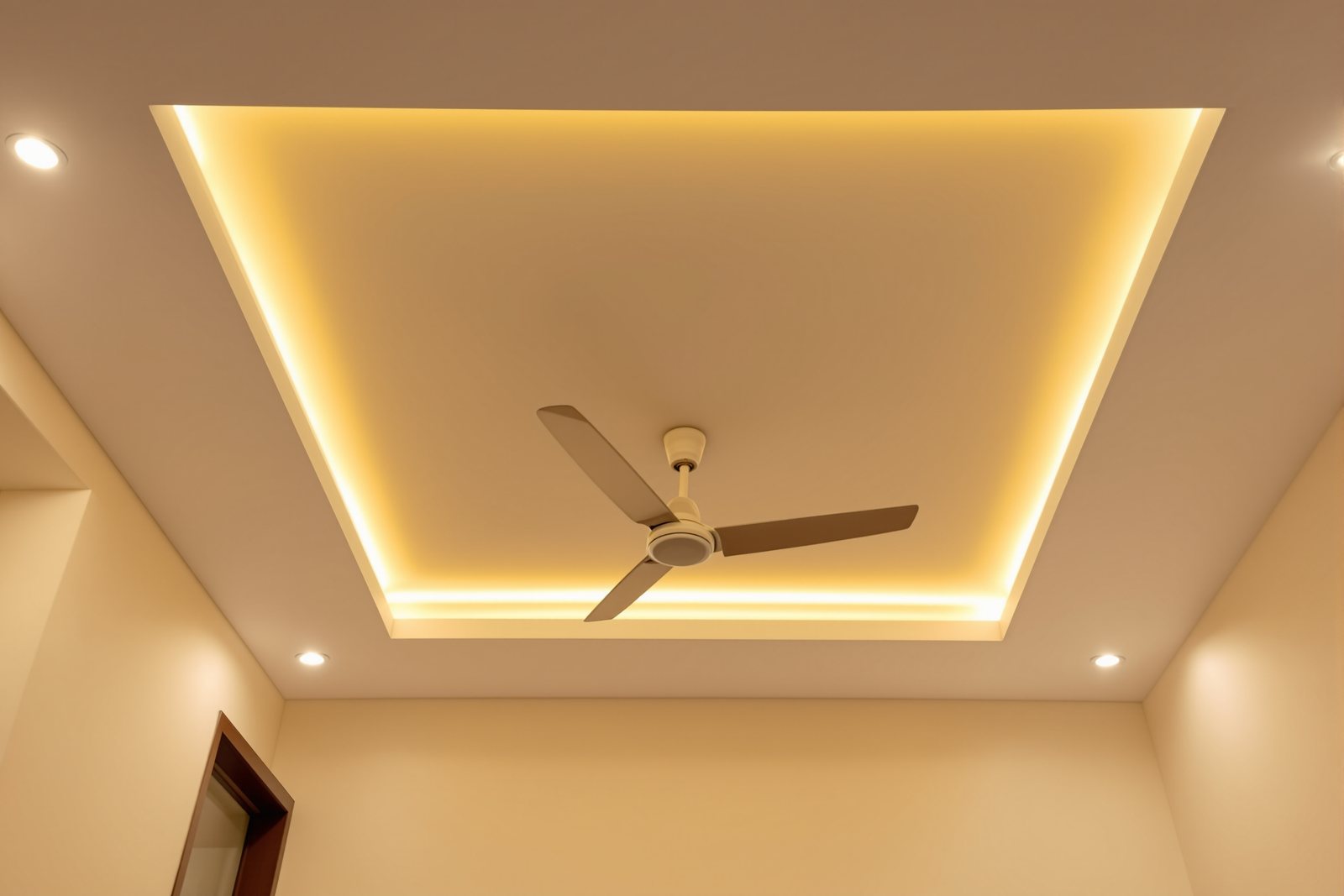
- The bare slab soffit - the plastered, painted underside of the concrete slab. Honest, cheap, and it gives you every last millimetre of height. The default in older homes. - The exposed-services look - the slab left raw with ducts, conduits and pipes on show, painted out in one colour. An industrial style borrowed from cafes and offices; loved for its height and edge. - The gypsum or POP false ceiling - a second skin hung below the slab on a metal frame, made of gypsum board or Plaster of Paris. This is the workhorse of modern Indian interiors. - The cove - a stepped recess running along the edge where ceiling meets wall, built to hide a strip of light that washes upward. The source of that soft, sourceless glow. - The coffered ceiling - a grid of recessed panels (the coffers), giving rhythm and a sense of crafted weight overhead. - The peripheral bulkhead - a dropped border around the room's edge that leaves the centre of the ceiling at full height. The clever middle path, and worth a star.
Most real ceilings mix these: a peripheral bulkhead with a cove tucked into its inner edge and a central pendant or fan in the high middle is the most common "designer" ceiling you will see in a Bengaluru or Pune flat.
What a false ceiling is actually for
Here is the part contractors rarely explain: a false ceiling is mostly about the gap it creates, not the surface you see.
Hang a gypsum sheet 200mm below the slab and you open up a hidden void - and that void is enormously useful. It swallows the air-conditioning ducts, the drainage pipe from the bathroom above, the tangle of electrical wiring, and the recessed light fittings, so none of it shows. The same void lets you bury recessed downlights flush with the surface and tuck a cove lighting strip into a step for indirect glow. It dampens echo, which is why offices and home theatres love it. And by bringing the plane down, it can make a too-tall room feel cosier and a bit easier to cool.
But - and this is the honest part - that void is stolen height. A typical false ceiling eats 150-450mm of floor-to-ceiling height depending on how much service it hides. In a flat that started at 2.7-3.0m, dropping the whole ceiling to 2.4m everywhere can leave a tall person feeling the room press down on them. It also costs real money: a full gypsum false ceiling runs roughly ₹80-160 per square foot installed, and a richly layered POP design more.
So the void earns its keep when it has a job - ducts to hide, lighting to integrate. Where there is nothing to conceal, a false ceiling is just height and rupees spent to look busy.
Light, and the ceiling fan question
The ceiling is where most of a room's light is born, so the two are designed together.
There are three moves, usually combined. Cove lighting hides an LED strip in a recess so the light bounces off the ceiling and pours down soft and shadowless - calm, ambient, flattering. Recessed downlights sit flush in the surface and throw focused pools for tasks and accents. A central pendant or chandelier marks the heart of the room with a single decorative gesture. Layer all three and you can shift one room from bright-and-working to dim-and-restful with a switch.
Then there is the very Indian complication: the ceiling fan. A fan needs the blades a safe distance below the ceiling and clear of your head - and a dropped false ceiling shrinks that gap from both sides. Plan it badly and the fan hangs uncomfortably low or its blades strobe across a downlight, throwing a flicker across the room. The fix is to keep the fan in a high central zone (a peripheral bulkhead leaves exactly that), use a slimmer fan-mount, and place downlights between the blade sweep, not under it. Fans and false ceilings can absolutely coexist - but only if you draw them on the same plan, not one after the other.
The honest trade-off
Put it together and the rule is simple: treat the ceiling for a reason, not for show.
In a generous home with 3.0m-plus heights, ducts to hide and a budget to spend, a full layered ceiling with cove and downlights is a genuine upgrade. In a compact flat already at 2.6-2.7m, blanketing every room in a 300mm-deep false ceiling can quietly make the whole home feel lower and heavier - you lose the one luxury a small flat still had, which is air above your head.
The smart middle is selective. Run a peripheral bulkhead only where the AC duct and wiring actually travel, tuck a cove into it, and leave the centre of the ceiling high and bare. Or make a single feature drop over the dining table and leave the rest as a clean painted slab. You get the lighting and the polish without surrendering height across the whole home.
The ceiling rewards restraint more than almost any other surface. The best ones do their three jobs - height, light, calm - and then disappear.
Three altitudes on the same idea
Read the band that fits you — or all three.
Before you sign off on a false ceiling, ask one blunt question: what is it hiding? If the AC ducts, drain pipe and wiring run through a room, a dropped ceiling there earns its place. If there is nothing to conceal, you may be paying ₹80-160 a square foot to lose 150-300mm of height for purely decorative reasons.
Measure your floor-to-ceiling height first. If you are already at 2.6-2.7m - common in newer flats - be ruthless about where you drop the ceiling. A peripheral border with a cove, or one feature drop over the dining table, gives you the soft light and the finished look without making the whole home feel low. Blanket false ceilings in a compact flat are the single most common way people accidentally make their home feel smaller.
Coordinate the ceiling as a services drawing, not a finish. Pin the required drop from the deepest element passing through the void - usually the AC duct or the sloped drainage from the slab above - and only then set your finished ceiling level. Typical drops: 75-150mm for lighting and minor wiring, 200-300mm where a duct runs, more for a concealed split AC's drain fall.
Specify the right system: gypsum board on a GI framework for clean planar work and fast installation; POP where you want curved or ornate moulded forms. Detail the cove depth and the LED strip's setback so the light grazes the ceiling without a hotspot, keep an access panel near every light driver, and resolve the fan - its downrod length, blade clearance and the downlight layout - on the same reflected ceiling plan. Never let the false ceiling drop the room below a comfortable 2.4m finished height without flagging it to the client.
Think of the ceiling as the overhead plane - the third of the room's defining surfaces, and the one most loaded with feeling per square metre. Where the floor grounds you and the walls enclose you, the ceiling sets the volume overhead: its height is the single strongest lever on whether a space reads as lofty, intimate, or oppressive.
It is also the room's lighting machine. The plane that scatters ambient light, hides the sources, and frames the bright centre is the ceiling. Train yourself to read it: a low, dark, heavy ceiling pulls a room down and quiets it; a high, light one lifts and energises it; a coffered or coved one adds rhythm and crafted calm. The overhead plane is rarely looked at and almost always felt - which makes it the most quietly powerful surface a designer controls.
“Every room needs a false ceiling - it is what makes a home look finished.”
Run the method yourself
This whole lesson lives over your head. Stand up, look up, and find out what your ceilings are actually doing.
- 1Measure the height. Take a measuring tape from floor to ceiling in your main room. Note the number in mm. Under 2.6m is low, 2.7-3.0m is typical, above 3.0m is generous - this number decides how freely you can drop a ceiling.
- 2Hunt for a false ceiling and read its drop. Find a room with a dropped ceiling (or visit a mall or office). Look for the step where it meets the wall and estimate how far it hangs below the original slab - 150mm? 300mm? That is the height it cost.
- 3Tell cove from recessed. Spot the lighting: is there a soft glow with no visible bulb (cove, bouncing off the ceiling) or small circles set flush into the surface (recessed downlights)? Find both in the same space if you can.
- 4Find what the ceiling is hiding. Look for the giveaways of a service void - an AC grille, a flat panel that hides a duct, an access hatch. Ask yourself whether the drop in that spot has a real job or is purely decorative.
- 5Feel the height change. Walk from a room with a high or bare ceiling into one with a low dropped ceiling - a bathroom under a service void is often lowest. Notice the shift in your body: does the low room feel cosier, or does it press down on you? That feeling is the ceiling at work.
The plane that disappears when it works
You have now closed in the room from below, around and above - floor, walls and ceiling, the three planes of the enclosure. But a sealed box is a prison, not a home. Next we cut into it: the openings that let light, air and people pass through. On to **doors and windows**, where the enclosure breathes.
The author
Amogh N P
Architect, interior designer, and creative polymath. Studio Matrx began in his notebooks — his vision of design made honest, useful, and open to everyone. Its Academy is written and taught in his memory, and free, forever.
More about Amogh →