
 Lesson 6.4
Lesson 6.4 · Lighting and Acoustics
Acoustics: Noise, Absorption and Isolation
Why an empty flat booms, why a tiled living room tires you, and the two completely different ways to make a room sound right.
You can hear a bad room before you understand why.
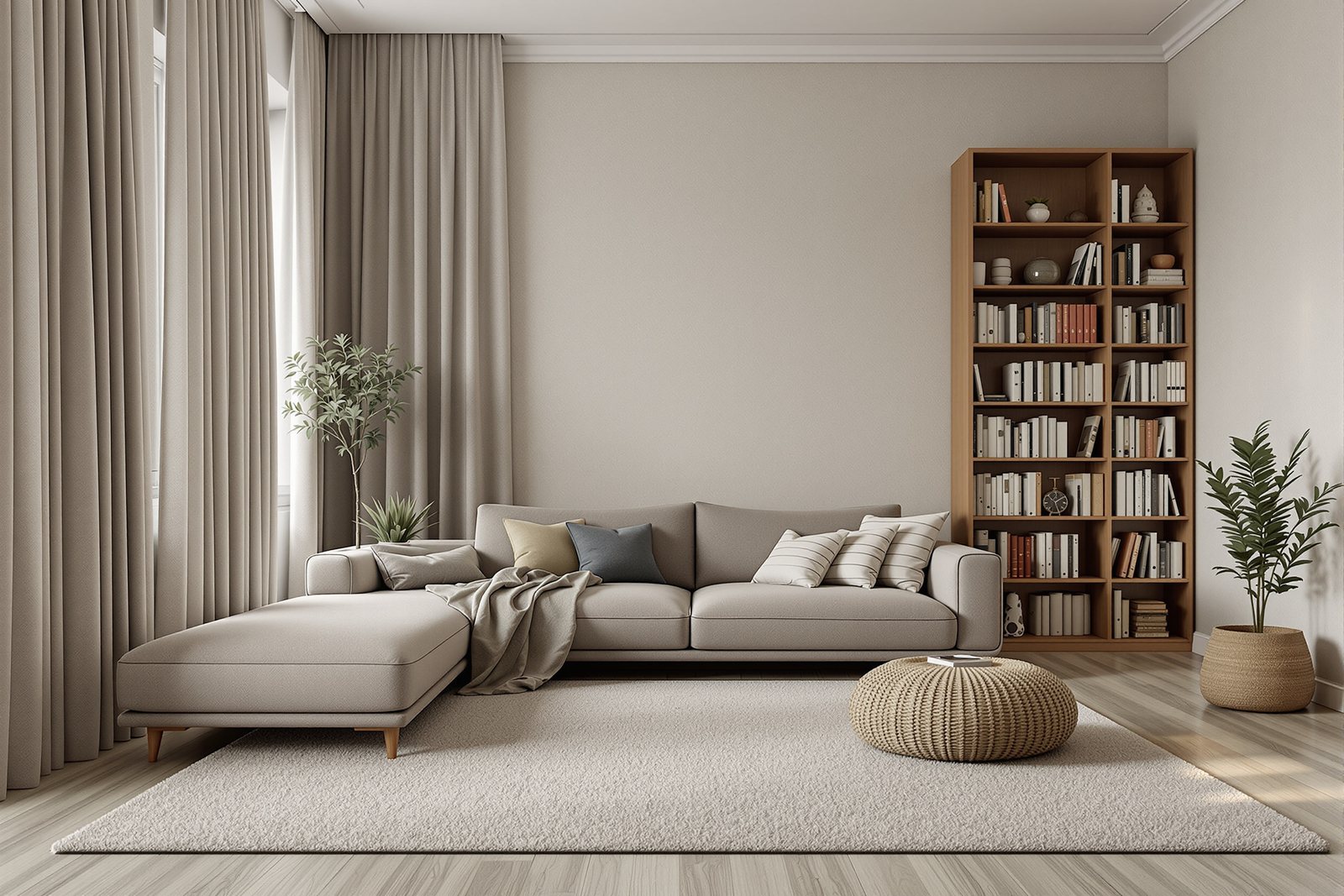
Walk into a brand-new flat before the furniture arrives. You clap, and the sound rings — a hard, hollow boom that hangs in the air for a moment too long. Voices bounce. Your own footsteps sound loud. Now picture that same room a month later: rug down, curtains hung, sofa in place. Clap again and the ring is gone; the room sounds soft and settled. Nothing structural changed. You simply added soft things. That is acoustics — the most-ignored, most-fixable sense in interior design, and once you can hear it, you can never un-hear it.
Split a page in two. Left half: a tiled empty room with a clap drawn as wild arrows ricocheting everywhere — label it 'RINGS -> add soft area (rug, curtains)'. Right half: a wall with a TV behind it, arrows sneaking through the door gap (airborne) and footsteps thudding down through the slab (structure-borne) — label it 'LEAKS -> mass + gap + seal'. Two problems, two cures, one page.
When people say 'noise', they mean two different things
Almost every acoustic complaint is really one of two separate problems, and confusing them is why people spend money on the wrong fix.
The first is reverberation — the echo and ring inside a room. The room sounds harsh, speech is hard to follow, the TV has to go louder, and an evening in there leaves you oddly tired. This is about taming the sound that is already in the room.
The second is isolation — sound passing between spaces. The neighbour's television comes through the wall, footsteps thud from the flat above, traffic leaks in through the window, and you can hear every word from the next bedroom. This is about stopping sound that wants to travel.
The cures are almost opposites. You calm reverberation by adding soft, absorptive area — a rug, curtains, upholstery. You stop transmission with mass, air gaps and sealing. A thicker wall does almost nothing for an echoey room; a rug does almost nothing to keep the neighbour's TV out. Get the diagnosis right first, and you will never waste money on the wrong cure.
Why hard rooms ring: reverberation and absorption
Sound is energy bouncing around. When it hits a hard, smooth surface — vitrified tile, glass, a polished stone floor, bare plaster, a glossy laminate — almost all of it reflects and keeps bouncing. The Indian flat is full of exactly these surfaces, which is why a freshly finished, unfurnished room booms: there is nothing to soak up the energy.
The measure of this is reverberation time — roughly, how long a sound takes to fade away after the source stops. A long reverberation time (a tiled, glassy, empty room) sounds live, harsh and tiring. A short one sounds calm, intimate and clear. You shorten it by adding sound-absorption: soft, porous things that let sound enter and turn its energy into a tiny bit of heat instead of bouncing it back — rugs, fabric curtains, an upholstered sofa, cushions, a soft false ceiling, even a shelf of books.
How well a material absorbs is rated by its noise reduction coefficient (NRC) — a number from 0 (a mirror for sound, like glass or tile) to about 1.0 (a thick acoustic panel that swallows nearly everything). A bare tiled living room might sit near 0.05; throw down a wool rug and hang heavy curtains and you have transformed the room without touching a single wall.
Tune a room by ear, before you spend a rupee
Reverberation is wonderfully democratic to fix, because the cure is just soft area, and you can preview the effect before buying anything.
Think in priority order. The floor is usually the largest hard surface in the room, so a generous rug is the single highest-impact move. Then the windows — full, heavy curtains gathered with extra fabric absorb far more than thin flat ones. Then the seating — a fabric-upholstered sofa absorbs; a leather or cane one barely does. Then the ceiling, the second-largest plane, where a soft or perforated false ceiling does quiet, invisible work. Even a wall of books, with all their irregular spines and pages, scatters and soaks up sound.
This is exactly what our Room Acoustics Tuner lets you feel. Start with a bare, hard room and watch the echo meter sit at ringing. Drop in a rug, the needle falls. Add curtains, it falls again. Add an upholstered sofa, a soft ceiling, a bookshelf — and watch the room move from ringing to calm. The lesson lands in your hands in seconds: it is the total soft, absorptive area that quiets a room, not any one magic object.
Why sound gets in: airborne and structure-borne paths
Isolation is a different game, and it starts with understanding how unwanted sound arrives. There are two paths.
Airborne noise travels through the air and through any gap it can find: the neighbour's TV, voices, traffic, music. Here the great enemy is leakage. A 10 mm undercut gap below a door, a hollow flush door, an open kitchen, an ill-fitting window — sound pours through these exactly the way light pours under a door in a dark room. If light can get through, so can sound. A single unsealed gap can undo an otherwise solid wall, because sound takes the easiest path it can find.
Structure-borne noise travels as vibration through the solid building itself: footsteps and dragged chairs from the flat above, a neighbour drilling into a shared wall, the building's lift machinery, a pump. Because it rides through concrete and brick, soft furnishings inside your room do nothing for it — the sound is being delivered through the structure and radiated straight into your space. This is the harder, sneakier problem, and the reason a thick rug never silences the upstairs neighbour's heels.
The three tools of blocking sound: mass, gap, seal
To keep sound out — to achieve sound-insulation — you have exactly three levers, and serious isolation uses all three together.
Mass. Heavy, dense, solid barriers resist being vibrated by sound, so they pass less of it. A solid-core door blocks far more than a hollow flush door; a 230 mm brick wall blocks more than a thin partition; double glazing more than single. When in doubt, heavier and denser wins.
Air gap and decoupling. If two layers are rigidly connected, vibration bridges straight across; separate them with an air gap or a resilient layer and that bridge breaks. This is why two leaves of wall with a cavity beat one thick wall of the same weight, and why an upstairs floor needs a soft underlay to stop footstep vibration from coupling into the slab.
Sealing. Sound is a fluid that escapes through every gap, so a barrier is only as good as its weakest leak. Seal the door's perimeter, fit a drop seal or threshold to close the undercut, caulk the gaps around windows and service penetrations. The cheapest, highest-return isolation move in most Indian homes is simply sealing a door: a solid-core door with proper edge seals and a closed undercut quietly transforms a bedroom beside a noisy lift lobby or living room.
Hands-on
Start with the bare tiled room ringing at the top, then add soft surfaces and watch the meter fall — the floor rug usually does the most because the floor is the largest hard plane. Note this only tames echo inside the room; it does nothing to block the neighbour’s TV, which needs mass and sealing.
Three altitudes on the same idea
Read the band that fits you — or all three.
Diagnose before you spend. Clap in the room: if it rings, you have an echo problem and the fix is soft — a large rug, full heavy curtains, a fabric sofa, soft cushions. If you can hear the neighbours or the lift, you have an isolation problem, and soft furnishings will not help; you need a solid-core door, seals around it, and a closed gap under it. For a home theatre or music room, do both: heavy absorption inside for clean sound, plus a sealed solid door so the rest of the house gets peace. The two cheapest, most transformative moves in an Indian flat are a good rug and a properly sealed bedroom door.
Treat acoustics as a brief item, not an afterthought, and specify it. For reverberation, estimate the room's hard-to-soft surface ratio and target a comfortable reverberation time for the use — short for media and bedrooms, slightly livelier for social spaces — by specifying absorptive area: rug coverage, curtain fullness, NRC-rated ceiling or wall panels. For isolation, write mass-air-seal into the detail: solid-core doors with perimeter and drop seals, decoupled or resilient-mounted partitions for party walls, floating or underlaid floors above noisy slabs, and sealed service penetrations. Crucially, separate the two on drawings and schedules so the contractor does not 'solve' an echo with a thicker wall.
Lock in the mental model that absorption and isolation are independent variables. Absorption (NRC, reverberation time) governs how a room sounds from inside; isolation (mass, decoupling, sealing) governs what passes through the boundary. A perfectly absorptive room can still leak every word to the next flat; a perfectly isolated room can still ring like a bell inside. In practice, sketch the two flowcharts: 'room rings -> add soft area' and 'sound transmits -> add mass, break the path, seal the gaps'. Then practise hearing it — clap in every room you enter and predict its reverberation before you reason about why.
“If a room echoes badly, I need thicker, heavier walls to fix it.”
Run the method yourself
Spend twenty minutes turning your ears on. Acoustics is the one design sense you can train almost instantly, just by listening with intent.
- 1Walk into the hardest room in your home — the tiled, glassy, least-furnished one — and clap once, sharply. Listen to the ring hang in the air. Now go into your most furnished, curtained, carpeted room and clap again. The difference you hear is reverberation, and it is entirely about soft surfaces.
- 2Open the Room Acoustics Tuner and start with the bare hard room, meter sitting at ringing. Add a rug, then curtains, then an upholstered sofa, then a soft ceiling, then a bookshelf — and watch the echo meter fall toward calm. Notice it is the total soft area that wins, not any one item.
- 3Switch off the lights in a room at night and look for light leaking under the door. That same gap is where airborne sound leaks. Press a rolled towel against the undercut while someone talks on the other side and hear how much the gap was leaking.
- 4Stand still in a quiet moment and sort the sounds you hear into two buckets: airborne (traffic through the window, voices through the wall) and structure-borne (footsteps above, a distant drill, the lift). Notice that the structure-borne ones would survive even if you sealed every gap.
- 5Pick the one room that bothers you most and write its real diagnosis: 'rings inside' (needs absorption) or 'leaks from outside' (needs isolation), or both. Then list the single cheapest move for each — usually a rug for the first, a sealed solid-core door for the second.
Hear the room, then choose the right cure
That closes Module 6 — you can now shape both the light and the sound of a room, the two invisible atmospheres that decide how a space _feels_. Next we turn to the visible, touchable layer: **finish materials**, the actual surfaces of a room. And as you will see, those choices are never just about looks — every glossy tile, soft fabric and dense slab you specify is _also_ an acoustic decision, quietly making a room ring or calm.
The author
Amogh N P
Architect, interior designer, and creative polymath. Studio Matrx began in his notebooks — his vision of design made honest, useful, and open to everyone. Its Academy is written and taught in his memory, and free, forever.
More about Amogh →