
 Lesson 1.3
Lesson 1.3 · The Interior Space
Building Services: The Hidden Half
Water, drainage, power, air and data - the systems you can't see but must plan around
The Half of Your Home You Will Never See
Switch on a tap, flick a light, feel the cool breath of a split AC. Each tiny act rides on a hidden network buried in your walls, floors and ceilings. Move it carelessly and the loveliest room turns into a damp, leaking apology. This lesson is about respecting the invisible half before you draw a single wall.
Pipes don't read your moodboard. Gravity wins every argument.
The invisible systems that make a room habitable
A room is not just floor, walls and ceiling. Threaded through that shell is a quiet bundle of building services — the systems that carry water in, carry waste out, deliver power, move air and now carry data. In a typical Indian home this means a CPVC or PVC water-supply line feeding taps and the geyser, a drainage and sewerage network ending at the soil stack, a concealed electrical layout running back to the distribution board and its MCBs (often with an inverter or UPS feeding a few backup points), split-AC piping with its condensate drain, sometimes a piped LPG line, and the cabling for broadband, TV and Wi-Fi.
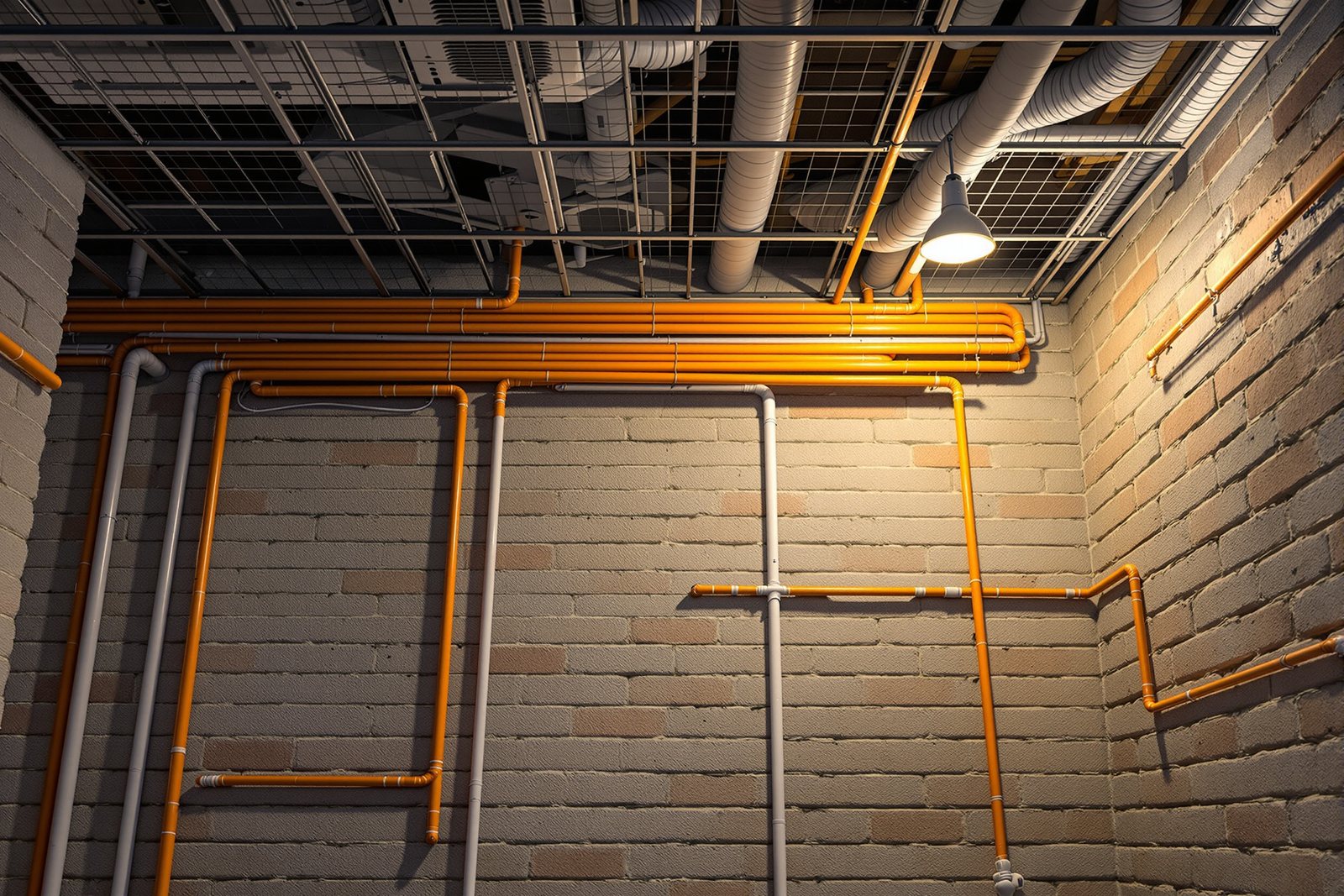
You notice none of it when it works. You notice all of it the day a slab leaks onto the floor below, or a tripping MCB plunges half the flat into darkness. The figure shows these routes cut away through a single room — supply in blue, waste in grey, power in red, air in green — so you can see how densely a calm-looking space is actually wired and plumbed.
Why drainage rules the plan
Of all the services, drainage is the tyrant — because it runs on gravity, not pressure. Waste water has to fall towards the soil stack, so every horizontal drain needs a steady slope, usually around 1:40 to 1:100 depending on pipe size. A 110 mm WC branch at roughly 1:40 drops about 25 mm per metre of run; push the WC too far from the stack and either the pipe disappears into the floor or it simply will not flow.
This single fact quietly dictates your layout. A water closet, a kitchen sink, a washing-machine point — none of them can wander far from where the stack drops through the building. Water supply is forgiving because it is pressurised and the pipes are thin; drainage and the soil stack are not. When a client says "can we just shift the toilet to the other corner?", the honest answer usually begins with where the stack is.
Wet areas want to stack and cluster
Because drainage is fussy, the smartest plans gather all the wet areas together. Kitchens and bathrooms should sit close to a common plumbing shaft — that vertical duct, often 450 mm to 900 mm wide, where supply risers and waste stacks travel between floors. Better still, they should line up vertically: the bathroom on the third floor over the bathroom on the second over the one on the first, all draining into the same stack.
The figure shows this in plan — toilets and the kitchen drawn tight against one shaft rather than scattered to the four corners of the flat. Cluster them and the pipe runs stay short, slopes stay easy, future leaks stay findable. Scatter them and you buy long buried drains, fragile falls, and a maintenance nightmare. In apartment work this is non-negotiable: you almost never get to move the shaft, so your wet rooms come to it.
Where the services hide
Services survive by hiding, and there are only a few places for them to go. Horizontal pipes and the AC condensate line tuck into the false ceiling void. Vertical supply and waste travel the plumbing shaft. Electrical conduits and thin water lines are buried in a chase — a groove cut into the masonry, filled over with plaster, which is why we call it concealed wiring. And drainage often hides in the floor screed, the levelling layer poured over the structural slab.
The section figure stacks all of this: slab at the bottom, screed and finish above it, a chase running up the wall, the false-ceiling void overhead, and the shaft cutting through everything vertically. Each void has a budget. A false ceiling typically eats 150 mm to 300 mm of height; a chase can only go so deep before it weakens the wall. Knowing how much room each hiding place really offers is half of services planning.
Coordinate early, or pay later
Here is the whole lesson in one line: services must be coordinated before the layout is locked, not after. Electrical points, switch heights and socket positions have to be marked before plastering. Miss one and your choices are ugly — re-cut a finished, painted wall to chase it, or run a surface conduit that announces your mistake forever.
Numbers help you commit. General-purpose sockets usually sit around 300 mm above floor; switchboards at 1200 mm; a kitchen counter point at 1100 mm to 1200 mm; a geyser point high, around 1800 mm to 2000 mm. A split AC needs both an indoor mounting height near the ceiling and a condensate drain that actually slopes out to a gully, plus outdoor-unit space on a ledge or wall. Get these onto the drawing during planning and the trades flow smoothly. Leave them to "sort out later" and later means leaks, dampness, rework, and a design quietly compromised to fit pipes you forgot.
Three altitudes on the same idea
Read the band that fits you — or all three.
Before you fall in love with a layout, ask one blunt question: "where does the water go out?" Find out where the soil stack and plumbing shaft are, because they decide where your kitchen and bathrooms can sensibly sit. Insist that every socket, switch and AC point is marked on a drawing and approved by you before plastering — after that, changes mean breaking walls.
Lock your services layout before finishes. Issue coordinated drawings: a plumbing layout keying every wet point to the soil stack with branch slopes called out (~1:40 for 110 mm waste, gentler ~1:60–1:100 for larger runs), and an electrical layout with point heights specified — sockets 300 mm, switchboards 1200 mm, geyser 1800–2000 mm, counter points 1100–1200 mm. Mark the AC condensate route falling to a drain, allocate outdoor-unit space, and confirm false-ceiling void (150–300 mm) against your beam soffits before promising a ceiling height.
The governing principle is that drainage works by gravity, everything else can be routed. Because waste must fall at a fixed slope, the position of the soil stack is effectively a fixed point that the plan must obey, while pressurised supply and electrical wiring are flexible and can chase wherever needed. Derive the rest from there: cluster wet areas to keep gravity runs short, then hide the flexible services in chases, screeds and ceiling voids.
“Services can be sorted out at the end, once the walls and rooms are decided.”
Run the method yourself
Put the book down and go on a services hunt through your own home.
- 1Find your soil stack: open the bathroom or peer down the back of the WC and trace the thick vertical pipe (usually 110 mm) where waste drops away. Note which wall it hugs.
- 2Locate the distribution board: find the small metal box of MCBs, usually near the entrance or kitchen. Open the cover, count the switches, and see which one feeds your inverter/UPS backup points.
- 3Hunt the plumbing shaft: in the kitchen or bathroom, look for the boxed-in vertical duct (often a tiled or removable panel) where supply and waste risers run between floors.
- 4Count the power points in one room: tally every socket and switchboard, measure a couple of heights with a tape, and ask whether each one actually sits where you would want it.
- 5Trace your split AC's condensate drain: follow the thin pipe from the indoor unit and find where it finally drips out — onto a balcony, a wall, or a gully — and check it slopes downward.
The hidden half, made visible
Now that you know the hidden half exists, the next lesson teaches you to read an existing space — surveying its structure, services, light and condition before you dare to design.
The author
Amogh N P
Architect, interior designer, and creative polymath. Studio Matrx began in his notebooks — his vision of design made honest, useful, and open to everyone. Its Academy is written and taught in his memory, and free, forever.
More about Amogh →