
 Lesson 5.3
Lesson 5.3 · Environmental Systems
Electrical and Wireless Systems
How power enters, divides, and reaches every point where life actually happens — and the wiring you must plan before the plaster goes up.
One wire comes in. Sixty points need power. The plan in between is yours.
A single supply cable enters your home at the meter, and from that one thread the electrician must feed every light, fan, charger, geyser and air-conditioner — each at the right current, each protected, each switchable from where a hand reaches. Get the division right on paper and the home simply works. Get it wrong and you are chasing open walls after the plaster has dried.
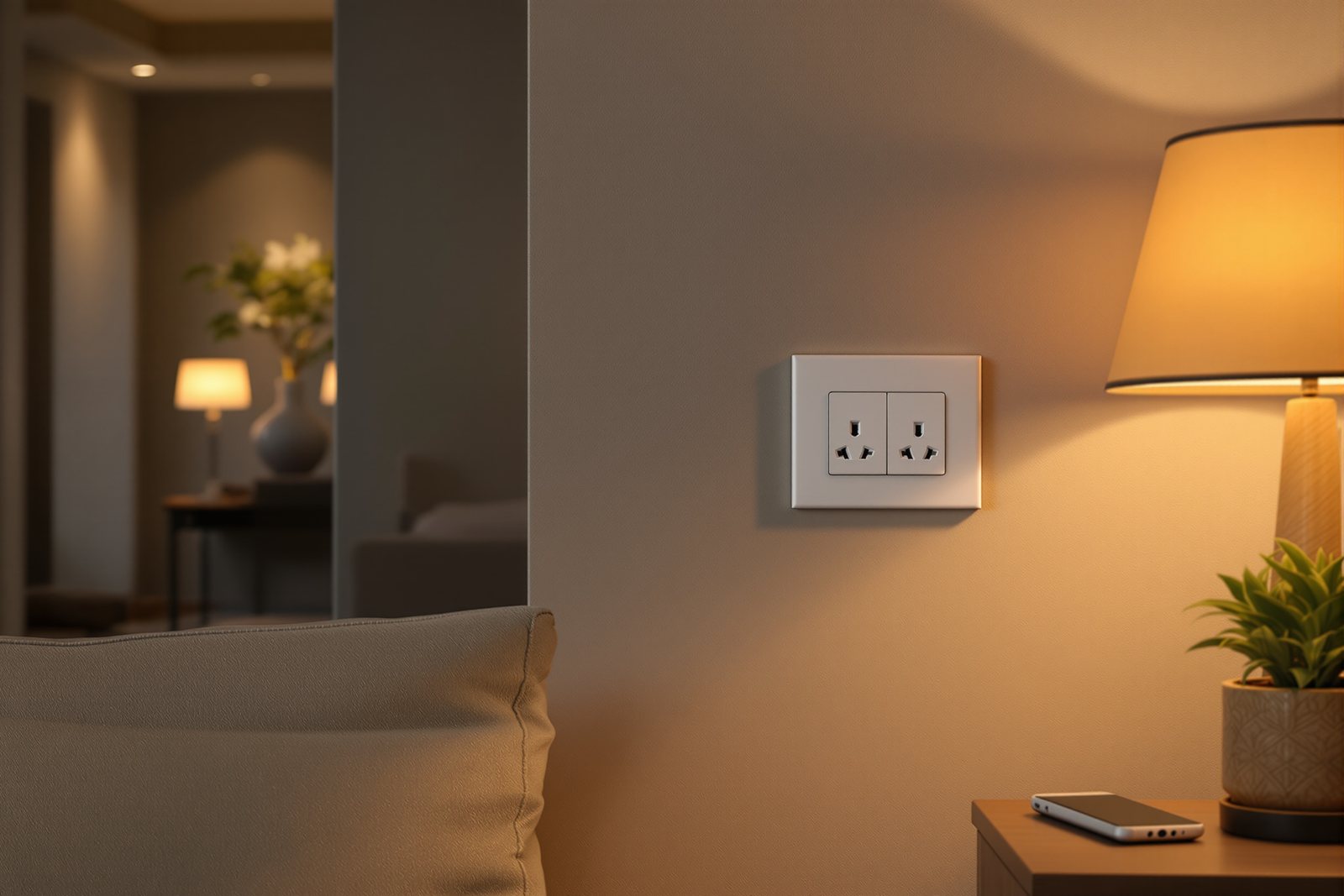
A grey distribution board with one fat wire entering the top and a fan of thin labelled wires spraying out the bottom — lights, kitchen, geyser, AC — each ending in a tiny wall socket.
How power arrives and gets divided
Power reaches an Indian home as a service connection from the utility — typically 230V single-phase for apartments and most houses, or three-phase (415V between phases) where the load is heavy. It lands at the energy meter, then a main switch that lets you kill everything at once, and finally the distribution board — the consumer unit, that grey box of clicking switches near your entrance.
Inside the DB, that single incoming supply is split into many circuits. Each circuit is one cable run leaving on its own little switch, feeding one group of points — say all the bedroom lights, or the kitchen sockets. Think of the DB as a railway junction: one main line in, many platforms out, each with its own signal. The art of electrical design is deciding how many platforms you need and what travels on each.
You do not design the meter or the supply cable — the utility does. But everything downstream of that DB is your drawing, and it decides whether the home is convenient and safe or a maze of extension cords.
The three protections everyone confuses
An Indian home needs three separate forms of protection, and people mix them up constantly. They do different jobs.
The MCB (miniature circuit breaker) is the little switch per circuit. It trips when too much current flows — an overload (you plugged in more than the cable can carry) or a short-circuit (live touches neutral). It protects the cable from overheating and catching fire. A 6A MCB guards a lighting circuit; a 16A/20A/32A MCB guards heavier ones.
The RCCB (residual current circuit breaker, sometimes called an ELCB) protects you. It compares the current flowing out on live against what returns on neutral. If even 30mA is leaking away — through a person, through wet insulation — it trips in milliseconds. An MCB will happily let a fatal shock pass; only the RCCB catches earth-leakage.
Earthing is the third leg: a dedicated wire connecting every metal appliance body to a buried earth electrode, giving fault current a safe path to ground. It is what lets the RCCB sense a leak and what stops a geyser shell from going live. MCB guards the wire, RCCB guards the person, earthing gives faults somewhere safe to go — you need all three, not a choice between them.
Why everything gets its own circuit
Most home wiring is radial — a cable leaves the DB, runs to a string of points, and ends. The temptation is to put everything on one fat circuit. Resist it. Separate circuits earn their cost.
Keep lights on their own circuit (or two), so when a faulty iron trips the power circuit, you are not plunged into darkness mid-tripping. Keep general power sockets separate by zone. Give the kitchen its own heavy circuits — toasters, microwaves, mixers and induction tops draw hard, and a kitchen socket circuit on 16A with 2.5 sq mm cable is sized for it. The geyser gets a dedicated circuit with its own MCB, because a 3 kW/4.5 kW heater on a shared line is a recipe for nuisance tripping. Each air-conditioner gets its own circuit too — a 1.5-ton AC pulls 6–8A running and far more at start-up, on 2.5 sq mm or 4 sq mm cable.
The logic is always the same: heavy loads get the right cable thickness and the right MCB, and faults stay contained to one room's worth of life instead of taking down the whole flat.
Connected load, and sizing what you ask the supply for
Add up the wattage of every appliance you own and you get the connected load — and it is always alarmingly large. Lights, fans, two ACs, a geyser, fridge, microwave, washing machine, iron: easily 12–15 kW on paper. But you never run them all at once. The kettle and the iron and both ACs blazing simultaneously is rare.
So the supply is sized on diversity — a realistic estimate of how much runs together, often half or less of the connected total. This is why you might sanction a 5 kW or 7 kW supply for a home whose appliances sum to far more. Push past it and the main MCB trips; size it too generously and you pay higher fixed charges.
This is where you reach for the circuit-load estimator. Tick the appliances you expect on a single circuit, and it totals the load in kW and amps and tells you whether it fits a 6A lighting MCB or needs a 16A power circuit with thicker cable. It turns the abstract sum into a clear yes-or-no for each run before the electrician ever cuts a wire.
Placing points, heights, and the wireless layer
A circuit is useless if the socket is in the wrong wall. Plan points where life actually happens: a pair beside each side of the bed for lamps and chargers, a bank above the study desk, a generous row along the kitchen counter at backsplash height, a spot by the sofa for the inevitable phone charging, a point behind the TV, near the dining table for a hot-plate. Walk the room in your mind and ask where a plug will be wanted, then add one more.
Standard heights keep a home coherent: switch plates around 1200mm above floor; general sockets at 300mm for a clean low line, or 1100mm over counters; kitchen-appliance and AC points placed for their machine. Mark them on plan, not by guess on site.
Layer in the low-voltage and wireless services early too. Place the Wi-Fi router centrally and high, away from the metal DB and the microwave, and run structured data cable to it; plan points for CCTV, intercom, doorbell and any smart switches, which still need a neutral at the switch box. Finally, decide which circuits ride the inverter/UPS backup — a few lights, fans, the router, one TV point — and wire them to a separate backup DB so essentials stay alive when the grid drops.
Hands-on
Watch what happens when you add the geyser or the AC: a single heavy appliance pushes the current past what a normal socket circuit can carry, which is exactly why those get their own dedicated run with thicker cable and a bigger MCB.
Three altitudes on the same idea
Read the band that fits you — or all three.
Walk through your home and list every spot where you have ever stretched an extension cord — that is your shortfall. Insist on a separate circuit for the geyser and each AC, an RCCB on the whole board, and proper three-pin earthed sockets in wet areas. Ask your electrician to mark every switch and socket on the plan before plastering, and add chargers at the bedside and sofa now, because adding them later means breaking the wall.
Coordinate the electrical layout with your furniture and joinery drawings, not after them — a socket behind a fixed wardrobe is a dead socket. Issue a points layout with heights and a DB schedule listing every circuit, its MCB rating, cable size and the load it serves. Specify the inverter circuits explicitly and segregate the backup DB. Confirm RCCB and earthing on every sheet; these are the items that trigger liability if they are quietly omitted on site.
Learn to read a single-line diagram of a DB: incomer, main switch, RCCB, then the row of MCBs each labelled with its circuit and rating. Practise sizing — match cable cross-section to MCB rating to load (1.5 sq mm/6A for lights, 2.5 sq mm/16A for power, heavier for geysers and ACs). Understand why MCB, RCCB and earthing are three different devices solving three different failures; explaining that distinction clearly is a sign you have truly grasped electrical safety.
“An MCB protects you from electric shock, so if the board has MCBs the home is safe.”
16A MCB. Shock protection comes from the RCCB, which senses earth-leakage and cuts power in milliseconds, working together with proper earthing. A home with MCBs but no RCCB is protected against fire, not against electrocution.Run the method yourself
Turn theory into a real layout. Take one room you know well and work it through end to end.
- 1Sketch the room and mark, from memory, every place you would actually want a socket — bedside, desk, counter, sofa, TV — then deliberately add one more spot you almost forgot.
- 2Group your marks into circuits: which points are lighting, which are general power, and what needs its own dedicated run like a geyser or AC.
- 3Open the circuit-load estimator, tick the appliances you expect on your busiest circuit, and read off whether the total fits a
6Aor16AMCB or needs thicker cable. - 4Find your home's distribution board and identify the main switch, the RCCB, and three MCBs — name out loud what circuit each one feeds.
- 5Set heights for every switch and socket on your sketch (
1200mmswitches,300mmor counter-height sockets) and circle anything that would land behind future furniture.
Power is a plan, not an afterthought
Wiring that is safe and convenient still has to satisfy the rules that govern it — and the people who must escape, reach, and use the space. Next we turn to the codes, fire-safety provisions and accessibility requirements that turn good intentions into compliant, humane design.
The author
Amogh N P
Architect, interior designer, and creative polymath. Studio Matrx began in his notebooks — his vision of design made honest, useful, and open to everyone. Its Academy is written and taught in his memory, and free, forever.
More about Amogh →