
 Lesson 5.4
Lesson 5.4 · Environmental Systems
Codes, Fire Safety and Accessibility
How the distilled memory of past disasters becomes the quiet rules that let everyone get in, move around, and get out alive.
Somebody died so you would know to make the door swing the other way.
It feels harsh to say, but it is the truest thing about codes. Almost every line in a fire or accessibility code is a scar. A crowd that crushed against a door opening inward. A ramp too steep for a wheelchair to climb. A locked exit in a burning hall. The code is simply the memory of those moments, written down so the next designer does not have to learn the lesson the same way.
A single doorway drawn twice side by side: on the left it swings inward with a little crowd of stick figures crushed against it and an X; on the right the same door swings outward into open air with the figures streaming through and a tick. Beneath, a small ramp labelled 1:12 with a wheelchair gliding up it.
The code is a memory, not a nuisance
When a builder grumbles about the sanction process, it is easy to absorb the idea that codes are bureaucratic friction — boxes to tick on the way to building. Unlearn that now. The National Building Code of India, in its 2016 form, is the country's collected wisdom on how not to get people killed inside buildings, gathered across decades and tragedies. Each clause earned its place.
As an interior designer you will not touch most of the NBC — you are not sizing beams or designing drainage. But a surprising amount lands squarely in your lap. You shape how people enter a space, how they move through it, how they get out when something goes wrong, and whether a person using a wheelchair or pushing a pram can use it at all. The NBC governs occupancy and how many people a space may hold, means of escape, fire protection, ventilation and daylight, and accessibility. Every one of those is decided partly by furniture, partitions, doors, and finishes — which is to say, by you.
One idea to carry through everything below: codes are minimums, not aspirations. A 1:12 ramp is the steepest you are allowed, not the target. A clear door width is the narrowest acceptable, not the goal. Meeting code means you have done the least the law permits. Good design starts there and gets kinder.
Means of escape: the geometry of getting out
Fire safety, for an interior designer, is mostly one idea wearing several hats: means of escape. When a room fills with smoke, people must be able to leave quickly, in the dark, possibly in panic — and your layout decides whether they can.
Start with travel distance: how far someone must walk from the most remote point in a space to reach an exit. The code caps it, because beyond a certain distance smoke overtakes you before you reach the door. Larger or higher-risk spaces need shorter distances and often two separate ways out, placed apart so a single fire cannot block both at once. If your beautiful open-plan layout leaves one corner where the only path to the door is forty metres long and passes the kitchen, you have designed a trap.
Then the door itself. Exit doors swing outward, in the direction of escape, and this is not a stylistic choice. A crowd pressing toward an inward-opening door pins it shut with their own bodies; people have died inches from a door that would not open. An exit door must also stay unobstructed and unlocked while the space is occupied — never bolt it, never park a console table or a planter in front of it, never let a sofa drift across the only way out. These are the interior-designer sins that kill: locked exits, blocked exits, and the slow creep of furniture into an escape route.
Containing the fire: compartments, detectors, and extinguishers
Getting people out is half the job; the other half is slowing the fire down so they have time. This is compartmentation — the building is divided into pockets separated by fire-resisting walls and fire-rated doors that hold back flame and smoke for a rated period, say sixty or ninety minutes. Those doors only work if they can close. An interior designer who wedges a fire door open for convenience, or swaps it for a pretty hollow one, has quietly removed a wall the engineers were counting on.
Finishes matter too. Combustible cladding and highly flammable wall and ceiling materials turn a small fire into a fast one and fill escape routes with toxic smoke. Along exit paths especially, lean toward materials that resist flame and produce little smoke.
Detection and firefighting are the last layer. Smoke detectors belong on ceilings where rising smoke collects — in rooms, corridors, and near sleeping areas — so the alarm sounds while escape is still easy. Fire extinguishers go on escape routes and near specific hazards: by the kitchen, near electrical panels, at exits and corridor junctions, mounted so a person can see and reach them without hunting. The rule of thumb is that you should never be far from one along the path you would actually run.
Universal design: making a space everyone can use
Accessibility is often imagined as a special accommodation for a few. It is the opposite. Universal design means building so the widest range of people can use a space without adaptation — and it quietly helps everyone: an elder with a stick, a parent steering a pram, a delivery person with a trolley, you yourself the month you break an ankle. India's Harmonised Guidelines for accessibility and the intent of the RPwD Act make this a baseline expectation, not a favour.
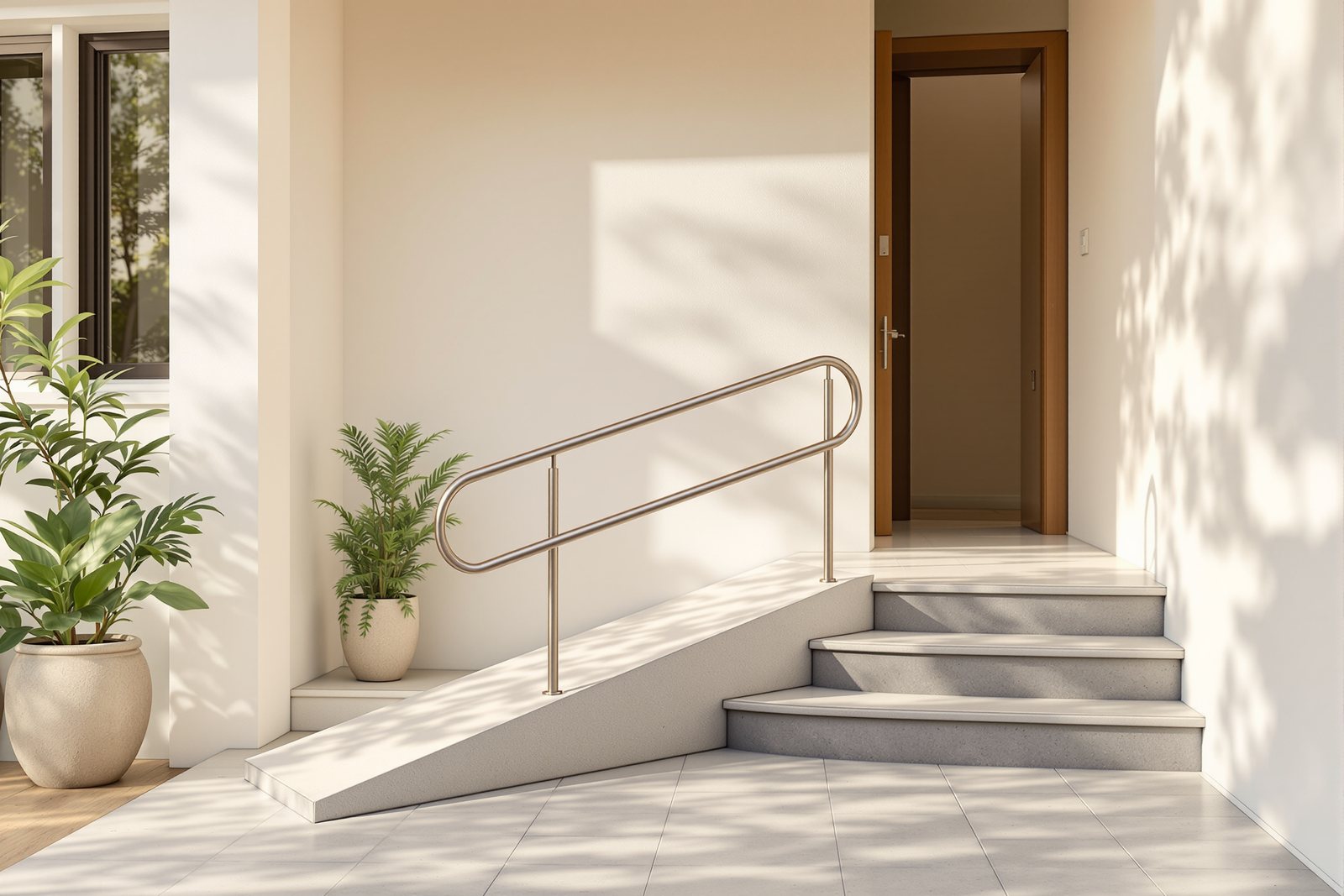
The core dimensions are easy to remember. A level change crossed by a ramp should not exceed a 1:12 gradient — one unit of rise for every twelve of length — and gentler is always better for the person pushing themselves up it. Entries should be level or zero-threshold: no lip to catch a wheel or a toe. Doors need a clear width of around `900mm` so a wheelchair passes without scraping knuckles. Inside, you need a `1500mm` turning circle — clear floor for a wheelchair to rotate fully — in any room someone must manoeuvre in, especially bathrooms and at the foot of a bed.
Finally, the small things that decide everything: lever handles, not knobs, because a closed fist, an arthritic hand, or an elbow can work a lever and cannot grip a round knob. Universal design is mostly a series of such mercies.
The accessible WC, ramps you can check, and getting it sanctioned
The accessible toilet is where universal design is tested hardest, because it asks for independence in the most private act. It needs the 1500mm turning circle of clear floor, a WC set at a height a person can transfer to from a wheelchair, clear transfer space beside the pan, and grab bars — fixed, load-bearing rails on the wall and beside the WC that a person hauls on to move between chair and seat. Add a lever tap, a basin with knee clearance beneath, and a mirror low enough to use seated, and the room serves nearly everyone.
Before you commit a ramp to drawings, sanity-check the geometry. Open the Ramp Slope Checker in this lesson: enter the rise — the vertical level change you must overcome — and it returns the ramp length needed at 1:12, with a green or red mark on whether a ramp you have in mind actually meets the gradient. It makes the brutal truth visible fast: a 600mm step needs 7200mm of ramp, and there is no negotiating with that.
A word on approvals. Interiors that change layout, occupancy, or fire arrangements may need sanction from the local authority, and your drawings become part of that record. Treat the codes as the floor of your ambition, not the ceiling — sanction confirms you met the minimum; your conscience decides whether you went further.
Hands-on
A 1:12 ramp needs twelve units of length for every one of rise — so even a single 150 mm step becomes a 1.8 m ramp, and a 600 mm porch needs a daunting 7.2 m. There is no negotiating with the gradient; if the run will not fit, you find another route.
Three altitudes on the same idea
Read the band that fits you — or all three.
You have more power here than you think. When you renovate, refuse the small dangerous conveniences: don't let anyone lock or block your main exit, keep a clear path from every bedroom to the door, and put a smoke detector in the corridor near where you sleep and an extinguisher by the kitchen. If anyone in your life is ageing or might one day use a wheelchair — and that is most families — ask for level thresholds, a 900mm door to the bathroom, and lever handles now. They cost almost nothing during work and are painful to retrofit later.
On every project, walk the escape route before you finalise furniture: trace the longest path to an exit, confirm doors on that path swing outward and stay clear, and never let a layout depend on a single blocked-able exit for a crowded room. Specify fire-rated doors that self-close, flag combustible finishes on escape routes, and mark detector and extinguisher positions on your drawings rather than leaving them to chance. Build the 1500mm turning circle and 900mm clear widths into your plans from the first sketch — accessibility designed in is invisible; accessibility bolted on always shows.
Train your eye on real spaces. Next time you are in a cinema, mall, or college hall, find the exits: count them, check which way they swing, see if anything blocks them, and look for the green running-man signs and the extinguishers. Then find one space that fails an accessible person — a stepped entry with no ramp, a 750mm toilet door, a knob where a lever should be — and redraw it fixed. Doing this a dozen times wires the code into your instincts so you never have to look it up under pressure.
“Fire and accessibility codes are extra costs that make a design worse, so a good designer meets the bare minimum and moves on.”
1:12 ramp is the steepest the law tolerates, not the kindest; a clear door width is the narrowest, not the best. Safety and accessibility rarely make a design worse. A clear escape route is also a calm, legible space, and a level threshold a wheelchair rolls over is the same threshold a suitcase, a pram, and your own tired feet glide across. Good design starts at the code and chooses to be gentler.Run the method yourself
Pick a real room you can stand in — your home, studio, or a café. Spend twenty minutes auditing it the way a code officer would, and the rules stop being abstract.
- 1Trace the escape: stand at the spot farthest from the door and walk the path you would take in smoke. Note anything you would trip over or have to swing around. That is your travel distance — and your hazards.
- 2Check the exit door: which way does it swing, and is it clear? If it opens inward or has furniture, a mat-heavy planter, or a stack of chairs near it, you have found a real risk.
- 3Find the safety kit: locate the nearest smoke detector and fire extinguisher. If you cannot find either, note where you would mount them — ceiling for the detector, escape path and kitchen for the extinguisher.
- 4Use the Ramp Slope Checker: enter a
150mmlevel change, read the ramp length needed at1:12, then try a600mmchange and watch how fast the required length grows. Notice the green-to-red flip when a ramp is too short. - 5Test one door for access: measure the clear width and check the handle. Under
900mm, or a round knob instead of a lever, means this room turns someone away — sketch the fix.
The room as a promise
1:12 ramp, the level threshold, the 900mm door, the 1500mm turning circle, grab bars and lever handles. The codes that govern all of it are not obstacles between you and a finished room; they are the distilled memory of everyone who was failed by a room that broke that promise. Meet them as a floor, then build something kinder on top.1:12 ramps, level thresholds, 900mm doors, a 1500mm turning circle, accessible WCs with grab bars, and lever handles. Codes are minimums; good design goes gentler.This closes Module 5, where we treated the building as a set of environmental systems — air, water, structure, services, and the codes that keep them safe. Next, in Module 6, we turn from the systems that keep a space working to the two senses that decide how it _feels_ to be in: Lighting and Acoustics. We will design with light and sound — shaping mood, focus, and comfort with the same care you have just learned to bring to safety.
The author
Amogh N P
Architect, interior designer, and creative polymath. Studio Matrx began in his notebooks — his vision of design made honest, useful, and open to everyone. Its Academy is written and taught in his memory, and free, forever.
More about Amogh →