
Security Systems
Access control, CCTV, intruder alarms and perimeter protection.
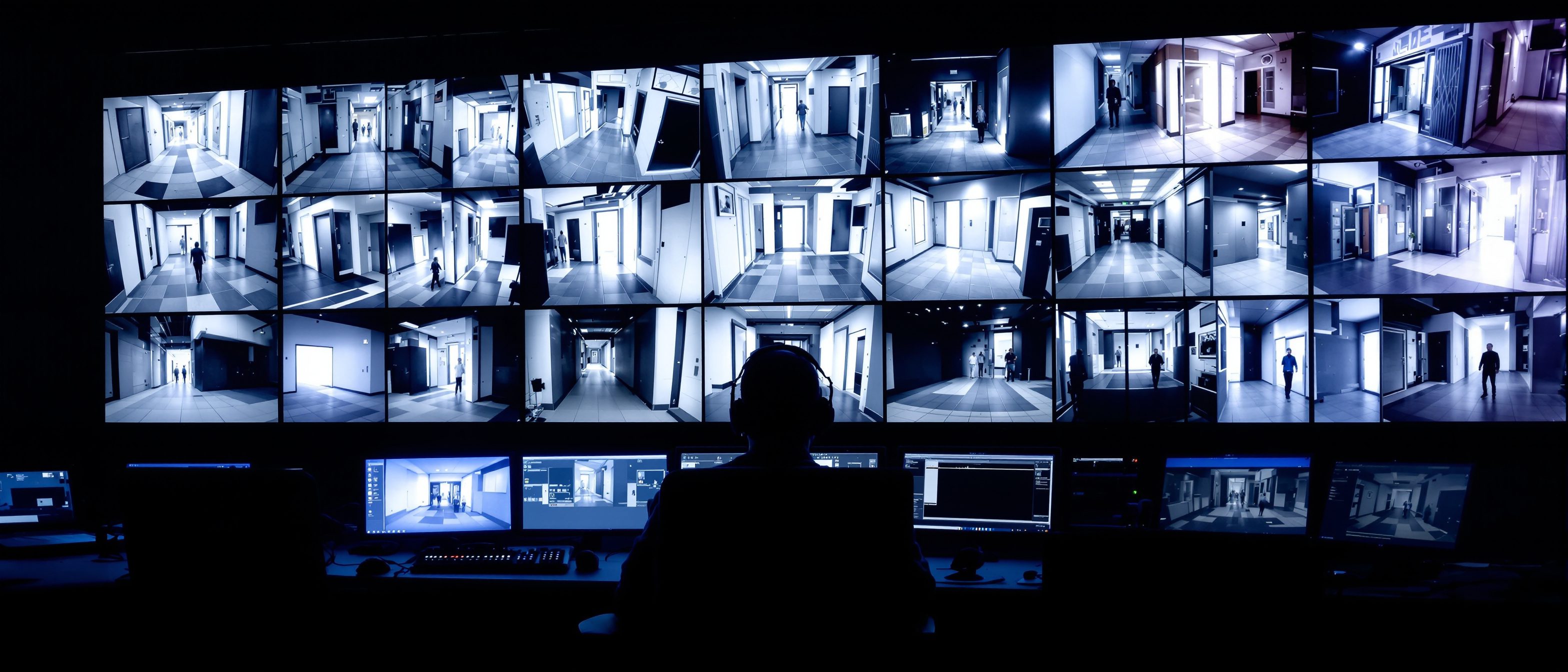
A building must protect not only against fire but against UNAUTHORISED ACCESS, theft and intrusion — and modern security is a set of electronic systems the architect must plan for. This unit covers why security systems are needed and the main types: access control (who may enter where), CCTV (seeing and recording), intruder alarms (detecting break-in), and perimeter protection (securing the boundary). It covers their components and technologies, and how they are designed and installed — increasingly as one integrated security system.
Learning objectives
By the end of this unit, you will be able to — mapped to the course outcomes for Integrated Building Management Systems:
Explain why security systems are required and their main types.
Describe access control, CCTV, intruder alarm and perimeter protection.
Identify the essential components and technologies of each system.
Plan the security systems appropriate to a building.
The security systems
Security protects people, assets and information through layered deter-detect-delay-respond — access control, CCTV, intruder alarms and perimeter protection, each with its components and technologies.[7, 9, 10]
Protect people and assets
Security systems protect a building's PEOPLE, ASSETS and INFORMATION against unauthorised access, theft, vandalism and threat — and provide a record when something happens. Different buildings need different levels (a home, an office, a bank, a data centre, an airport differ enormously). The aim is LAYERED security — deter, detect, delay and respond — combining electronic systems with physical design and people. The architect plans where and how these systems sit, ideally designed in, not bolted on.[7]
Designing security
Design security in layers and integrate it; resolve the security-vs-safety tension (doors must fail-safe for escape — life safety always wins); respect privacy; and converge onto one platform and the IBMS.[11, 1, 7]
Layered and integrated
Designing security means a LAYERED approach (perimeter → building skin → internal zones → critical assets), choosing the right system for each layer, locating cameras/readers/sensors for full coverage without gaps, providing the cabling, power, network and control room, and INTEGRATING the systems so they work together (a forced door triggers a camera and an alarm). It is designed WITH the architecture — entries, circulation and sightlines all matter — and increasingly onto the same IBMS platform as the other building systems (Unit IV).[11]
At a glance
| Aspect | One | The other |
|---|---|---|
| Modern access | Mechanical keys | Cards/biometrics — auditable, revocable |
| Security vs safety on a door | Locked against all | Fail-safe (unlocks) for fire escape |
| CCTV coverage | Everything, everywhere | What's necessary, privacy-respecting |
| Security systems | Separate gadgets | Layered, converged, integrated |
| Who wins, security vs life safety | Security | Life safety — always |
Key terms
Systems (cards, biometrics, readers, locks) deciding who may enter where and when, with an audit log.
Identity by a physical trait — fingerprint, face — used as a credential.
Cameras, recording and monitoring that let security see and record events.
Door/window contacts, motion and glass-break sensors that detect unauthorised entry.
Securing the boundary first — fence sensors, beams, gates and bollards.
Deter, detect, delay, respond across perimeter, skin, zones and assets.
Security doors must unlock on a fire alarm/power loss so escape is never blocked.
Formerly separate security systems unified on one network/platform, often the IBMS.
Studio task
Plan the security of a building you know in LAYERS: perimeter, skin, internal zones and a critical asset. Place access-control points, cameras and intruder sensors for full coverage. Then identify every security door on a fire escape route and confirm it FAILS-SAFE (unlocks) on a fire alarm. Note one CCTV location you would NOT use, for privacy reasons.
Self-assessment
1. When a security-controlled door is on a fire escape route, it must —
2. Access control improves on mechanical keys mainly because it is —
3. Modern building security is increasingly —
Recap
References & further reading
- [1]BIS — National Building Code of India (NBC 2016), Part 4 (egress and fail-safe requirements).
- [7]Traister, John E. — Design and Application of Security/Fire Alarm Systems.
- [9]Constant, Mike & Turnbull, Peter — The Principles and Practice of Closed-Circuit Television (CCTV).
- [10]Standard electronic-security practice — intruder detection and perimeter protection.
- [11]Eyke, Maurice — Building Automation Systems (on convergence and integration).
Further reading
- Mike Constant & Peter Turnbull — The Principles and Practice of CCTV.
- John E. Traister — Design and Application of Security/Fire Alarm Systems.
Sources gathered and fact-checked June 2026. Published values vary by source, sample and method — treat as indicative and confirm against the cited standard before structural use.
The author
Amogh N P
Architect, interior designer, and creative polymath. Studio Matrx began in his notebooks — his vision of design made honest, useful, and open to everyone. Its Academy is written and taught in his memory, and free, forever.
More about Amogh →