
Building Automation Systems
One brain for the whole building — the BAS and the IBMS.
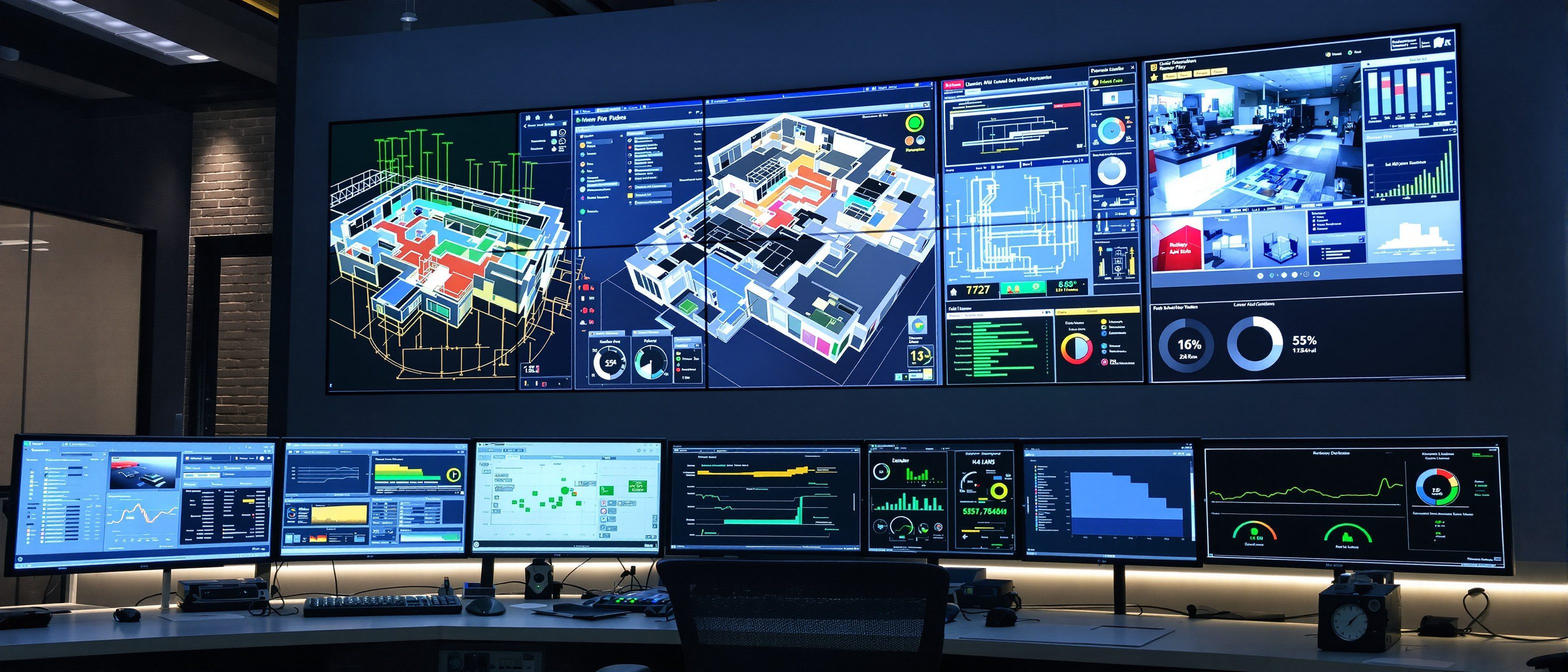
All the systems of the previous units — HVAC, lighting, fire, security, lifts — were once separate. The BUILDING AUTOMATION SYSTEM (BAS) and the IBMS bring them together into ONE intelligent platform that monitors and controls the whole building. This unit covers the OBJECTIVES of automation, which utility, safety and security systems are controlled, the COMPONENTS of an IBMS (sensors, controllers, network, software), the types of INTEGRATION, and how integrated services benefit a multi-storeyed building. Explore what integration enables below.
Learning objectives
By the end of this unit, you will be able to — mapped to the course outcomes for Integrated Building Management Systems:
Explain the objectives of a Building Automation System (BAS).
Identify the utility, safety and security systems monitored and controlled by an IBMS.
Describe the components of an IBMS and the types of integration.
Explain how integrated services benefit a multi-storeyed building.
The BAS & IBMS
A BAS monitors and controls; the IBMS integrates all utility, safety and security systems onto one platform of sensors, controllers, a network on open protocols, and software.[2]
One brain, many systems
A BUILDING AUTOMATION SYSTEM (BAS, or BMS) automatically MONITORS and CONTROLS a building's systems. The IBMS goes further — it INTEGRATES all the utility, safety and security systems onto ONE platform. The OBJECTIVES: comfort (right temperature, light, air), EFFICIENCY (huge energy and cost savings by running systems only as needed), SAFETY (coordinated emergency response), and OPERATION (one screen to monitor and run the whole building, fewer staff, faster fault-finding). It turns a collection of systems into one intelligent building.[2]
Build the IBMS
Toggle the building's subsystems onto the IBMS platform and watch the integration level rise — and see what a coordinated response becomes possible once fire is integrated.
Build the IBMS · toggle the systems onto the platform
The more systems share one platform, the more the building behaves as one coordinated whole.
Why integrate
Integration pays off in efficiency, coordinated safety, simpler operation and data; a multi-storeyed building can only be run well by an IBMS — the basis of the smart building the architect must design for.[2, 1]
The payoff
Integration pays off in EFFICIENCY (systems coordinate — no heating and cooling fighting each other; lights and AC off in empty rooms — cutting energy 20–30%+), SAFETY (one coordinated emergency response across all systems), OPERATION (one dashboard, fewer operators, faster fault detection and predictive maintenance), and DATA (the building's performance is measured, analysed and improved). For a large MULTI-STOREYED building with thousands of devices, an IBMS is not a luxury but the only practical way to run it well.[2]
At a glance
| Aspect | One | The other |
|---|---|---|
| Building systems | Separate, manual silos | One integrated, automated IBMS |
| Empty room | Lights & AC stay on | Sensed and switched off — energy saved |
| On a fire alarm | Each system acts alone | Coordinated: HVAC off, lifts recall, doors unlock |
| Integration needs | Proprietary silos | Open protocols (BACnet, Modbus, KNX) |
| A tall building | Run manually | Run from one IBMS control room |
Key terms
Building Automation/Management System — automatically monitors and controls building systems.
Integrated BMS — all utility, safety and security systems on one unified platform.
Field devices that measure conditions and drive equipment.
The device running the local control logic between sensors and equipment.
BACnet, Modbus, KNX, LonWorks — common languages that let different systems integrate.
Systems sharing data and triggering each other (fire → HVAC off, lifts recalled, doors unlock).
Coordinating a tall building's many interdependent systems through one IBMS.
A building that senses, responds to and optimises its own operation using its data.
Studio task
For a multi-storeyed building, use the integration explorer to design its IBMS: which subsystems go on the platform, and what each integration enables. Write out the automatic fire-mode sequence (what HVAC, lifts, doors and CCTV do on a fire alarm). Then identify the spaces the architect must provide for the IBMS — control room, risers, plant — and note one energy saving integration delivers.
Self-assessment
1. An IBMS (Integrated Building Management System) differs from separate systems in that it —
2. What makes true integration between different vendors' building systems possible?
3. A key benefit of an integrated building on a fire alarm is that it can automatically —
Recap
References & further reading
- [1]BIS — National Building Code of India (NBC 2016) — integrated services for high-rise buildings.
- [2]Eyke, Maurice — Building Automation Systems: A Practical Guide to Selection and Implementation.
Further reading
- Maurice Eyke — Building Automation Systems: A Practical Guide to Selection and Implementation.
- BIS — National Building Code of India (NBC 2016).
Sources gathered and fact-checked June 2026. Published values vary by source, sample and method — treat as indicative and confirm against the cited standard before structural use.
The author
Amogh N P
Architect, interior designer, and creative polymath. Studio Matrx began in his notebooks — his vision of design made honest, useful, and open to everyone. Its Academy is written and taught in his memory, and free, forever.
More about Amogh →