
Fire Alarm & Suppression Systems
Detect the fire, warn everyone, and put it out.
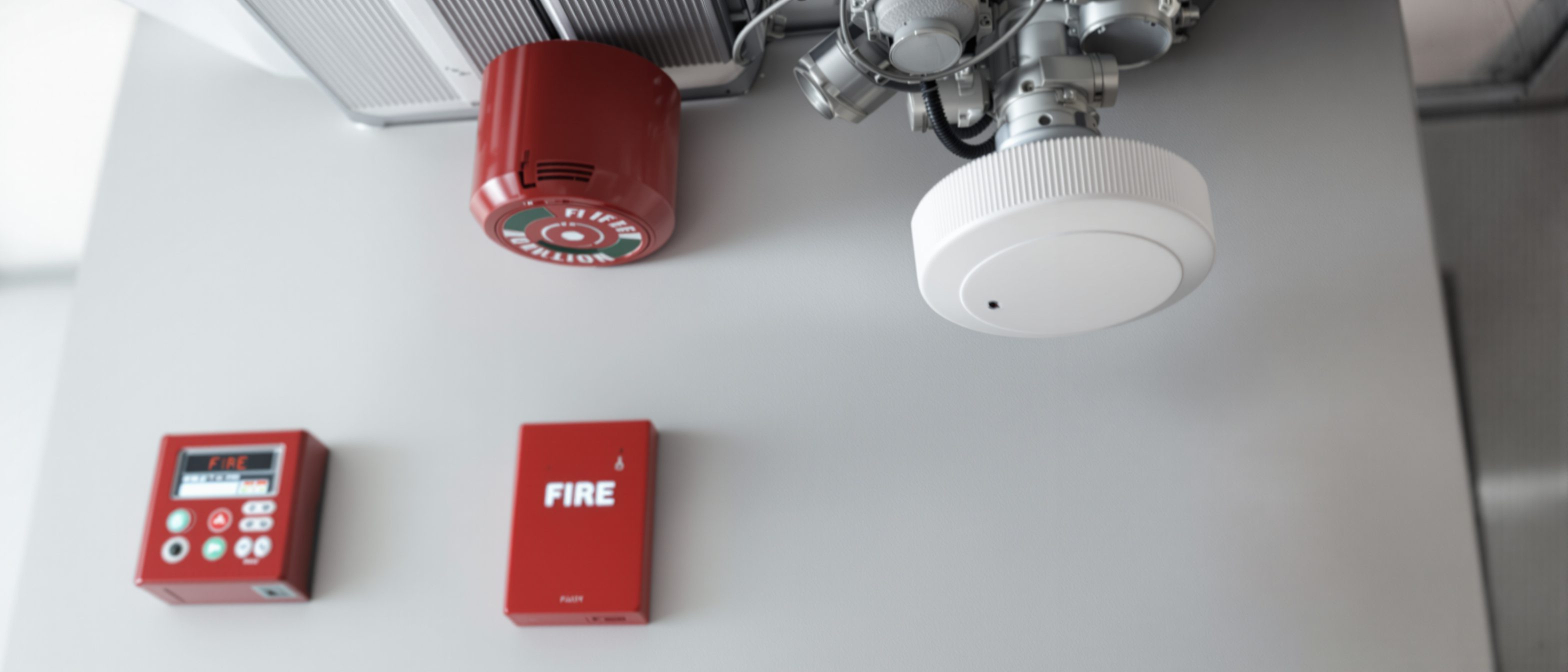
When fire starts, two things must happen fast: everyone must be warned, and the fire must be fought. This unit covers both active systems. The fire ALARM system — its detectors (smoke, heat, flame), control panel and sounders, and how it is designed and installed (IS 2189). And the fire SUPPRESSION system — built on the fire triangle (heat, fuel, oxygen: remove one and the fire dies) — from the workhorse sprinkler to clean-agent gas for server rooms. Explore the systems below.
Learning objectives
By the end of this unit, you will be able to — mapped to the course outcomes for Integrated Building Management Systems:
Explain the objective, components and detection technology of a fire alarm system.
Explain the fire triangle and how suppression extinguishes a fire.
Describe the different types of fire suppression systems and where each is used.
Identify the right detection and suppression for a given space.
The fire alarm
A fire alarm system detects (smoke/heat/flame) and warns (sounders, strobes) through a control panel; addressable systems pinpoint the device, and IS 2189 governs it.[3]
Detect and warn
A fire ALARM system has one job: DETECT a fire early and WARN everyone to evacuate. Its components are DETECTORS and manual call points (inputs), a CONTROL PANEL (the brain that monitors and decides), and NOTIFICATION devices — sounders and visual strobes (outputs) — plus power and backup. ADDRESSABLE systems pinpoint exactly which device triggered (vital in a large building); simpler CONVENTIONAL systems only identify a zone. IS 2189 governs the design and installation in India.[3]
Suppression & the fire triangle
Suppression attacks the fire triangle — remove heat, fuel or oxygen; sprinklers are the workhorse (only heads over the fire open), with clean-agent gas for server rooms and wet chemical for kitchens.[4, 5]
The workhorse
The automatic SPRINKLER is the workhorse of suppression: a network of pipes with heat-sensitive heads that open ONLY over the fire (not the whole building — a common myth), releasing water to cool and control it. Types suit the setting: WET-pipe (water always in the pipes — most common), DRY-pipe (for freezing areas), PRE-ACTION (for water-sensitive areas, needs two triggers), and DELUGE (all heads open, for high-hazard). Sprinklers are mandatory in high-rises and dramatically cut fire deaths.[5]
Explore the fire systems
Pick a fire detection or suppression system and read what it is, how it works, and where it is best used.
Fire systems · pick one
Senses smoke particles — photoelectric (optical, best for smouldering fires) or ionisation (best for fast, flaming fires).
Best for: Most occupied spaces — offices, homes, corridors; the commonest detector.
Detection warns; suppression fights. Match each to the space and what must be protected.
At a glance
| Aspect | One | The other |
|---|---|---|
| Detector for a server room | Standard smoke detector only | Early detection + clean-agent suppression |
| Sprinklers on fire | Myth: all heads soak the building | Only the heads over the fire open |
| Suppression principle | Random | Attack a side of the fire triangle |
| Kitchen fire | Water (spreads oil fire) | Wet-chemical hood system |
| Alarm + suppression | Separate, independent | Integrated — detection triggers response |
Key terms
Detectors + control panel + sounders/strobes that detect a fire and warn occupants (IS 2189).
Addressable pinpoints the exact device; conventional only identifies a zone.
Detection matched to risk — smoke for most spaces, heat for kitchens, flame for high-hazard.
Heat + fuel + oxygen; remove any one to extinguish (the tetrahedron adds the chain reaction).
Heat-sensitive heads that open only over the fire; wet, dry, pre-action or deluge.
Water-free suppression (gas/CO2) for server rooms, archives and museums.
Fire-fighting water infrastructure for the fire service in tall buildings.
Detectors and sprinkler flow switches raise the alarm and trigger building responses.
Studio task
For a small mixed building (office + a server room + a kitchen), specify the fire systems: which DETECTOR each space needs (use the explorer), and which SUPPRESSION — sprinkler, clean-agent gas, or wet chemical — and why. Then explain, using the fire triangle, how each suppression method actually puts the fire out.
Self-assessment
1. The 'fire triangle' that all suppression attacks consists of —
2. For a data centre / server room, the right fire suppression is —
3. A common myth about sprinkler systems is that —
Recap
References & further reading
- [1]BIS — National Building Code of India (NBC 2016), Part 4 Fire & Life Safety.
- [3]BIS — IS 2189: Selection, Installation and Maintenance of Automatic Fire Detection and Alarm System; Traister, John E. — Design and Application of Security/Fire Alarm Systems.
- [4]Bryan, John L. — Fire Suppression and Detection Systems.
- [5]Tariff Advisory Committee — Rules of Automatic Sprinkler Installation; NFPA sprinkler standards.
Further reading
- John L. Bryan — Fire Suppression and Detection Systems.
- John E. Traister — Design and Application of Security/Fire Alarm Systems.
- BIS — IS 2189; Tariff Advisory Committee — Rules of Automatic Sprinkler Installation.
Sources gathered and fact-checked June 2026. Published values vary by source, sample and method — treat as indicative and confirm against the cited standard before structural use.
The author
Amogh N P
Architect, interior designer, and creative polymath. Studio Matrx began in his notebooks — his vision of design made honest, useful, and open to everyone. Its Academy is written and taught in his memory, and free, forever.
More about Amogh →