
 Lesson 7.1
Lesson 7.1 · Atmosphere & the Senses
Lighting the Mood
Light is the number-one mood tool in hospitality - the one element that, turned and tuned through the day, can change how a whole room feels without moving a single wall
You can change how a whole room feels - intimate to clinical, calm to electric - without moving one wall. You just change the light.
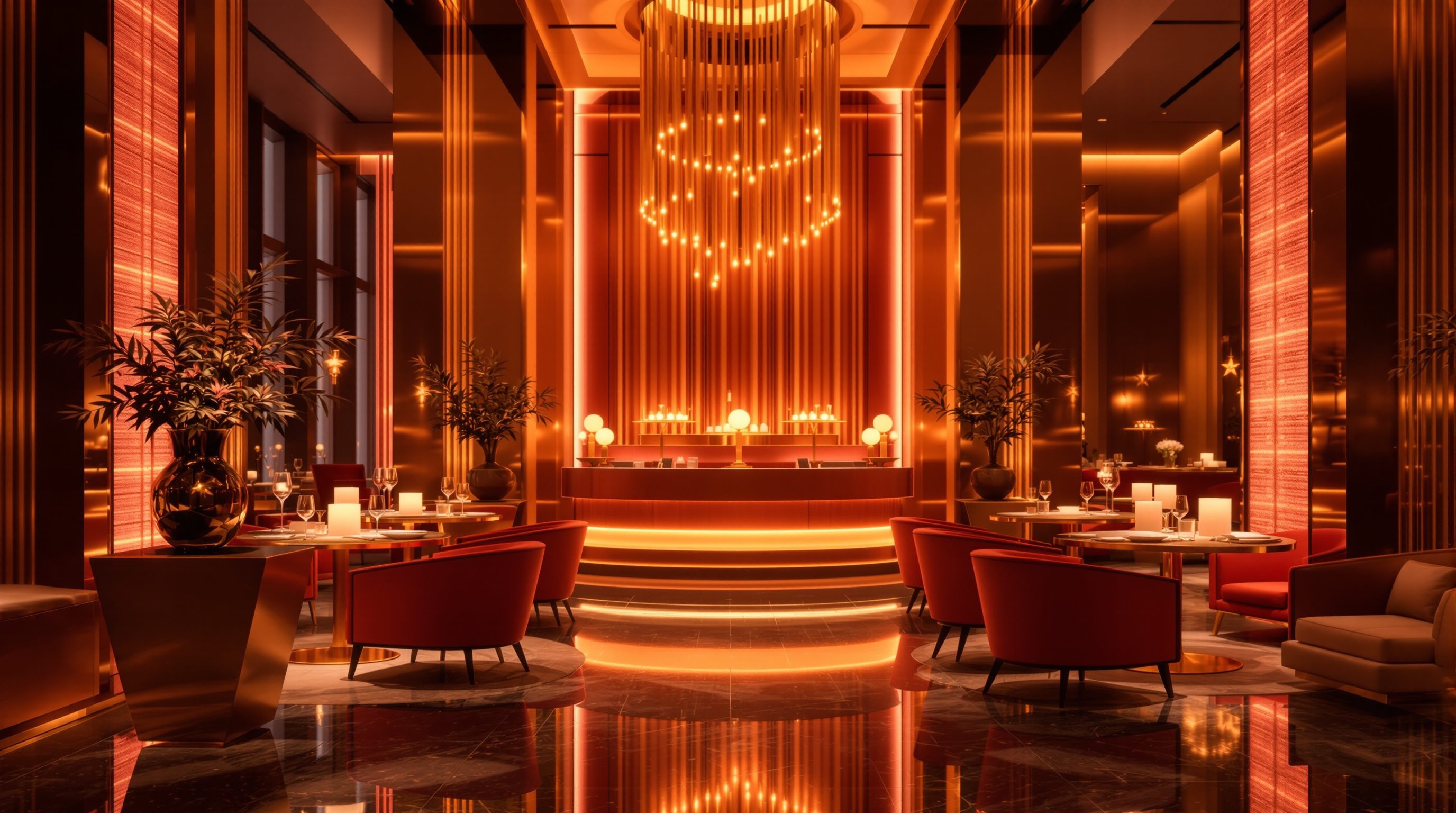
Stand in a restaurant at four in the afternoon, bright and flatly lit for the cleaners, and then return at nine in the evening when the same room is low, warm and glowing. It is physically identical - same walls, same furniture, same art - and yet it feels like two different places: the first ordinary and a little cold, the second intimate, flattering and alive. Nothing moved. Only the light changed. That is why, of all the tools that build atmosphere, lighting is the first and the most powerful in hospitality.
Light is the medium through which a guest sees everything else you designed - every material, every colour, every face across the table - so it does not sit alongside the other atmospheric choices; it governs how all of them read. Get it wrong and the loveliest materials look dead, the food looks grey, and guests feel subtly uneasy without knowing why. Get it right and an ordinary space feels special and people stay longer, spend more and come back. This lesson treats lighting as the mood instrument it is - its layers, its warmth, its choreography by the hour, its sparkle and shadow - while deferring the binding technical numbers, the lux levels and emergency-lighting rules, to a lighting designer and the codes.
Change the light, change the room. Warm, layered, full of sparkle and shadow - never flat and even.
Layers, not a lighting level
The first mistake in hospitality lighting is to think of it as a single quantity - "how bright is the room?" - and to solve it with a grid of downlights that floods everything evenly. That produces the flat, institutional wash of an office or a supermarket, and it is the enemy of atmosphere. Good hospitality lighting is not one level; it is several distinct layers, each doing a different job, combined and then dimmed and balanced against one another to make a mood. Learn the four layers and you have the vocabulary of the whole craft.
Ambient (or general) light is the soft base wash that lets a guest move and see safely - but in hospitality it is kept low and gentle, a floor to build on, never the whole scheme. Task light is aimed where a guest actually needs to see: the menu on the table, the registration desk, the bathroom mirror, the bar top where drinks are made. Accent light is the tight, directional beam that picks out what you want noticed - a painting, a textured wall, a sculpture, a plant, the food on the plate - and, crucially, creates the contrast that makes a room feel three-dimensional and intentional. Decorative light is the fitting you are meant to see and enjoy as an object: the chandelier in the lobby, the pendant over the table, the lantern on the verandah, the candle - it carries style, scale and sparkle, and it signals the brand before it lights anything at all.
The art is in the combination and balance. A restaurant with low ambient light, warm task pools on each table, crisp accents on the art and a glittering decorative pendant overhead feels intimate, layered and alive. Strip out three of those layers and leave only a bright ambient wash, and the same room feels like a canteen. So the designer's real question is never "is it bright enough?" but "what is each layer doing, and how do they balance to make the feeling I want?" Everything else in this lesson - warmth, dimming, sparkle - is played out across these layers.
Never ask 'how bright?' Ask 'what is each layer doing?' Ambient + task + accent + decorative = mood.
Warmth: the colour temperature of feeling
After layers, the single biggest lever on mood is the warmth of the light - its colour temperature, measured in kelvin but felt as a mood. Low colour temperatures give a warm, golden, candle-like light; high colour temperatures give a cool, bluish, daylight-like light. The human response is deep and consistent: warm light reads as relaxing, intimate, flattering, evening, home, safety and calm; cool light reads as alert, clean, clinical, efficient, morning and work. Hospitality, which is almost always trying to make people relax, unwind, linger and feel cared for, lives overwhelmingly in the warm end - the golden glow of a good hotel bar, the amber of a fine-dining room, the soft warmth of a spa. Cool, bluish light in a restaurant makes food look grey and dead and guests look tired; it is one of the fastest ways to kill an atmosphere.
Warmth also flatters, and flattery matters more than designers like to admit. Warm, slightly dimmed light with a good colour-rendering quality makes skin look healthy and food look appetising - guests feel attractive and at ease, which is a real part of the welcome. This is why candlelight is the eternal benchmark of hospitality lighting: very warm, very low, gently moving, endlessly flattering. Much of the craft of hotel and restaurant lighting is, in effect, an attempt to reproduce the feeling of firelight and candlelight with modern sources.
There are nuances to respect. A bright breakfast room or a poolside cafe may want a fresher, more daylight-linked feel; a gym or a bathroom mirror needs cooler, truer light to function. And the warmth should usually shift with the day - crisper in the morning, warmer as night falls - which is the subject of the next section. The designer's job is to choose a deliberate warmth for each space and daypart and to keep it consistent, because mismatched colour temperatures in one view - a warm lamp beside a cold downlight - look like a mistake and quietly unsettle the guest. As with everything technical here, the target values and the colour-rendering specification belong with the lighting designer; the judgement of *what mood the warmth should make* is yours.
Dimming and scenes: one room, many moods
A hospitality space is not used in one way at one time; it lives through a day of completely different jobs, and its lighting has to change with them. The all-day dining room is a bright, practical breakfast room at eight in the morning, a relaxed lunch spot at one, a softer cafe in the afternoon and an intimate, low-lit restaurant at nine at night - in the *same* physical room. A lobby greets bleary arrivals at dawn, hosts meetings at midday and becomes a glamorous social stage in the evening. The only way one room can be all of these is if its lighting can be re-tuned, which is why dimming and scene-setting are not a luxury in hospitality but a basic requirement.
The technical mechanism is a control system that lets the operator select pre-set "scenes" - stored combinations of which layers are on and at what level and warmth - at the touch of a button, so staff do not fiddle with individual switches. A typical restaurant might have a bright "clean" scene for housekeeping, a "day" scene, a "dusk" transition and a low, warm "dinner" scene, each dropping the ambient light and lifting the relative weight of the warm accents and decorative fittings as the evening deepens. Done well, the guest never notices the change happening; they simply feel the room grow more intimate as night falls, exactly as they unconsciously expect.
This is where the designer thinks like a theatre lighting director, not an electrician. You are choreographing how the room feels across time, designing the transitions as much as the end states, and making sure that at every hour the layers balance into a coherent, flattering whole. It is also where you protect the atmosphere operationally: if the cleaning scene is the only bright one, staff will leave it on and ruin the evening, so the scenes and the simple control that selects them have to be designed for the real people who will use them. The count of scenes, the switching logic and the emergency and egress lighting that must over-ride everything are coordinated with the lighting designer and the electrical engineer and the code - but the *idea* that one room should hold many moods across the day is the hospitality designer's to set.
Think theatre lighting director, not electrician: design the scenes and the transitions, by the hour.
Sparkle, shadow, and why hotels are not offices
The final, and most hospitality-specific, idea is the deliberate use of contrast - sparkle and shadow - rather than uniform illumination. An office or a supermarket aims for even, shadowless, bright light everywhere, because its job is sustained visual performance: you must be able to read, work and scan shelves equally well in every square metre, for hours, without eye strain. Hospitality has almost the opposite job. It wants drama, intimacy and flattery, and those come precisely from *un*-evenness: pools of warm light with softer shadow between them, so a big room breaks into intimate zones; bright highlights on the things that should glitter - glassware, polished metal, water, a chandelier's crystal, a candle flame - set against darker surrounds that make them sing. Sparkle gives a room life and luxury; shadow gives it depth, mystery and calm. A flatly, uniformly lit restaurant, however warm, feels strangely dead, because it has no focus and nowhere for the eye to rest or be drawn.
This is the clearest way to understand why hotel lighting is not office lighting, and it is a distinction students must internalise. The two building types have opposite purposes. The office lights for the task and the clock - even, neutral, steady, optimised so people can work productively all day. Hospitality lights for feeling and for the moment - warm, layered, dimmable, full of contrast, tuned to flatter guests and food and to shift with the evening. Bring office-lighting instincts (bright, even, cool, all-on) into a hotel or restaurant and you will methodically destroy its atmosphere; the space will be perfectly *visible* and completely *unwelcoming*.
So the hospitality designer lights for a different success measure: not foot-candles delivered uniformly, but a guest who walks in and feels the place is warm, special and alive. Sparkle where delight should be, shadow where calm and intimacy should be, warmth almost everywhere, and layers that can be re-tuned through the day. The binding technical envelope - minimum light for safe movement, emergency and egress lighting, energy limits, the actual lux and uniformity figures - is set by the lighting designer, the services engineer and the code, and you defer to them without argument. But the mood itself, the reason a guest feels welcomed the instant they step inside, is made with light, and it is one of the most powerful things in your hands.
Lighting levels & quality (lighting designer)
Lux / illuminance, colour temperature, colour rendering, uniformity, glare
Principles and mood here; the binding target values and the technical specification belong with a qualified lighting designer and the relevant standards.
Emergency & egress lighting (NBC 2016 / fire authority)
Emergency lighting, illuminated exit signage, escape-route illumination
Safety-critical and non-negotiable - defer entirely to the current code, the fire/life-safety specialist and the electrical engineer. Overrides every mood scene.
Energy & controls (services / electrical engineer)
Lighting power density, energy limits, dimming and scene-control systems, daylight linking
Coordinate the control system and energy compliance with the electrical and services engineers; calibrate any efficiency figures to the current code.
Brand standard (operator)
Specified fittings, warmth, scenes and light levels for a branded hotel
A branded operator often dictates a detailed lighting standard - follow it, and calibrate, never copy, any figure to the specific brand and project.
Workshop — re-light one room in your mind (and on paper)
The best way to learn hospitality lighting is to diagnose a real room and redesign its light. You will analyse the lighting of a hospitality space you know, name its layers and faults, and propose a layered, scene-based scheme - all without a single lux calculation.
A hospitality space you can observe and a notebook or sketch pad. No meter, no software - this is about reading and shaping mood, not measuring lux.
Goal: read and redesign the lighting of one real hospitality space
Inputs: a cafe / restaurant / hotel space you can visit or recall + this lesson + a notebook or sketch pad
Time: ~50 minutes
- 1Pick a room and map its LAYERS: walk through (or recall) it and list every light you can identify as ambient, task, accent or decorative. Which layers are present, which are missing, and which one dominates?
- 2Judge the WARMTH and CONTRAST: is the light warm or cool, and how does it make the space (and the food and the people) feel? Is it flat and even, or does it have pools, sparkle and shadow? Note one thing the light does well and one thing it does badly.
- 3Imagine it at two DAYPARTS: describe how the room should feel at, say, 9am and 9pm, and whether its current lighting could actually be re-tuned to do both. If not, what is missing (dimming, scenes, warmth shift)?
- 4Redesign the scheme: sketch or list a layered lighting proposal - what ambient, task, accent and decorative light you would use, what warmth, and at least two scenes (e.g. 'day' and 'dinner') with how each layer changes between them.
- 5Write a one-paragraph brief for a lighting designer: state the MOOD you want at each daypart and the key moves (warmth, layers, sparkle, scenes), explicitly leaving the lux levels, colour-rendering spec, controls and emergency lighting to them.
You’ll walk away with
A one-page lighting read-and-redesign of a real space: its current layers and faults, a layered scene-based proposal with warmth and at least two dayparts, and a short mood brief that correctly defers the technical numbers to a lighting designer.
Three altitudes on the same idea
Read the band that fits you — or all three.
Your moves decide whether great lighting is even possible, long before a fitting is chosen. Daylight is the first and best light in hospitality, so the orientation, the window and skylight strategy, the depth of plan and the shading you set in the base-build govern how the public spaces and rooms feel by day - and glare, heat gain and the harsh overhead sun of Indian latitudes are architectural problems to solve, not lighting ones. You also own the ceiling: its height, its coffers and coves, the floor-to-floor depth that allows recessed and concealed fittings and the routes for the control wiring. Provide generous, coordinated ceiling and cove zones, a daylight strategy that admits soft light without glare or overheating, and early coordination with the lighting designer and services engineer; defer lux levels, emergency and egress lighting and energy limits to them and the code.
This is the heart of your atmosphere toolkit and one of the most satisfying parts of hospitality interiors. You set the layered scheme - the balance of ambient, task, accent and decorative light - choose the warmth for each space and daypart, select the decorative fittings that carry the brand, and design the scenes that re-tune each room through the day. Light for mood, contrast and flattery, not uniform brightness; make food and skin look good; create sparkle where there should be delight and shadow where there should be calm. Work closely with a lighting designer on the technical specification (levels, rendering, dimming, emergency) and with the electrical engineer on control, and always mock up and commission the scenes on site - lighting is the element most often ruined in the final weeks by value-engineering or a badly set control system.
Train your eye on light before anything else - it is the fastest way to learn why a space feels the way it does. In every cafe, hotel and restaurant, ask: what are the layers here (can I see ambient, task, accent, decorative)? Is it warm or cool, and how does that make me feel? Is it flat and even, or full of pools and sparkle and shadow? How would it feel at a different time of day? Notice how a bright, cool, evenly lit chain outlet feels utterly different from a low, warm, layered independent restaurant, and you will understand the whole lesson. You are not expected to calculate lux or specify emergency lighting yet - that is the lighting designer's and the code's domain - but you are expected to read and shape mood with light, which is a designer's core instinct.
“Lighting design means making sure a hotel or restaurant is bright enough and evenly lit so guests can see comfortably everywhere - a good scheme is one where nowhere is too dark.”
Do it yourself
No tools needed - reason it through and, where you can, go and look.
- 1Name the four layers of a lighting scheme and give a hospitality example of each.
- 2Why does hospitality live at the warm end of colour temperature, and what does cool light do to a restaurant?
- 3What is scene-setting, and why must an all-day dining room be able to re-tune its lighting through the day?
- 4Explain, with an example, why 'sparkle and shadow' makes a room feel better than flat, even light.
- 5Give the core reason hotel lighting differs from office lighting - what is each one optimised for?
The one line to carry out
Peer-reviewed journals & authoritative standards
- 01Lighting — Wikipedia — Lighting, 2026.
- 02Architectural lighting design — Wikipedia — Architectural lighting design, 2026.
- 03Daylighting — Wikipedia — Daylighting, 2026.
- 04Sensory design — Wikipedia — Sensory design, 2026.
Light is the sense we notice first, but it is only one channel of the atmosphere. Next we turn to the one guests complain about most when it goes wrong - sound - and how acoustics make a space feel buzzing or calm, private or exposed.
The author
Amogh N P
Architect, interior designer, and creative polymath. Studio Matrx began in his notebooks — his vision of design made honest, useful, and open to everyone. Its Academy is written and taught in his memory, and free, forever.
More about Amogh →