
 Lesson 7.1
Lesson 7.1 · Materials, Finishes & Character
Matching Old & New
The central aesthetic question of every renovation is whether the new work should vanish into the old or stand honestly apart from it - and there is no single right answer, only a decision you must make on purpose
When new work meets old, it can either disappear or declare itself - and the one thing it must never do is fall halfway, looking like a failed attempt at matching.
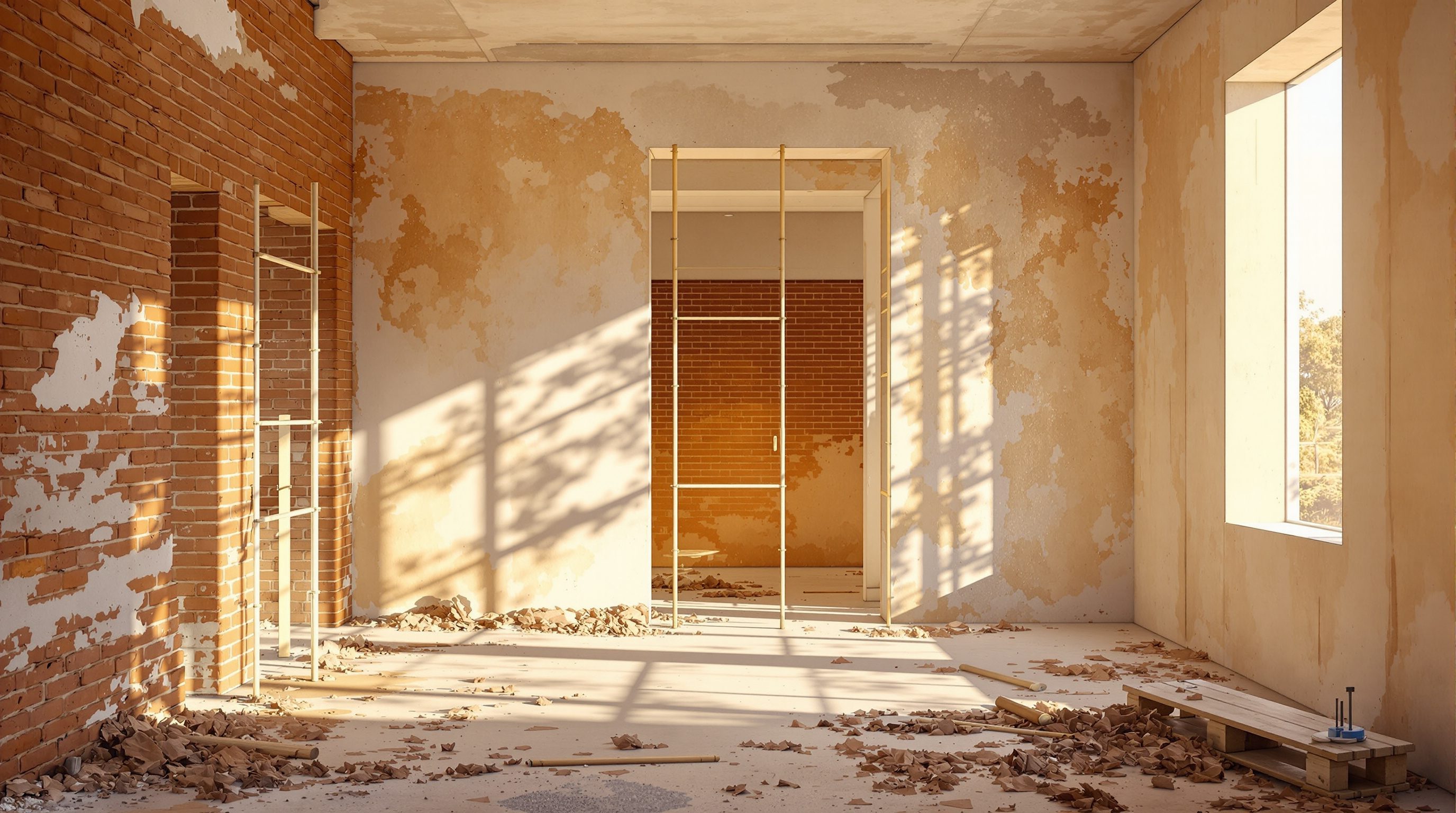
Every renovation reaches a moment that is purely a question of judgement, not of structure or services: where the new work you have added meets the old building that was already there, what should that meeting look like? A new floor beside the original one; a modern kitchen in a century-old room; an extension joined to a house built in a different decade with different bricks, different windows, different proportions. You can try to make the new vanish into the old so the join disappears, or you can let the new stand clearly as itself beside the old. Both are honest, accomplished answers. The disaster is the third option nobody chooses on purpose - the near-miss that tries to match and doesn't, and so reads to every eye as a mistake.
This is where renovation stops being only surgery and becomes an art, and the surgeon's discipline still applies: diagnose first. Before you can decide how new should meet old, you have to have really looked at the old - its materials, its proportions, its colour and texture and the particular way it has aged - the way Module 1 taught you to read a building. Matching old and new well is never about picking a tile that looks a bit like the original; it is about understanding what gives the old work its character, then deciding, deliberately, whether to continue that character or to set a confident new note against it. This lesson gives you the framework to make that decision well - and to avoid the two classic failures that lie on either side of it.
Read the old. Then choose: match true, or contrast clean. Never fake.
The real choice: blend seamlessly or contrast honestly
There are two legitimate strategies for joining new work to old, and almost every good renovation is a conscious choice between them - or a considered mixture applied room by room. The first is to blend: to match the new so closely to the old that the join disappears and the eye reads a single, continuous, coherent whole. You extend the same flooring, repeat the same cornice profile, source reclaimed bricks of the same size and colour, copy the window proportions. Done with real care, blending is invisible - and invisibility is the point. It suits buildings whose whole value lies in their unbroken period character, and clients who want the renovation never to announce itself.
The second strategy is to contrast: to let the new work be plainly new, sitting beside the old as its own clear thing, so that each reads as itself and the conversation between them becomes part of the pleasure. A sheet-glass link joining an old stone house to a new wing; a deliberately modern kitchen inserted into a room whose old plaster and beams are left frankly exposed; a crisp steel-and-timber stair in a weathered masonry shell. This is the approach most heritage and conservation thinking actively prefers, precisely because it is honest: it does not pretend the new is old, it does not confuse future readers of the building about what is original, and it lets the old fabric keep its authority rather than being diluted by imitations of itself.
The craft lies in choosing one on purpose, and committing. Both strategies can be beautiful; what is almost never beautiful is drifting between them by accident - matching in some places, contrasting in others, with no governing idea. A useful rule of thumb: where you can match truly and completely, blending can be lovely; where you cannot match convincingly, do not try - contrast cleanly instead. The moment a match is merely approximate, the contrast approach is not just safer, it is more honest and usually more handsome. Decide early, write the decision into your brief, and let it govern every material choice that follows - this is the difference between a renovation that looks intended and one that looks like a series of unrelated compromises.
Blend OR contrast - both honest. The halfway near-miss is the only real failure.
Matching versus complementing old materials
When you do choose to work with the character of the old building rather than against it, there is a second, subtler distinction worth holding: the difference between matching a material and complementing it. Matching means reproducing the old as exactly as you can - the same stone from the same quarry, the same lime plaster, the same terrazzo mix, the same timber species and profile. True matching is wonderful when it is achievable, but it is often harder and costlier than people expect: old materials were made by processes that may no longer exist, to sizes that are no longer standard, in colours that came from a particular clay or pigment, and they have then aged for decades in ways a brand-new piece simply has not. A freshly fired brick next to a hundred-year-old one rarely matches, however carefully chosen, because age itself is part of the look.
Complementing is the gentler, often wiser move: choosing new materials that sit harmoniously with the old without pretending to be it. A new floor in a tone and warmth that befriends the original rather than copying it; a plaster finish of similar texture but honest new colour; joinery in a timber that relates to the old without impersonating it. Complementing respects the old building's palette and proportions while letting the new be quietly new - and because it is not attempting the impossible trick of perfect imitation, it avoids the uncanny near-miss that exact-matching so easily slides into.
In the Indian context this choice has real texture. An old house might have Athangudi or Mysore-style cement tiles, red-oxide or IPS floors, Kota or Kadappa stone, lime plaster, teak joinery - materials with strong character and often living craft traditions behind them. Sometimes you can still get the genuine article or have it made; sometimes you honestly cannot, and a sympathetic modern material that complements the old is the better, more affordable answer than a poor reproduction. The judgement is always the same: can I match this truly and well, or should I complement it honestly? Answer that material by material, and the renovation holds together.
'Old bones, new life' - the approach that usually wins
If one approach deserves to be the default for most home renovations, it is the one often summed up as 'old bones, new life': keep and celebrate the genuine old structure and character - the bones - and let the new interventions be clearly, comfortably contemporary life layered within them. The old brings soul, story and a quality of material and proportion that new work rarely buys cheaply; the new brings the comfort, light, services and spatial ideas that the old house never had. The two are not disguised as each other; they are allowed to be themselves, and the building is richer for the honest conversation between them.
This approach works so reliably because it sidesteps the hardest problem - faking age convincingly - and plays instead to what each era does best. You expose and repair the old timber, stone or brick rather than plastering over it; you keep the generous old proportions and the patina of use; and then you insert a frankly modern kitchen, a clean bathroom, good glazing, layered lighting and honest new finishes that make the place genuinely liveable. The contrast is not a compromise; it is the whole pleasure. A renovated home where you can read both the building's history and the care of its new chapter feels far more alive than one that tries, and fails, to pretend nothing has changed since 1950.
'Old bones, new life' also aligns perfectly with the course's through-line. It forces you to diagnose before you decide - you cannot celebrate the old bones until you have found out which bones are genuinely good, which are merely old, and which are failing and need a structural engineer or surveyor's attention (Modules 1 and 3). It keeps you from the wasteful instinct to strip everything back to a blank box and start again, which throws away exactly the character you cannot buy. And it gives a clear, teachable rule for the thousands of small decisions a renovation demands: keep and reveal the good old; add honest, quiet new; never fake. For most homes, most of the time, that is the approach that ages best - because it was honest to begin with.
Avoiding pastiche - and avoiding clumsy clashes
There are two failures that bracket every good decision about old and new, and naming them clearly helps you steer between them. The first is pastiche: fake-old work that imitates period character without understanding or honesty - the machine-made 'heritage' cornice of the wrong profile, the reproduction 'antique' door handles on a hollow flush door, the new extension dressed up in a costume of old-looking features that no real building of that age would ever have worn. Pastiche fails because it is hollow: it copies the surface of the past while missing its logic, and the eye, even an untrained one, senses the insincerity. It also confuses the building's real story, which conservation thinking rightly dislikes - a future reader can no longer tell what is genuinely old from what is dressed up to look it.
The opposite failure is the clumsy clash: new work dropped beside old with no thought for proportion, colour, scale or material, so the two simply argue. A glossy, cold-toned tile beside warm old stone; a window of jarring proportion punched into a finely ordered old facade; a material or colour that relates to nothing else in the room. Clashes are not failures of contrast - deliberate contrast is a discipline with its own care for proportion and dialogue - they are failures of attention, the result of choosing the new thing in isolation without ever holding it up against the old.
The path between the two is the same judgement this whole lesson has circled: be honest, and be considered. Do not fake age (that is pastiche); do not ignore the old (that is clashing). Whether you blend or contrast, let every new choice be made in deliberate relation to the old - its scale, its proportion, its colour temperature, its texture - so the finished home reads as one coherent intention rather than either a theme-park of the past or a pile of unrelated decisions. Get that right and the renovation will look, to everyone who enters, simply and quietly *right* - which is the highest compliment this art can earn.
Strategy before samples
Whether to blend or contrast - set it first
Decide the governing approach (blend / contrast / 'old bones, new life') at the start and write it into the brief, BEFORE picking individual materials. Illustrative principle - adapt to your building.
Match-true-or-complement test
Every new material beside an old one
Ask: can I match this truly and completely? If not, do not attempt an approximate match - complement or contrast cleanly instead. Test samples physically against the old in the room's real light.
Structure & damp behind the look
Old features you plan to expose or keep
Before celebrating old bones, confirm they are sound. Load-bearing elements and openings are for a structural engineer; damp/decay behind a finish for a surveyor. Modules 1 & 3. When in doubt, stop and ask.
Workshop - decide the old-and-new strategy for one real junction
The old-versus-new decision is abstract until you make it for a specific, real meeting of new work and old fabric. In this workshop you will choose one junction in a building you know and work the decision all the way to a committed strategy - practising the judgement this lesson teaches.
A building you can observe, a phone camera, and ideally a physical sample or two. No specialist tools - this is design judgement, and nothing here replaces a professional's check on structure or damp.
Goal: a committed, reasoned old-versus-new strategy for one real junction
Inputs: a building you know + a phone camera + samples or photos of the existing material
Time: ~45 minutes
- 1Pick ONE junction where new will (or could) meet old: a new floor beside an original one, an extension joining the house, a new kitchen in an old room. Photograph the existing material closely and note its character - colour, texture, proportion, and how it has aged.
- 2List the old building's character honestly: what gives this fabric its quality? Is it period detail worth continuing, or simply old? (This is the 'diagnose before you decide' step - you cannot choose a strategy until you have read the old.)
- 3Run the match-true-or-complement test: could you match this material truly and completely (source, size, colour, age)? Write 'yes' or 'no' - and be honest, because a 'no' pushes you firmly toward complement or contrast.
- 4Choose ONE strategy and commit in a sentence: 'For this junction I will [blend by... / contrast by... / keep old bones and add new life by...].' Name how proportion, colour and texture will relate across the join.
- 5Name the trap you are steering around: where could this slide into pastiche, and where into a clumsy clash? Write one safeguard for each. Flag any old feature whose soundness (structure/damp) a professional must confirm before you build the decision.
You’ll walk away with
A one-page junction decision: a photo of the existing material, an honest character note, your match-or-complement verdict, a one-sentence committed strategy, and your two safeguards against pastiche and clash. It is a template you can reuse for every old-new meeting in a real project.
Three altitudes on the same idea
Read the band that fits you — or all three.
The old-versus-new decision is one of the most visible judgements you make, and on extensions and adaptive reuse it is often explicitly assessed by conservation officers and planners. Many authorities and heritage bodies positively prefer honest contrast - new work legible as new - over imitation, so a confident contemporary addition in a sympathetic palette is frequently an easier approval than an unconvincing pastiche. Set the blend-or-contrast strategy at concept stage, carry it through proportion, datum lines, material and detailing, and document the reasoning. Where you match, match truly (reclaimed materials, correct profiles); where you cannot, contrast cleanly. And remember the boundary: how a new opening or junction is formed in the existing structure is a matter for the structural engineer, not only the eye.
This is core interiors territory - most of your renovation work lives in exactly this decision, surface by surface. Your craft is holding a coherent scheme across rooms where old and new meet: choosing finishes, flooring, joinery and colour that either blend with or confidently complement the existing fabric, and keeping the whole reading as one intention. Lead with a governing idea ('old bones, new life' suits most homes), build a tight material and colour palette, and test every new sample physically against the old in the actual light of the room - matches that look right in a showroom often clash on site. Resist client requests for fake-period detailing; steer instead to honest materials that complement. Where character features sit on structure or damp, loop in the right professional before you finish over them.
Learning to decide between blending and contrasting - and to spot pastiche and clashes - trains your eye better than almost any new-build exercise. Start looking, critically, at renovations and extensions around you: which ones read as one coherent whole, which as fake-old, which as careless clashes, and why. Name the strategy each one chose and judge whether it committed to it. Practise the matching-versus-complementing distinction on real materials: hold a new brick, tile or timber against an old one and notice how age, not just colour, separates them. The discipline to carry forward is that this is a decision to be made on purpose and early, grounded in a real reading of the existing building - not a series of isolated material picks made in a showroom.
“To renovate well you should make the new work match the old as closely as possible, so everything looks original and you can't tell what was added. Matching is always the respectful, high-quality choice.”
Do it yourself
No tools needed - reason each one through in your own words.
- 1Describe the two legitimate strategies for joining new work to old, and why the 'halfway' near-miss is the real failure.
- 2Explain the difference between matching a material and complementing it, with an example of each.
- 3What does 'old bones, new life' mean, and why does it suit most home renovations?
- 4Define pastiche and the 'clumsy clash', and state the single judgement that steers between them.
- 5Give an Indian-context example where complementing an old material is wiser than trying to match it exactly.
The one line to carry out
Peer-reviewed journals & authoritative standards
- 01Renovation — Wikipedia — Renovation, 2026.
- 02Building restoration — Wikipedia — Building restoration, 2026.
- 03Architectural conservation — Wikipedia — Architectural conservation, 2026.
- 04Interior design — Wikipedia — Interior design, 2026.
- 05Masonry — Wikipedia — Masonry, 2026.
Deciding how old and new should meet is the governing idea; next we get practical about the three surfaces that carry most of that decision - choosing and renovating the floors, walls and ceilings that define every room.
The author
Amogh N P
Architect, interior designer, and creative polymath. Studio Matrx began in his notebooks — his vision of design made honest, useful, and open to everyone. Its Academy is written and taught in his memory, and free, forever.
More about Amogh →