
The Modern Movement
Ornament falls away and architecture rebuilds itself around function, space and the machine — the Bauhaus, Le Corbusier and Mies.
In the 1920s a generation decided to start over. They swept away ornament, historical style and the whole weight of the past, and asked what architecture should be if it were built honestly for the machine age, from the frame and its freedoms. The answers came fast and confident: the Bauhaus united art and industry, Le Corbusier called the house "a machine for living in" and wrote down his Five Points, and Mies van der Rohereduced building to steel, glass and space with two words — "less is more."
Learning objectives
By the end of this lesson, you will be able to — mapped to the course outcomes for History of Architecture IV:
Explain the core principles of the Modern Movement — functionalism, honesty of structure, and the rejection of ornament and historical style.
Describe the aims of the Bauhaus and its union of art, craft and industry under Walter Gropius.
State and explain Le Corbusier's Five Points of a New Architecture through the Villa Savoye.
Explain Mies van der Rohe's 'less is more' and how the International Style became a shared modern language.
The modern credo
Four moves define the movement: subtract the ornament, codify the frame's freedoms into Le Corbusier's Five Points, reduce to essentials with Mies, and — underneath it all — treat architecture as flowing space and volume rather than solid mass.[1, 3]
Functionalism and honesty
The Modern Movement's first move was subtraction. Adolf Loos had already argued (provocatively) that ornament was a kind of crime — wasted labour dishonest to the modern age. The moderns took the frame's freedom and ran: strip off applied decoration and historical dress, show structure and materials honestly, and let a building's FORM come from its FUNCTION and construction. Beauty was to come from proportion, space and precision, not from carved detail.[1, 3]
The movement built
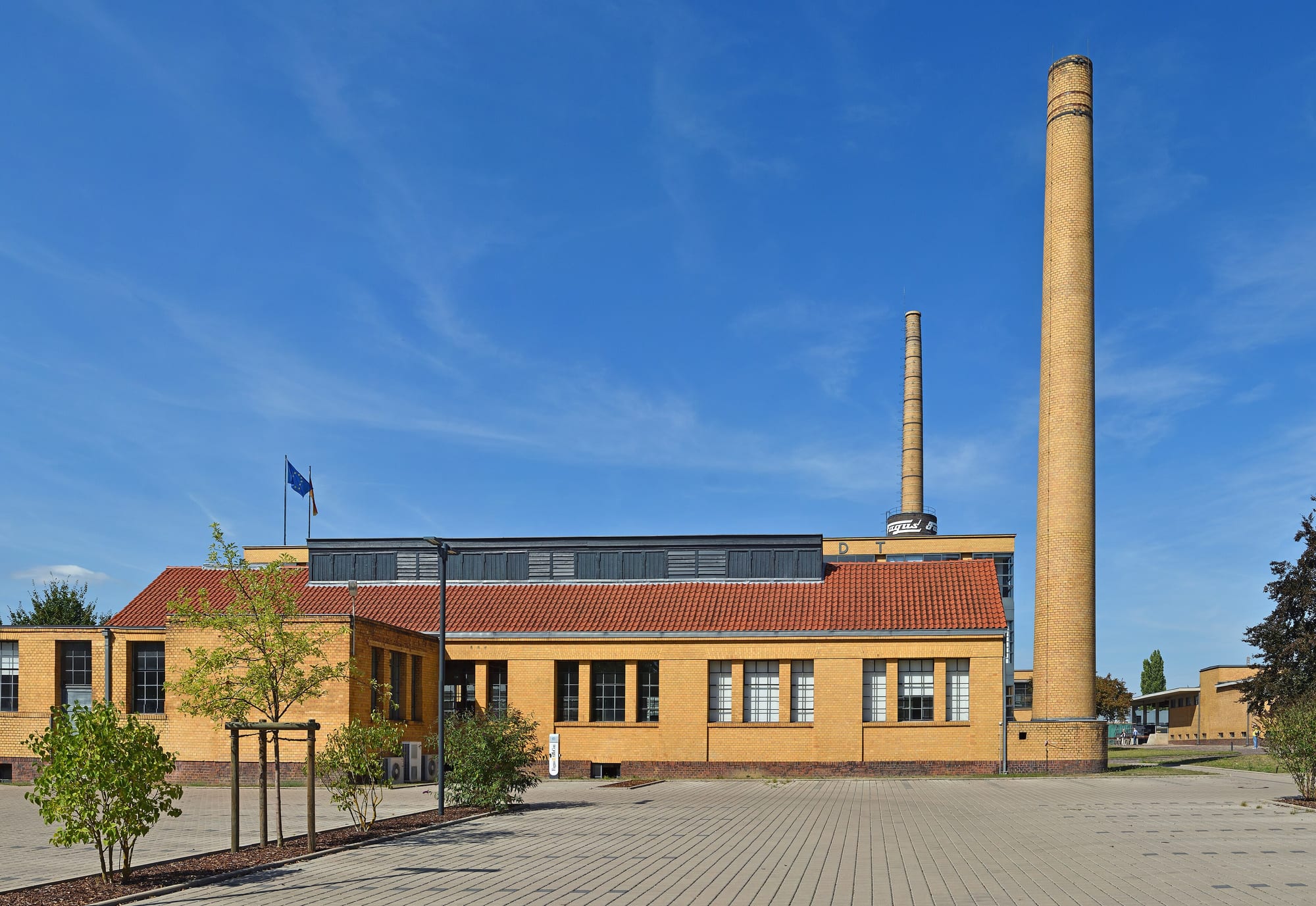
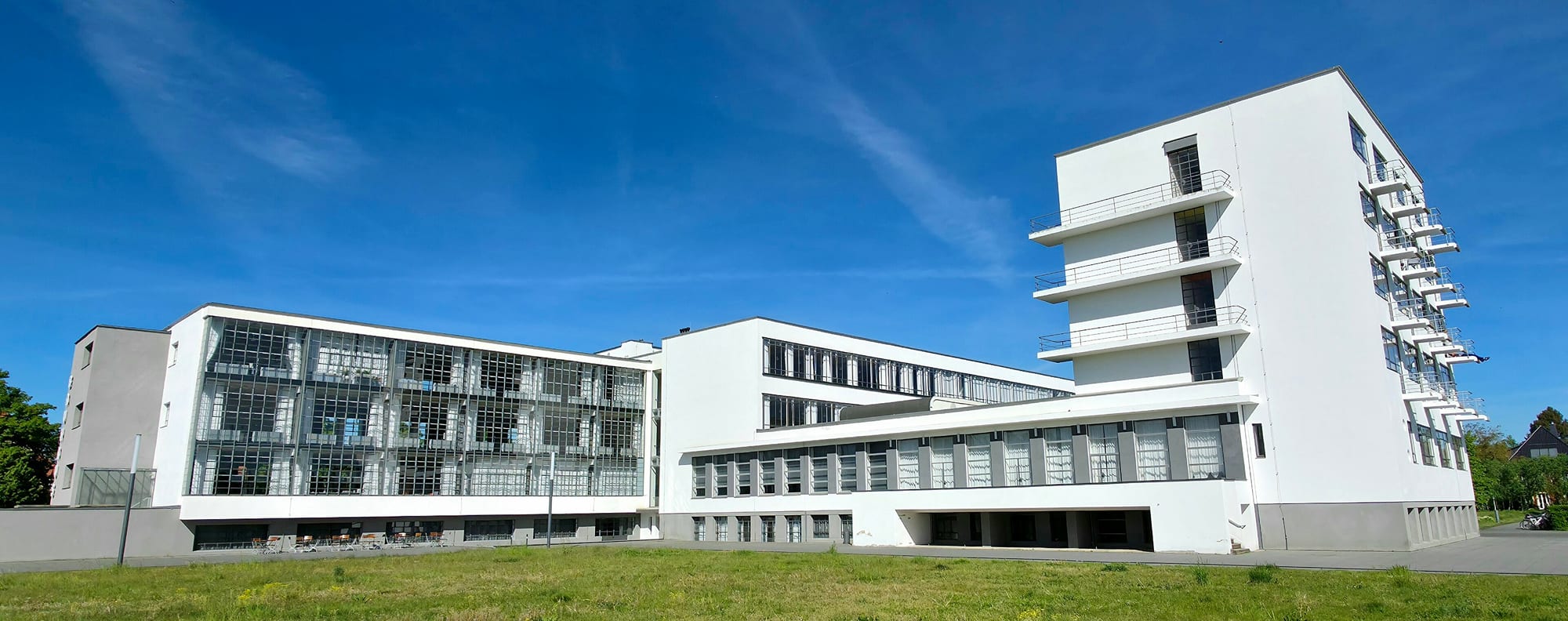
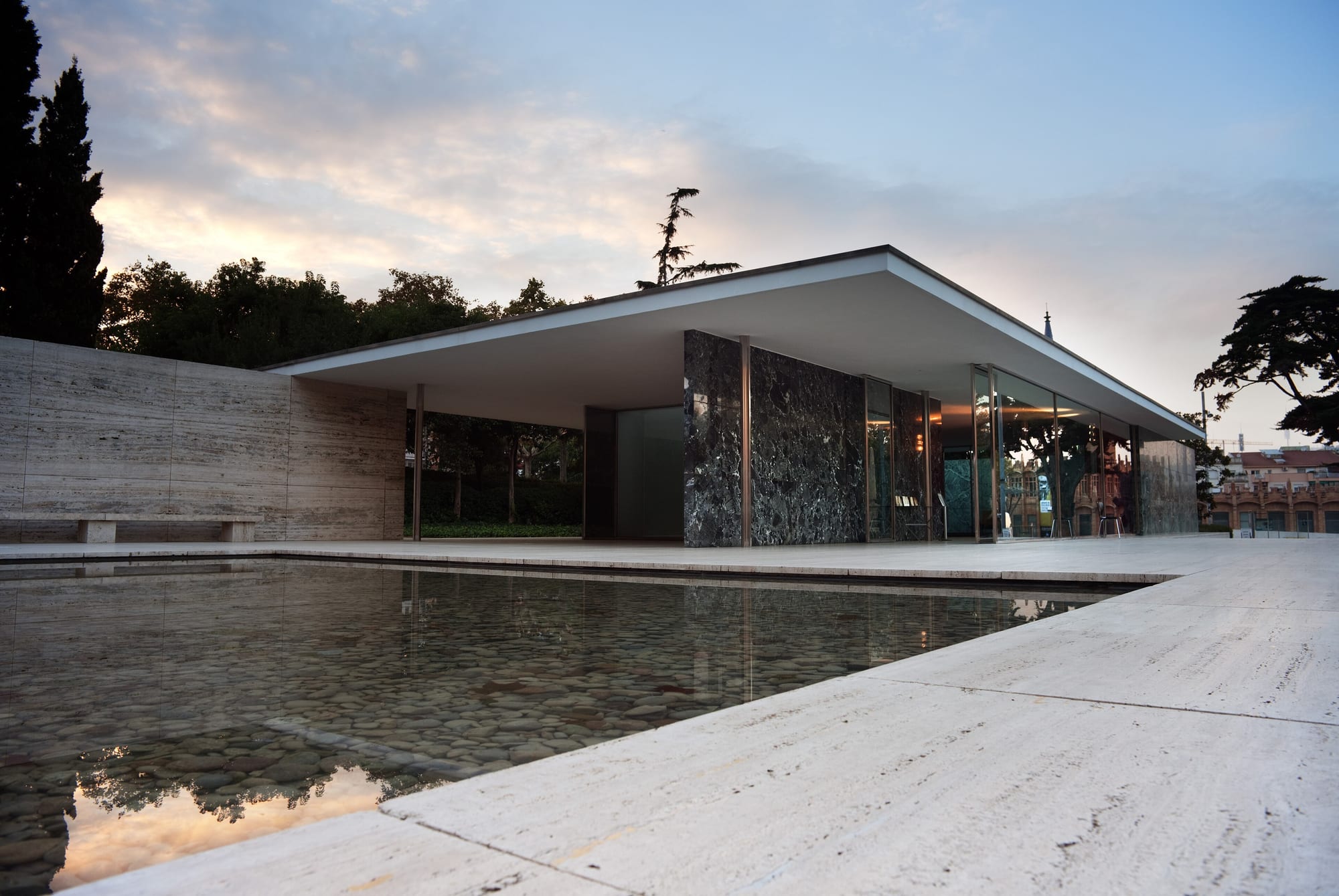
See the credo become buildings: Gropius's Bauhaus at Dessau, Le Corbusier's Villa Savoye floating on its pilotis, Mies's weightless Barcelona Pavilion, and the pure abstraction of De Stijl — all gathered, in 1932, under one name: the International Style.[1, 2]
Art, craft and industry united
The German Werkbund (1907) argued that good design and industrial production should join forces; Peter Behrens designed factories and products alike. Out of this, Walter Gropius founded the BAUHAUS (1919), the century's most influential design school. Its aim: reunite art, craft and industry and design for mass production. Gropius's own Bauhaus building at Dessau (1926) is a manifesto — a glass-curtain-walled workshop wing, asymmetrical interlocking volumes, flat roofs, and no ornament at all.[1, 3]
Old mass vs new volume
| Aspect | One | The other |
|---|---|---|
| Where beauty comes from | Before — carved ornament and historical style | Modern — proportion, space, structure and precision |
| The building as | Older — solid mass, carved and heavy | Modern — thin planes enclosing flowing volume |
| Le Corbusier | 'A house is a machine for living in' | The Five Points: pilotis, free plan, free façade, ribbon window, roof garden |
| Mies van der Rohe | 'Less is more'; 'God is in the details' | Steel + glass grid, free-flowing open space |
| Reach | Earlier styles — tied to place and craft | International Style — one portable modern language, worldwide |
Key terms
The 1920s–30s architecture built on functionalism, honesty of structure, and the rejection of ornament and historical style.
The principle that a building's form should follow from its function and construction, not from inherited style.
The German design school (1919, Gropius) that united art, craft and industry and shaped modern design worldwide.
Slender columns that lift a building off the ground, freeing the space beneath — the first of Le Corbusier's Five Points.
An interior freely arranged because the frame, not the internal walls, carries the loads.
A long horizontal window running the full width of a wall, made possible by the load-bearing frame.
Mies van der Rohe's dictum — beauty achieved through reduction to essential structure, space and fine detail.
The name (MoMA, 1932) for the modern architecture of volume-not-mass, regularity, and no ornament, as it spread worldwide.
Study task
Take a small everyday house plan (your own home, or any simple one) and redraw it as a free plan: place a regular grid of columns to carry the loads, then rearrange the internal partitions freely — open up the living space, curve a wall if you like. Then list which of Le Corbusier's Five Points your redesign now uses, and which it doesn't.
Self-assessment
1. Which is NOT one of Le Corbusier's Five Points of a New Architecture?
2. The deepest idea shared across the Modern Movement is that architecture is about —
3. The Bauhaus, founded by Walter Gropius, aimed to —
Recap
References & further reading
- [1]Kenneth Frampton, Modern Architecture: A Critical History (4th ed.). London: Thames & Hudson, 2007.
- [2]Francis D.K. Ching, Mark Jarzombek & Vikramaditya Prakash, A Global History of Architecture (3rd ed.). Hoboken: John Wiley & Sons, 2017.
- [3]William J.R. Curtis, Modern Architecture Since 1900 (3rd ed.). London: Phaidon, 1996.
- [4]Villa Savoye and gatehouse — UNESCO World Heritage Centre (The Architectural Work of Le Corbusier, inscribed 2016). https://whc.unesco.org/en/list/1321/
- [5]Bauhaus sites in Weimar, Dessau and Bernau — UNESCO World Heritage Centre (inscribed 1996, extended 2017). https://whc.unesco.org/en/list/729/
Further reading
- Le Corbusier, Towards a New Architecture (Vers une architecture). Dover / Frances Lincoln.
- William J.R. Curtis, Modern Architecture Since 1900. Phaidon.
- Reyner Banham, Theory and Design in the First Machine Age. Architectural Press.
Sources gathered and fact-checked June 2026. Published values vary by source, sample and method — treat as indicative and confirm against the cited standard before structural use.
Where this course goes next
The International Style promised one honest, universal architecture. Unit V asks what happened when that promise met the real, plural world — Brutalism, Postmodernism, High-Tech, Deconstructivism and Critical Regionalism — and follows the modern story into independent India, from Le Corbusier's Chandigarh and Kahn's Ahmedabad to Correa, Doshi and today's sustainable practice.