
Roman Architecture
The arch, the vault and concrete — architecture discovers interior space.
Rome took the Greek orders and added a revolution: the arch, the vault and the dome, made cheap and vast by concrete. Where the Greek temple was a solid to be admired from outside, the Roman building turned inward to enclose monumental space — and engineering spread that ambition across an empire in baths, arenas, aqueducts and the great domed Pantheon.
Learning objectives
By the end of this lesson, you will be able to — mapped to the course outcomes for History of Architecture II:
Explain the Roman shift to arcuate construction and the role of concrete (opus caementicium).
Identify the five Roman orders and the superimposition of orders up a façade.
Describe the arch, barrel and groin vault, and the dome as Roman building systems.
Assess the Pantheon, Baths of Caracalla, Colosseum and aqueducts as building types.
The arcuate systems and concrete
Roman concrete (opus caementicium) made the true arch, vault and dome economical at vast scale — spanning by compression and freeing architecture from the forest of columns. The arch extruded is the barrel vault; two crossing barrel vaults make the groin vault; the arch rotated is the dome.[1, 4]
The Roman revolution
Roman concrete — opus caementicium, of lime, volcanic pozzolana and aggregate cast against timber formwork and faced with brick or stone — made the true arch, vault and dome economical at vast scale. Spanning by compression freed architecture from the forest of columns and let Rome enclose monumental interior space.[1, 4]
The building types
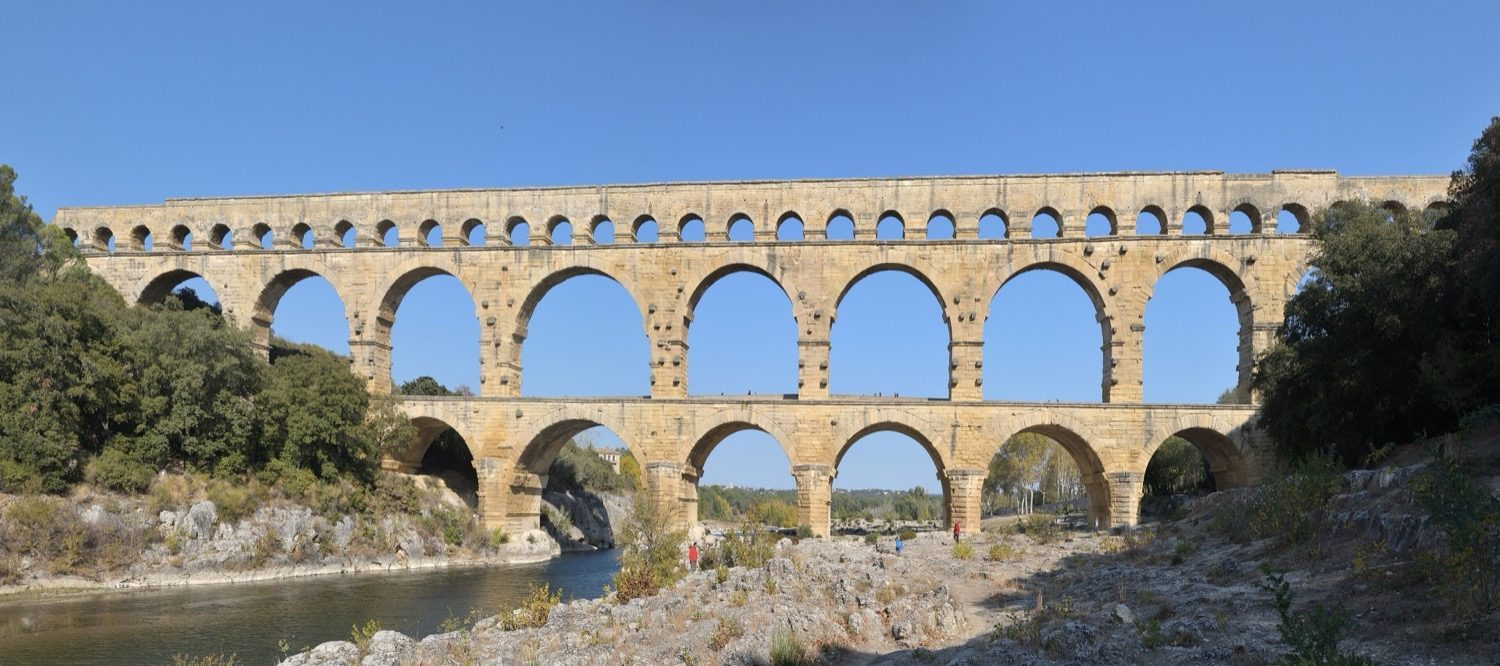
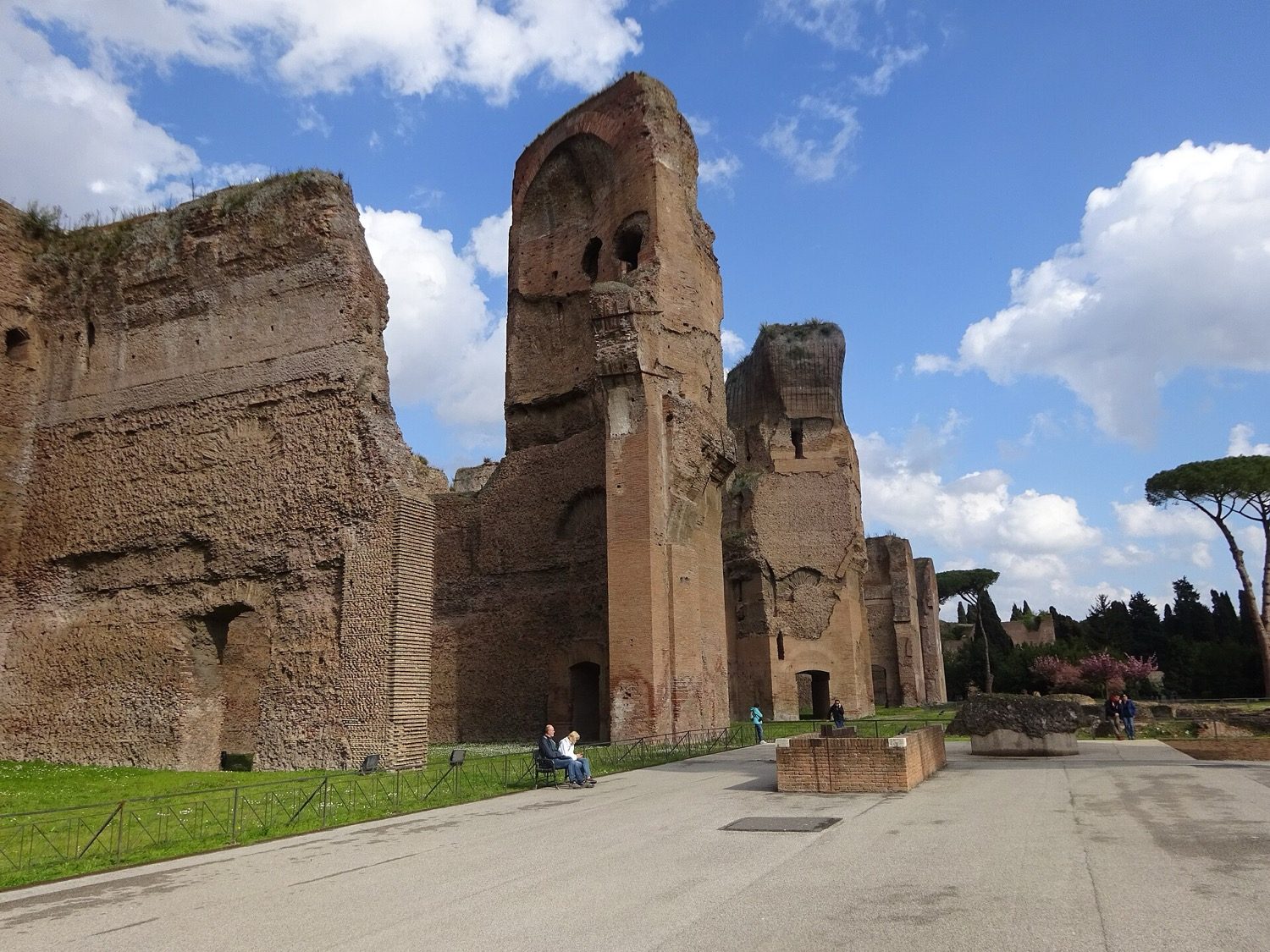
Rome's typologies show the new structure at work: the concrete-domed Pantheon, the vaulted Baths of Caracalla, the oval Colosseum, the chariot-racing Circus Maximus, the civic Forum, and the engineered aqueducts.[3, 1]
Religious — the concrete dome
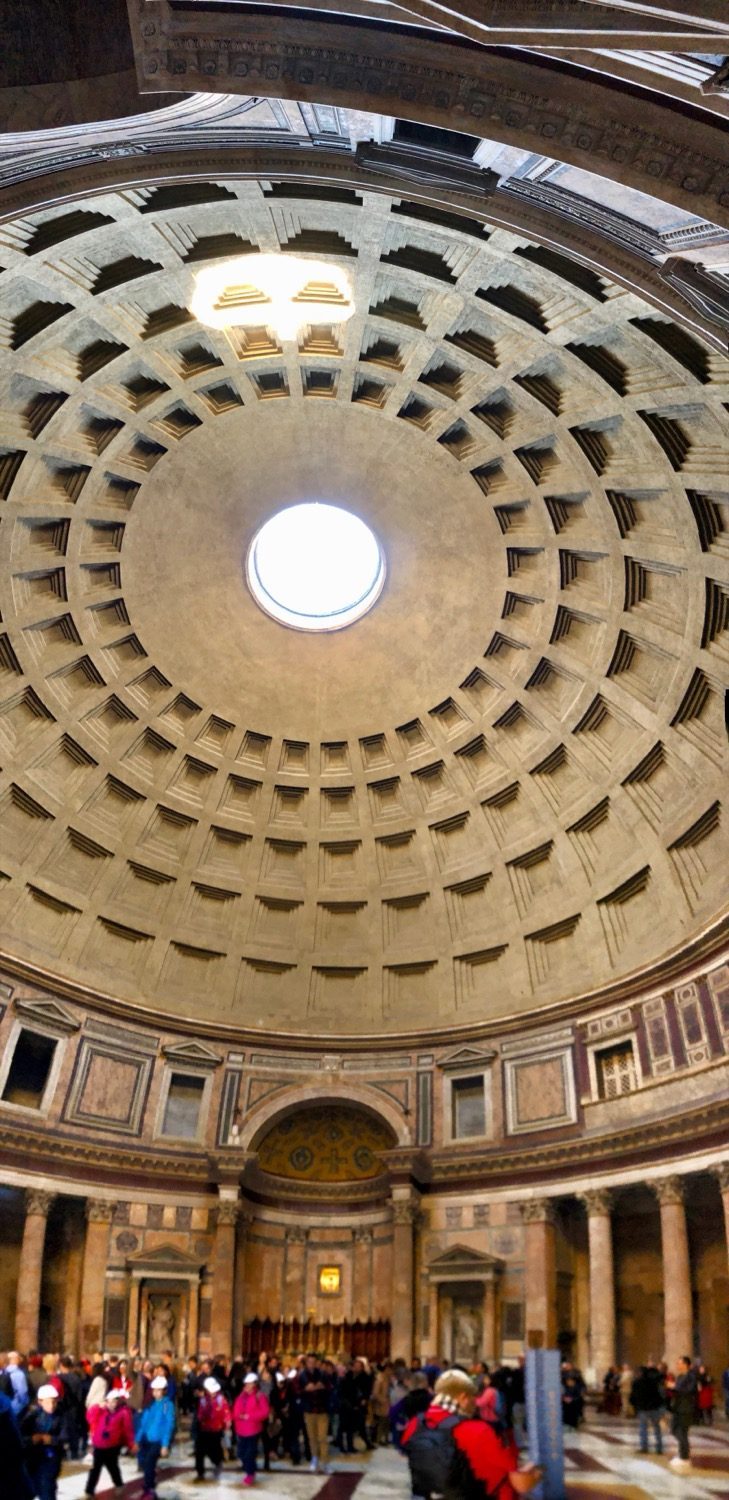
The Pantheon (c. AD 126) sets a coffered concrete dome 43.3 m across over a rotunda exactly 43.3 m high — a perfect sphere fits inside — lit only by the 8.9 m oculus at its crown. The unreinforced dome is lightened with graded aggregate, heavy travertine low down to light pumice at the top; it remains the largest unreinforced concrete dome on Earth.[3, 4]
The orders, applied and superimposed
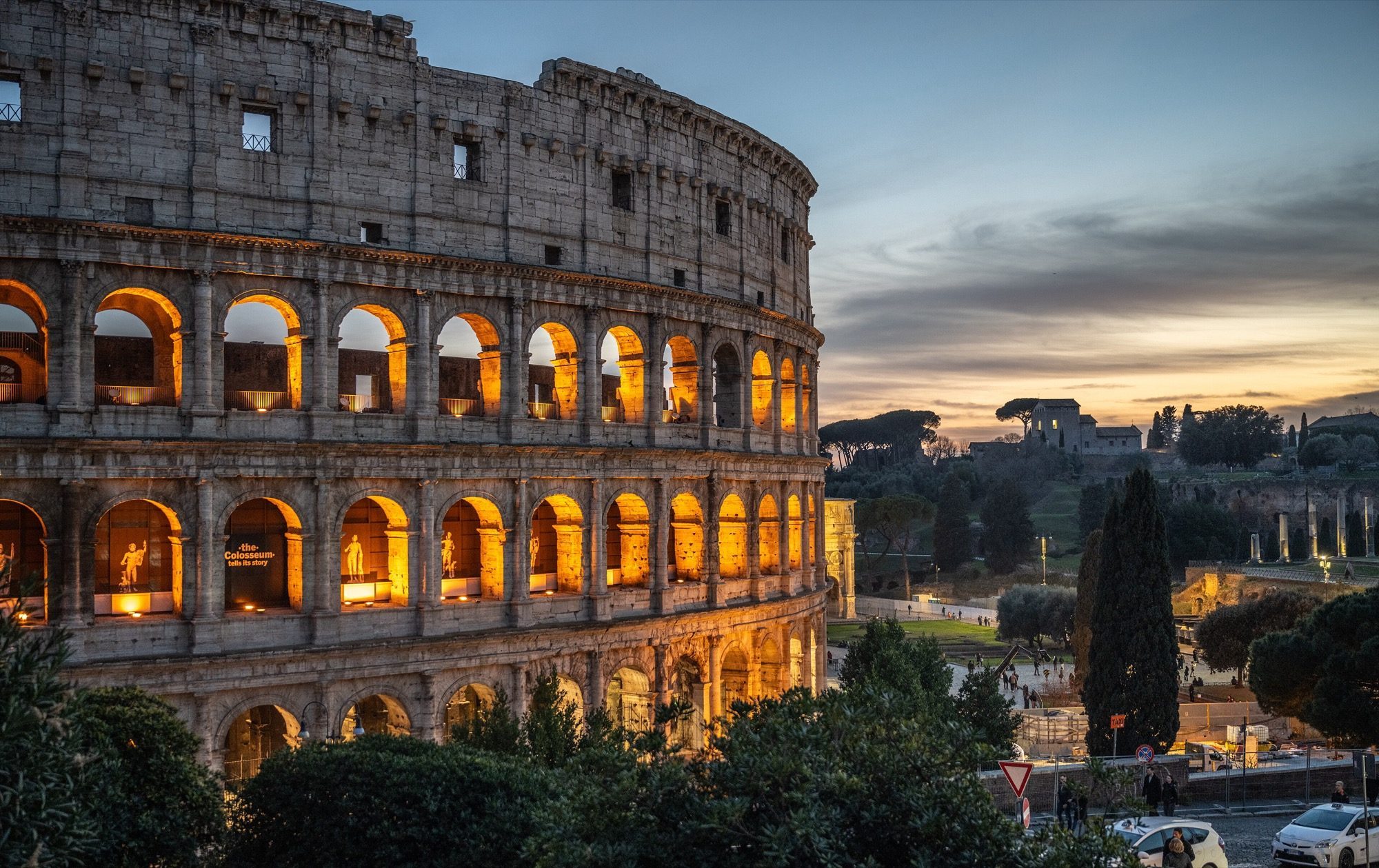
With the arch now carrying load, the orders became applied decoration — and Rome stacked them lightest over heaviest up a façade, Tuscan to Ionic to Corinthian, as on the Colosseum. Rome also added two orders of its own: the simplified Tuscan and the hybrid Composite.[1, 2]
Greek vs Roman
| Aspect | Greek | Roman |
|---|---|---|
| Structural system | Greek: trabeate (post-and-lintel) | Roman: arcuate (arch, vault, dome) |
| Signature material | Greek: marble, mortarless | Roman: concrete + brick/stone facing |
| Design emphasis | Greek: sculptural exterior, small interior | Roman: monumental interior space |
| Role of the orders | Greek: structural | Roman: applied, superimposed up façades |
| Number of orders | Greek: three | Roman: five (+ Tuscan, Composite) |
Key terms
Roman concrete — lime, volcanic pozzolana and aggregate cast in formwork.
The wedge blocks of an arch, locked by the central keystone.
A continuous semicylindrical vault — an extruded arch.
Two barrel vaults crossing at right angles; load goes to four corner piers.
The circular opening at the crown of a dome (the Pantheon).
Sunken decorative panels that lighten a ceiling or dome.
Under-floor heating — hot air circulating beneath a raised floor and through wall flues.
The retractable awning over, and the underground service level beneath, an amphitheatre.
Study task
Sketch the arch, barrel vault, groin vault and dome, labelling the keystone on the arch. Then in two lines explain why Roman concrete let buildings like the Pantheon enclose space the Greek temple never could.
Self-assessment
1. The Pantheon's great dome is made of —
2. The Colosseum is correctly classified as —
3. The two orders Rome added to the Greek three are —
Recap
References & further reading
- [1]Banister Fletcher, A History of Architecture (20th ed.). Architectural Press / RIBA, 1996.
- [2]Francis D.K. Ching, Mark Jarzombek & Vikramaditya Prakash, A Global History of Architecture. Wiley, 2007.
- [3]UNESCO World Heritage Centre — Historic Centre of Rome (inscribed 1980). https://whc.unesco.org/en/list/91
- [4]Spiro Kostof, A History of Architecture: Settings and Rituals (2nd ed.). Oxford University Press, 1995.
- [5]UNESCO World Heritage Centre — Pont du Gard (Roman Aqueduct) (inscribed 1985). https://whc.unesco.org/en/list/344
Further reading
- Banister Fletcher, A History of Architecture — the Roman chapters.
- Spiro Kostof, A History of Architecture: Settings and Rituals.
- D.S. Robertson, A Handbook of Greek and Roman Architecture.
Sources gathered and fact-checked June 2026. Published values vary by source, sample and method — treat as indicative and confirm against the cited standard before structural use.
The author
Amogh N P
Architect, interior designer, and creative polymath. Studio Matrx began in his notebooks — his vision of design made honest, useful, and open to everyone. Its Academy is written and taught in his memory, and free, forever.
More about Amogh →