
Greek Architecture
The orders, the perfected temple, and the building as a sculpted object.
Greek architecture is the foundation of the Western classical tradition — and its lesson is restraint. It is trabeate (post-and-lintel), and it treats the temple as a finely proportioned sculptural object seen from outside, perfected with optical refinements so subtle the eye barely registers them. Master the three orders and the temple plan here, and the whole of Roman, Renaissance and colonial classicism becomes readable.
Learning objectives
By the end of this lesson, you will be able to — mapped to the course outcomes for History of Architecture II:
Describe the character of Greek architecture — trabeate, proportioned, exterior-focused — and its optical refinements.
Identify the three orders (Doric, Ionic, Corinthian) by column and entablature.
Label the parts and plan-types of a Greek temple (peripteral, in antis, prostyle).
Read the Parthenon, Erechtheion and Theatre of Epidaurus as exemplars.
The three orders
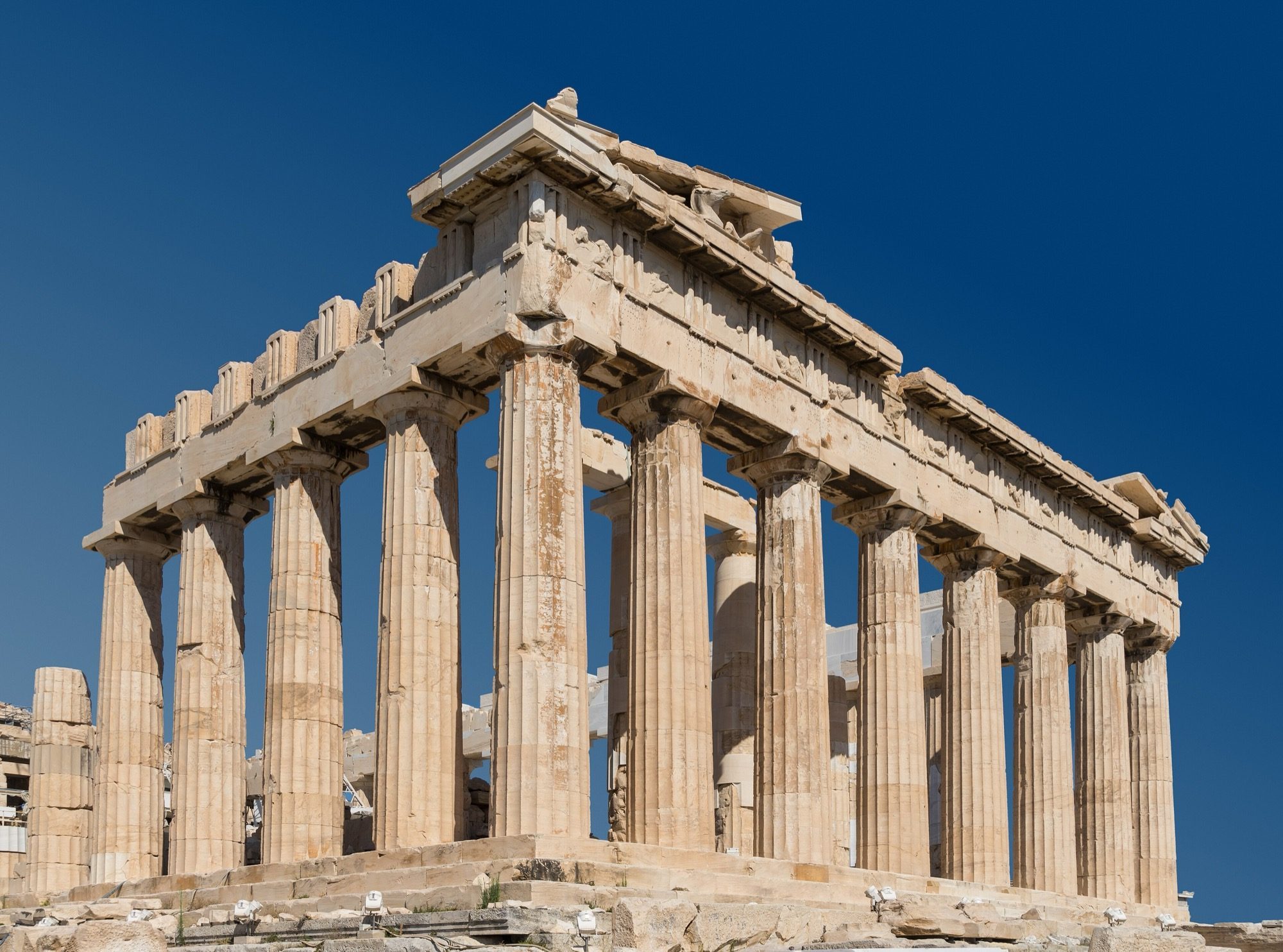
An order is a column-and-entablature system. Read it by the capital and the frieze: sturdy Doric (no base, triglyphs and metopes), slender Ionic (a base and scroll-like volutes), and ornate Corinthian (an acanthus-leaf basket).[2, 4]
The temple plan and its parts
Temples are classed by their colonnade (in antis, prostyle, amphiprostyle, peripteral) and read by their parts: the front porch (pronaos), the main room (naos/cella) holding the cult statue, and the rear porch (opisthodomos) — the whole ringed by the peristyle on the stylobate.
The Acropolis and Epidaurus
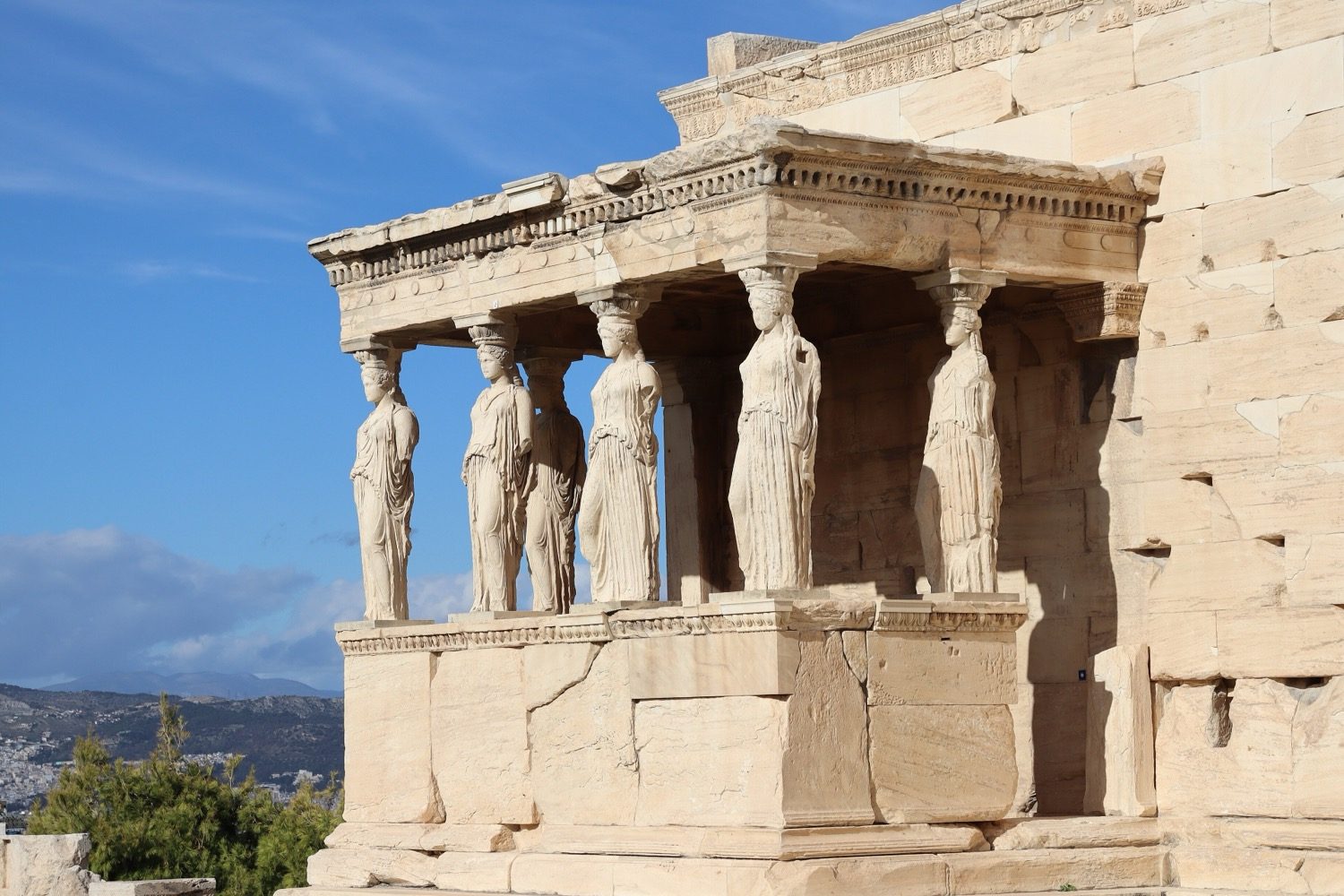
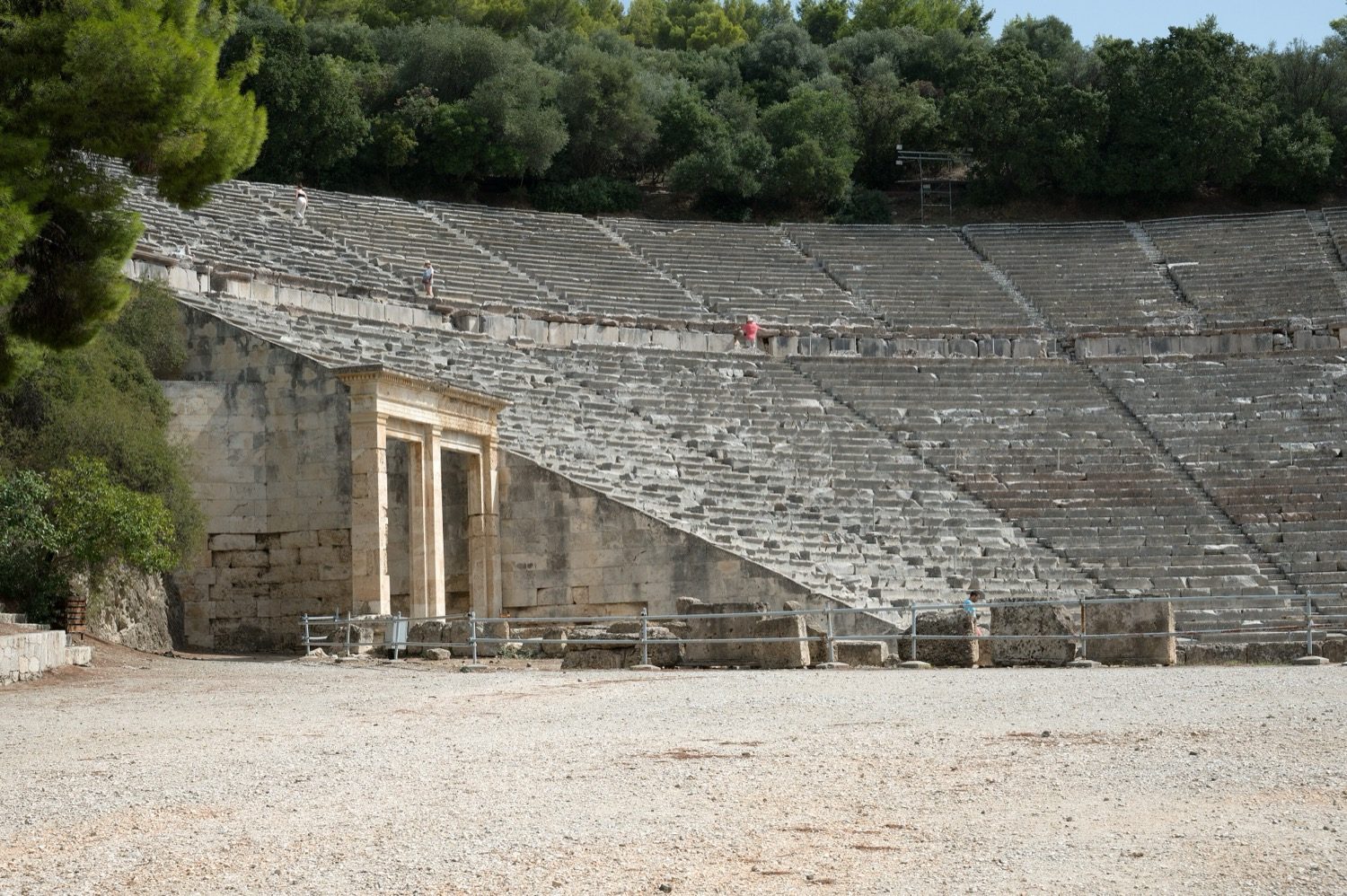
On the Athenian Acropolis stand the Doric Parthenon (Iktinos and Kallikrates, with its full suite of optical refinements), the Ionic Erechtheion with its Caryatid porch, and the monumental Propylaea gateway. Nearby, the Theatre of Epidaurus is the most perfect Greek open-air theatre — orchestra, cavea and skene — famous for acoustics.[3, 5]
The sacred citadel of Athens
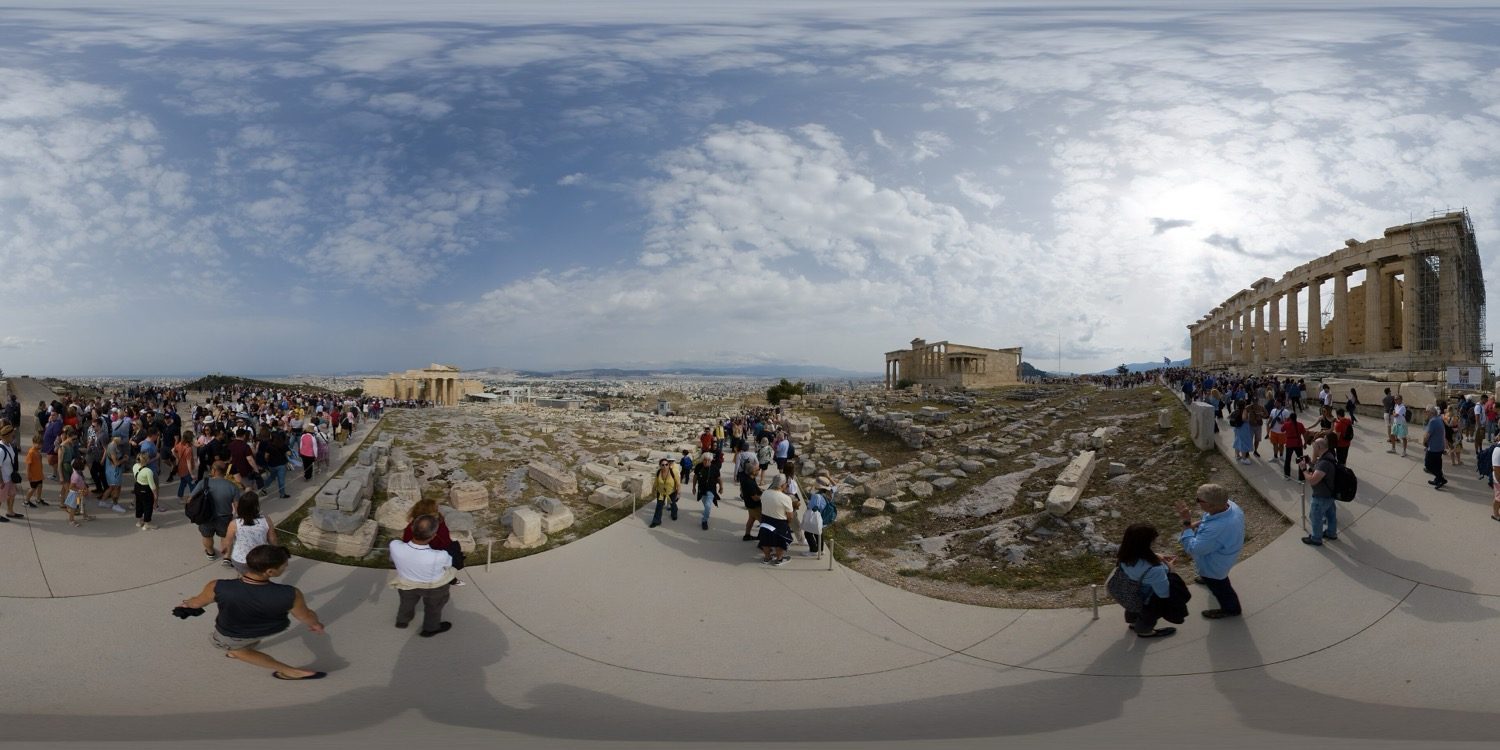
Rebuilt under Pericles after the Persian sack, with Phidias as artistic director — the Parthenon, Erechtheion, Temple of Athena Nike and the monumental Propylaea gateway (Mnesicles, 437–432 BCE). The planning is deliberately picturesque, set up for oblique three-quarter views as one ascends.[3, 4]
The orders compared
| Aspect | Doric | Ionic / Corinthian |
|---|---|---|
| Proportion | Doric: sturdy (~5.5 diameters) | Ionic / Corinthian: slender |
| Base | Doric: none — sits on the stylobate | Ionic / Corinthian: a moulded base |
| Capital | Doric: plain echinus + abacus | Ionic: volutes · Corinthian: acanthus |
| Frieze | Doric: triglyphs + metopes | Ionic: continuous frieze or dentils |
| Example | Doric: the Parthenon | Ionic: the Erechtheion |
Key terms
The slight convex swelling of a column shaft.
The top step the columns stand on (stylobate), over the lower stepped base (stereobate).
The grooved block and the square panel that alternate in the Doric frieze.
The spiral scroll of the Ionic capital.
The stylised leaf forming the Corinthian capital.
The main enclosed room housing the cult statue.
A colonnade running around the whole building (a peripteral temple).
A carved female figure used in place of a column.
Study task
Draw the three orders side by side, labelling base, shaft, capital and frieze, and naming one building for each. Then sketch a peripteral temple plan and mark the pronaos, naos and opisthodomos.
Self-assessment
1. The Parthenon is best described as a —
2. Entasis refers to the —
3. The Caryatid porch — figures of maidens used as columns — belongs to the —
Recap
References & further reading
- [1]Banister Fletcher, A History of Architecture (20th ed.). Architectural Press / RIBA, 1996.
- [2]A.W. Lawrence, Greek Architecture (rev. R.A. Tomlinson). New Haven: Yale University Press, 1996.
- [3]UNESCO World Heritage Centre — Acropolis, Athens (inscribed 1987). https://whc.unesco.org/en/list/404
- [4]Francis D.K. Ching, Mark Jarzombek & Vikramaditya Prakash, A Global History of Architecture. Wiley, 2007.
- [5]UNESCO World Heritage Centre — Sanctuary of Asklepios at Epidaurus (inscribed 1988). https://whc.unesco.org/en/list/491
Further reading
- A.W. Lawrence, Greek Architecture (Yale/Pelican History of Art).
- Spiro Kostof, A History of Architecture: Settings and Rituals.
- D.S. Robertson, A Handbook of Greek and Roman Architecture.
Sources gathered and fact-checked June 2026. Published values vary by source, sample and method — treat as indicative and confirm against the cited standard before structural use.
The author
Amogh N P
Architect, interior designer, and creative polymath. Studio Matrx began in his notebooks — his vision of design made honest, useful, and open to everyone. Its Academy is written and taught in his memory, and free, forever.
More about Amogh →