
Introduction to Islamic Architecture
The arch, the dome and the minaret arrive in India — and meet the temple-builder's chisel.
When the armies of the Delhi Sultanate arrived at the end of the twelfth century, they brought a wholly different way of building — one that spanned space with the true arch and dome, gathered worshippers in a courtyard mosque, and decorated with the written word and pure geometry rather than the figures of the temple. Yet the hands that raised these buildings were Indian. The story of this unit is that meeting: an imported form, executed by the temple-builder's chisel, slowly learning a new structural language.
Learning objectives
By the end of this lesson, you will be able to — mapped to the course outcomes for History of Architecture II:
Describe the defining elements of Islamic architecture — the arch, dome, minaret, mihrab and the courtyard-mosque plan.
Explain why ornament turned to calligraphy, arabesque and geometry, and how Hindu craftsmen executed Islamic forms.
Trace the move from corbelled (false) to true arcuate construction across the early Sultanate.
Distinguish the building character of the Slave, Khilji, Tughlaq and Lodi dynasties.
The vocabulary of Islamic architecture
Every congregational mosque shares the same parts: an open courtyard (sahn) fronting a covered prayer hall (liwan) on the Mecca-facing (qibla) side, with a niche (mihrab) and pulpit (mimbar), and towers (minarets) for the call to prayer.[2, 4] Hold this plan — it underlies every mosque in this course and the next.
Sahn, liwan and qibla
The congregational mosque is organised around an open courtyard (sahn) fronting a covered prayer hall (liwan) on the Mecca-facing (qibla) side. In the qibla wall a niche, the mihrab, marks the direction of prayer; beside it stands the stepped pulpit, the mimbar. Towers (minarets) carry the call to prayer.[2, 4]
Corbel to true arch — the structural story
India built by post-and-lintel (trabeate) and spanned openings with the corbelled “false” arch — courses stepped inward until they meet. Islam built by the true arch — wedge-shaped voussoirs locked by a keystone, working in pure compression. The early Sultanate screens are corbelled; the true arch arrives at Balban's tomb and reaches confident maturity at the Alai Darwaza in 1311.[3, 1] This single shift is the thread through every building below.
The Delhi Sultanate, dynasty by dynasty
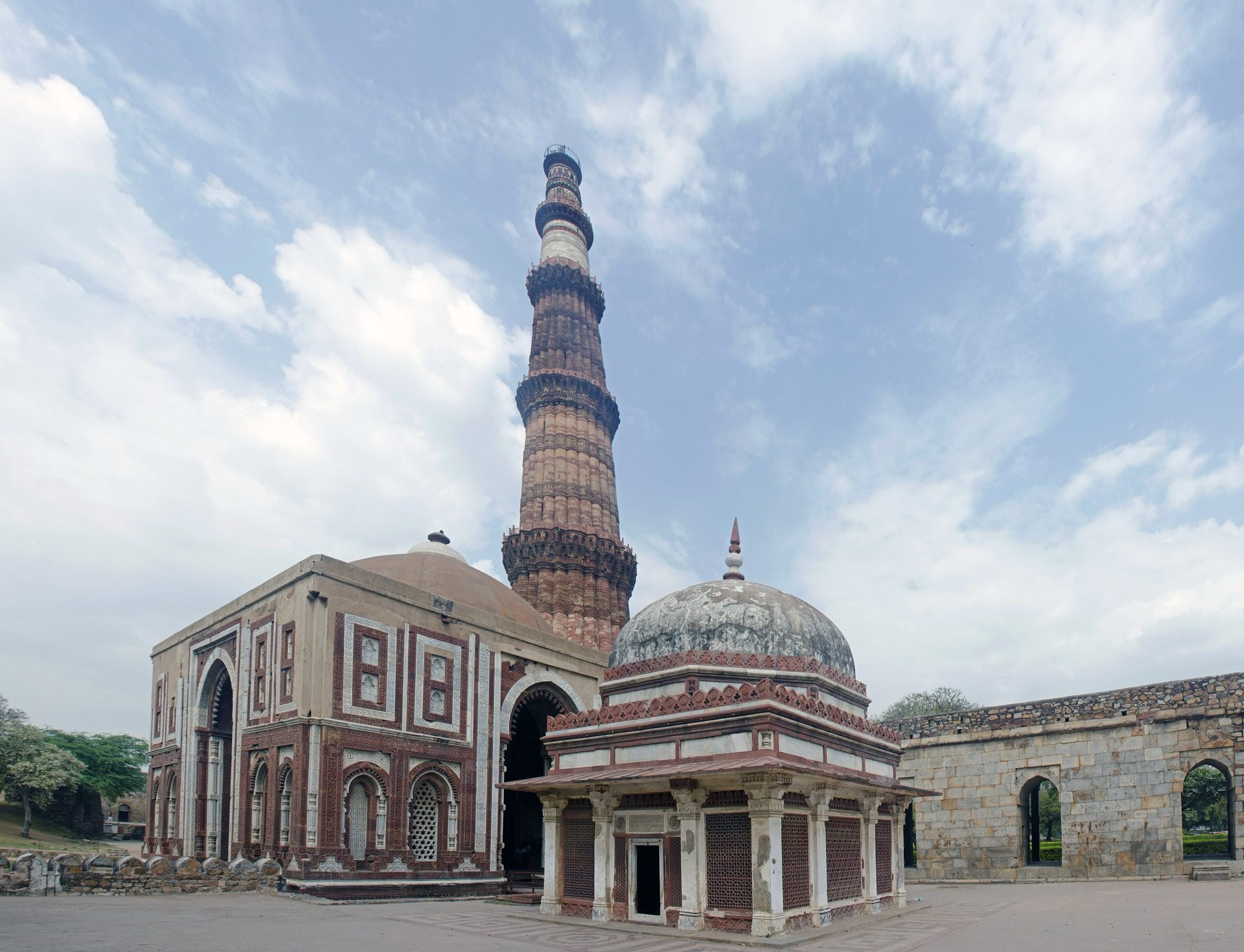
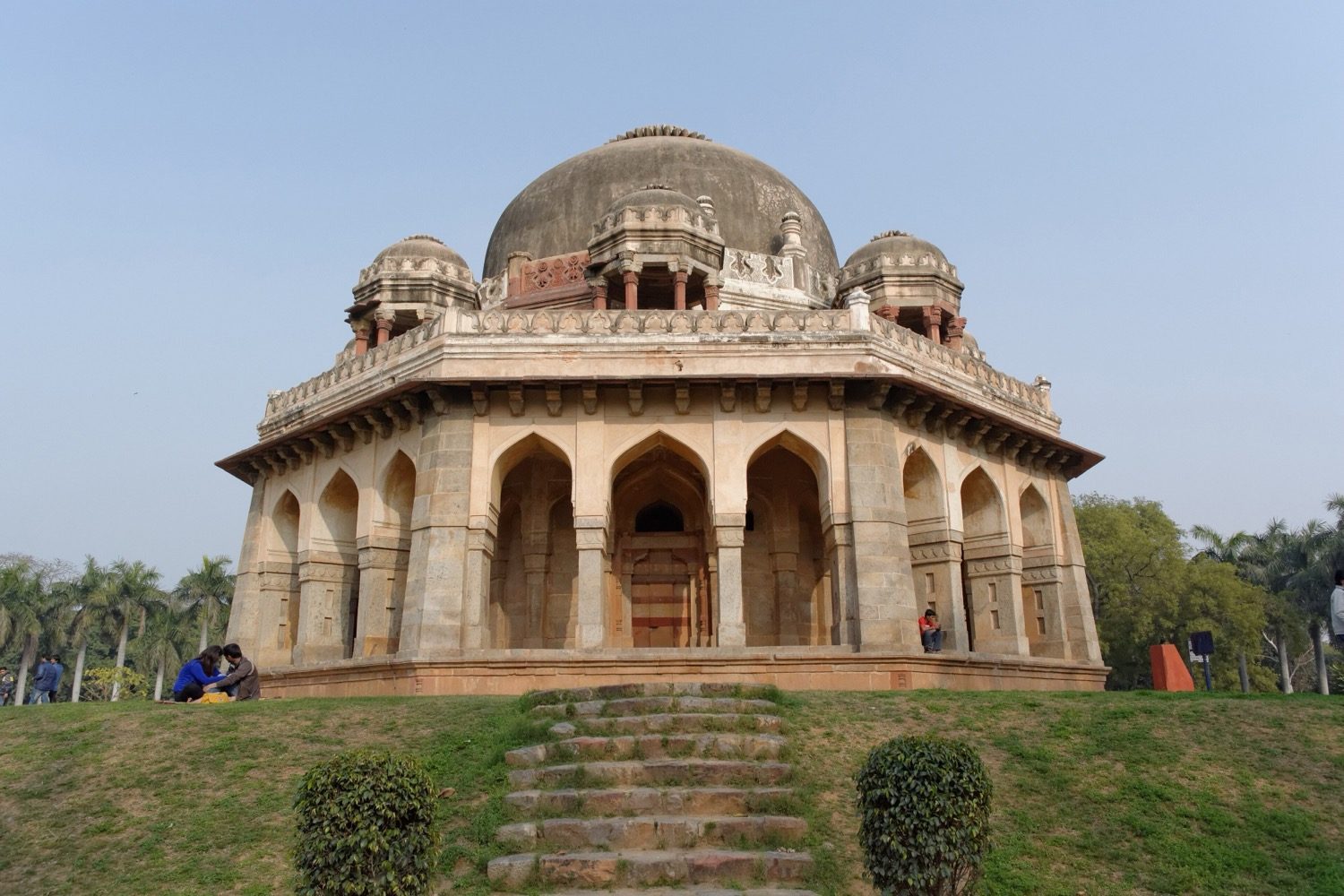
Read the Sultanate as a sequence of moods: the experimental, spolia-rich Slave dynasty (the Quwwat-ul-Islam mosque, the Qutb Minar); the Khilji mastery of the true arch (the Alai Darwaza); the austere, fortress-like Tughlaqs with their battered walls; and the Sayyid–Lodi age of the freestanding garden tomb.[3, 4]
Slave dynasty — the experiment (1206–90)
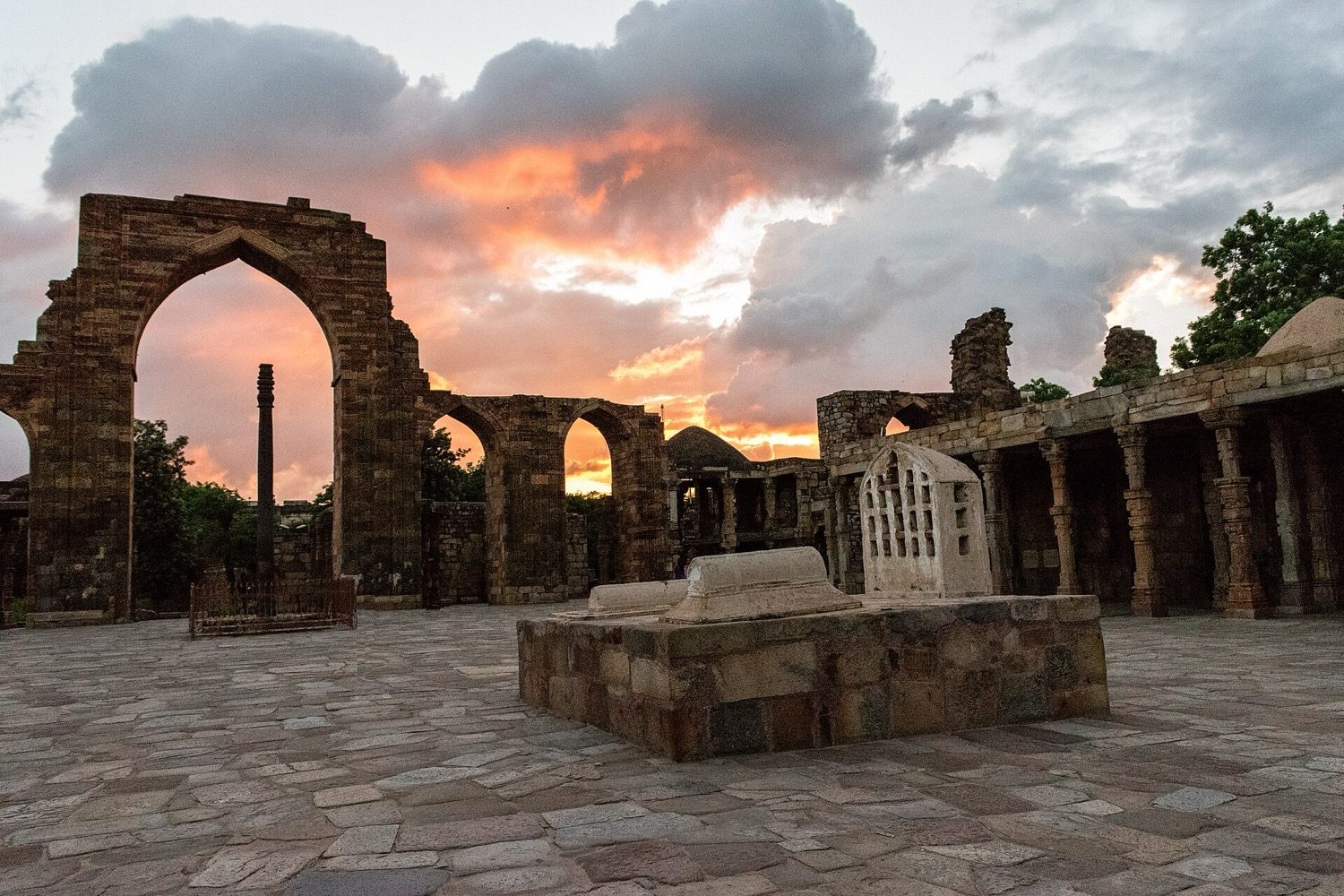
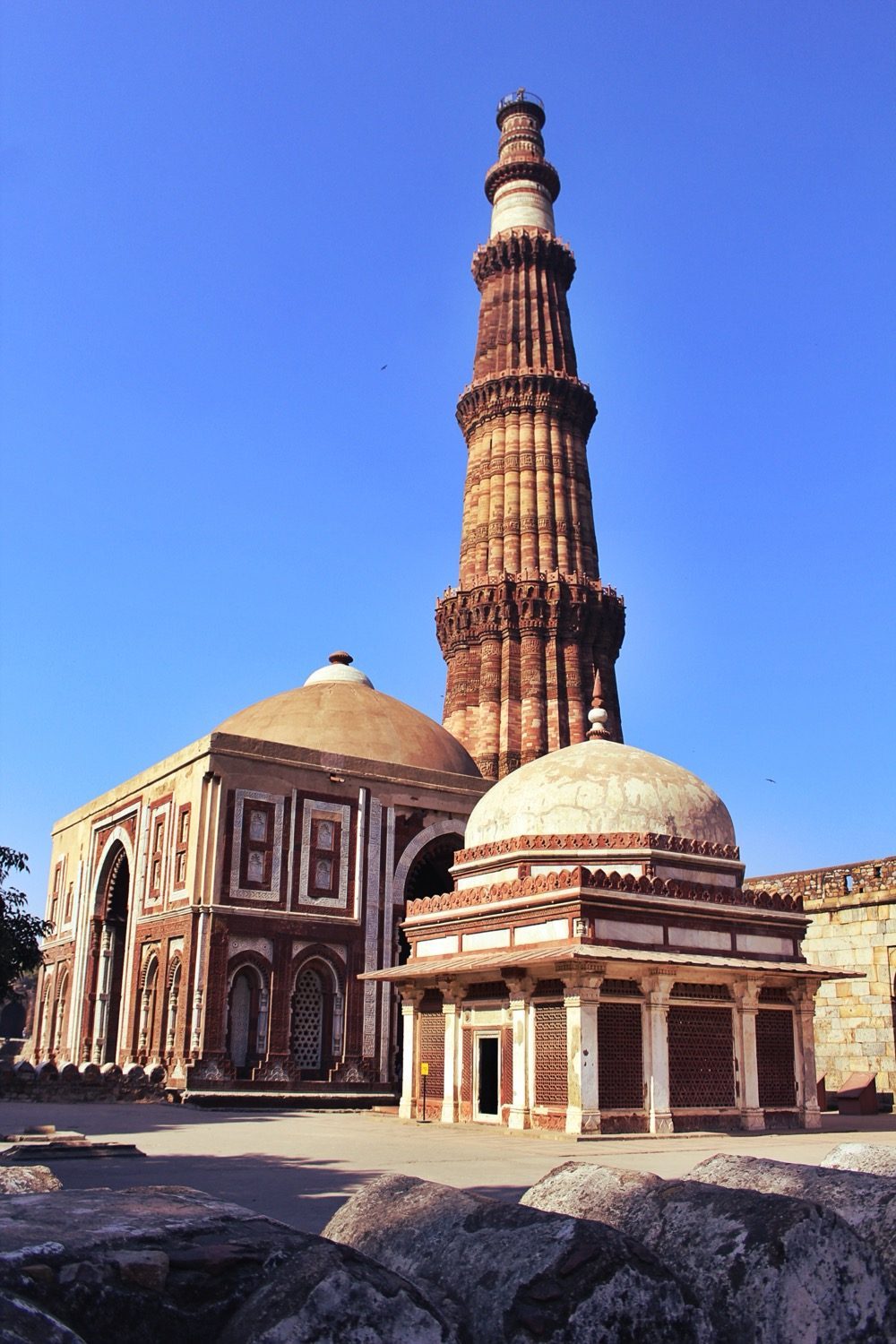
Transitional and spolia-rich. The Quwwat-ul-Islam Mosque (begun c. 1192) reused temple columns behind a great corbelled arched screen; Qutb-ud-din Aibak began the Qutb Minar, finished by Iltutmish. Arches here are decorative, not yet structural; Balban's tomb (c. 1287) is credited with India's first true arch.[3, 5]
Indigenous vs Islamic, and dynasty vs dynasty
| Aspect | Islamic / Khilji | Indigenous / Tughlaq |
|---|---|---|
| Spanning method | True arch (voussoirs) and true dome | Beam/lintel; corbelled 'false' arch |
| Load behaviour | Compression | Bending in lintels |
| Ornament | Calligraphy, arabesque, geometry — no figures | Figural sculpture, deities |
| Mood (Slave/Khilji vs Tughlaq) | Ornamented, experimental, vertical walls | Austere, fortress-like, sloping (battered) walls |
| Signature | Qutb Minar, Alai Darwaza | Tughlaqabad, Ghiyath al-Din's tomb |
Key terms
Niche in the qibla wall pointing to Mecca.
Stepped pulpit beside the mihrab for the sermon.
The open courtyard (sahn) and covered prayer hall (liwan) of a mosque.
A corner arch (squinch) or curved triangle (pendentive) that seats a round dome on a square room.
The wedge-shaped stones of a true arch, locked by the central keystone.
Indigenous post-and-lintel building vs Islamic arch-and-vault construction.
Pierced stone lattice screen of geometric or arabesque pattern.
Reused carved members salvaged from earlier (here, temple) buildings.
Study task
Draw, side by side, a corbelled arch and a true arch, labelling the courses, the voussoirs and the keystone. Then in two lines explain why the Alai Darwaza marks a turning point that the Quwwat-ul-Islam screen does not.
Self-assessment
1. The first true (arcuate) dome built on Islamic principles in India is generally credited to the —
2. Tughlaq architecture is best recognised by its —
3. The Qutb Minar was —
Recap
References & further reading
- [1]Banister Fletcher, A History of Architecture (20th ed.). Oxford: Architectural Press / RIBA, 1996.
- [2]Francis D.K. Ching, Mark Jarzombek & Vikramaditya Prakash, A Global History of Architecture. Hoboken: John Wiley & Sons, 2007.
- [3]Percy Brown, Indian Architecture (Islamic Period). Bombay: D.B. Taraporevala Sons, 1942.
- [4]Satish Grover, Islamic Architecture in India (2nd ed.). New Delhi: CBS Publishers, 1996.
- [5]UNESCO World Heritage Centre — Qutb Minar and its Monuments, Delhi (inscribed 1993). https://whc.unesco.org/en/list/233
Further reading
- Percy Brown, Indian Architecture (Islamic Period) — the standard reference for this unit.
- Satish Grover, Islamic Architecture in India.
- Catherine B. Asher, Architecture of Mughal India (New Cambridge History of India). Cambridge University Press, 1992.
Sources gathered and fact-checked June 2026. Published values vary by source, sample and method — treat as indicative and confirm against the cited standard before structural use.
The author
Amogh N P
Architect, interior designer, and creative polymath. Studio Matrx began in his notebooks — his vision of design made honest, useful, and open to everyone. Its Academy is written and taught in his memory, and free, forever.
More about Amogh →