
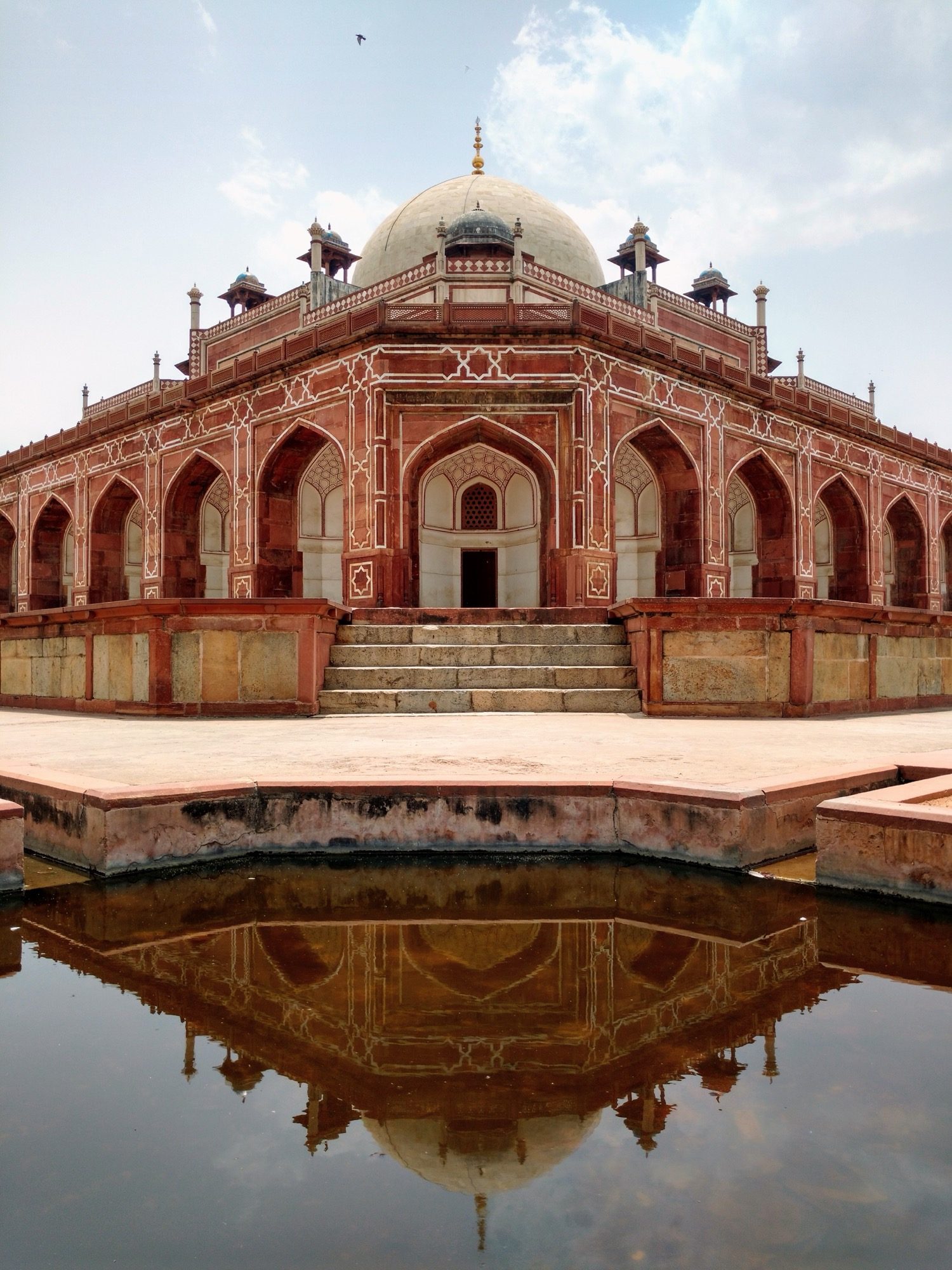
Provincial & Mughal Styles
Regional schools across India — and the Mughal road from red sandstone to white marble.
As central authority weakened, the provinces went their own way — and each grew an architecture from its own materials and crafts. Then a single dynasty unified the land and built the most famous architecture in India. This unit follows both stories: the regional provincial schools, and the Mughal road from Humayun's red-sandstone garden-tomb to the white marble of the Taj — all set within the four-quartered paradise garden.
Learning objectives
By the end of this lesson, you will be able to — mapped to the course outcomes for History of Architecture II:
Identify the major provincial schools and the local materials and craft that shaped each.
Trace the Mughal style ruler by ruler, from Humayun's tomb to the Taj Mahal.
Explain the shift from Akbar's red sandstone to Shah Jahan's white marble and pietra dura.
Read the charbagh garden-tomb as a four-quartered image of paradise.
The provincial styles
The provincial sultanates are distinct schools, not diluted Delhi: brick-and-glazed-tile Multan, the propylon screens of Jaunpur, terracotta Bengal with its curved roof, the temple-craft fusion of Gujarat, and the great Deccan domes of Bijapur.[3, 4]
The Mughals, ruler by ruler
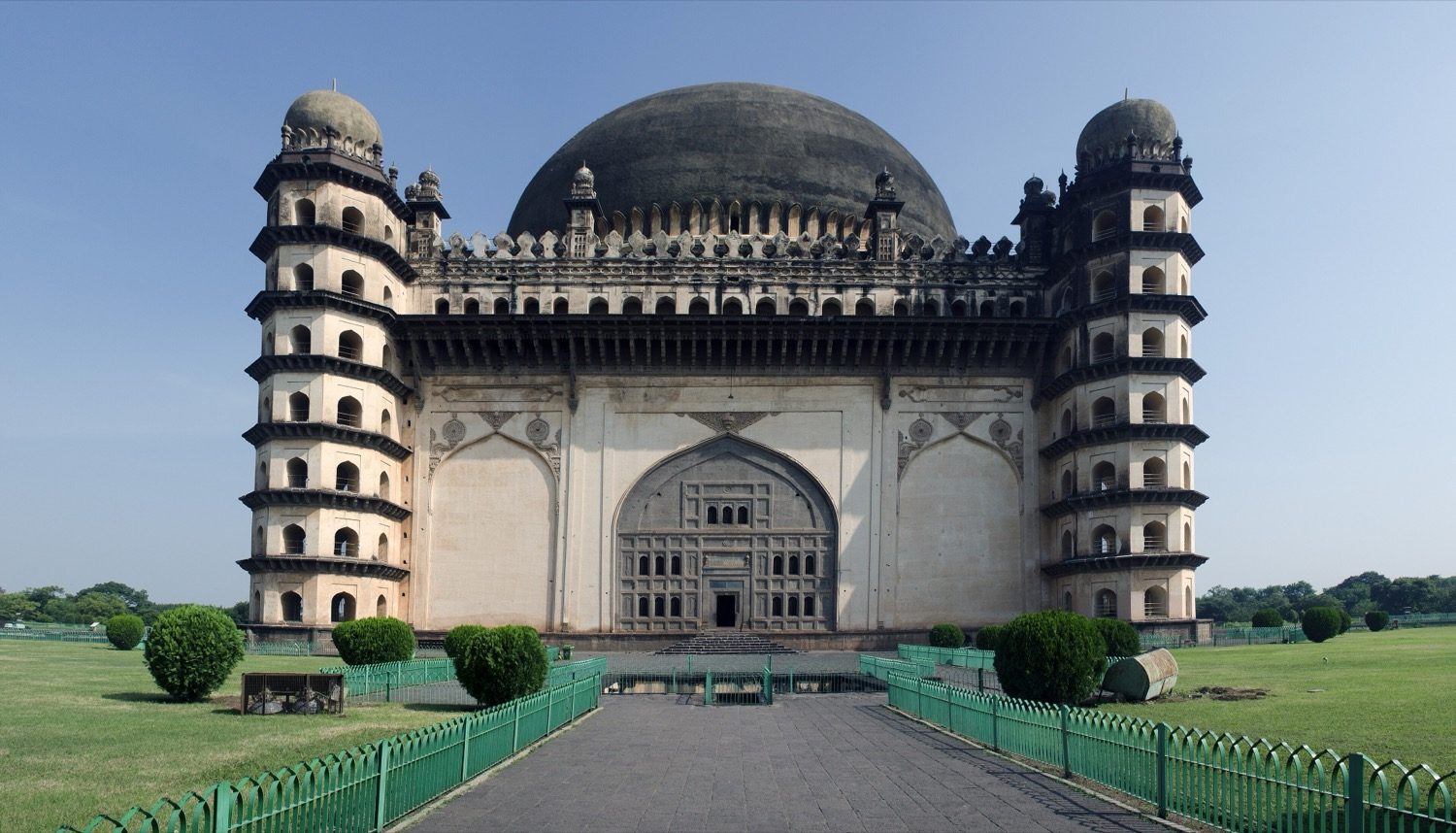
The Mughal line is a story of materials and refinement: Babur's gardens, Humayun's first charbagh garden-tomb, Akbar's syncretic red sandstone, Jahangir's turn to marble and pietra dura, Shah Jahan's marble zenith, and Aurangzeb's decline.[1, 8]
Gardens and a bridge (1526–55)
Babur's short reign left mainly gardens and victory mosques (Kabuli Bagh, Panipat). The Sur interregnum of Sher Shah was crucial: the octagonal Sher Shah Suri Tomb at Sasaram rises from an artificial lake, and the refined Qila-i-Kuhna mosque in Delhi pointed the way forward.[1, 5]
Akbar vs Shah Jahan
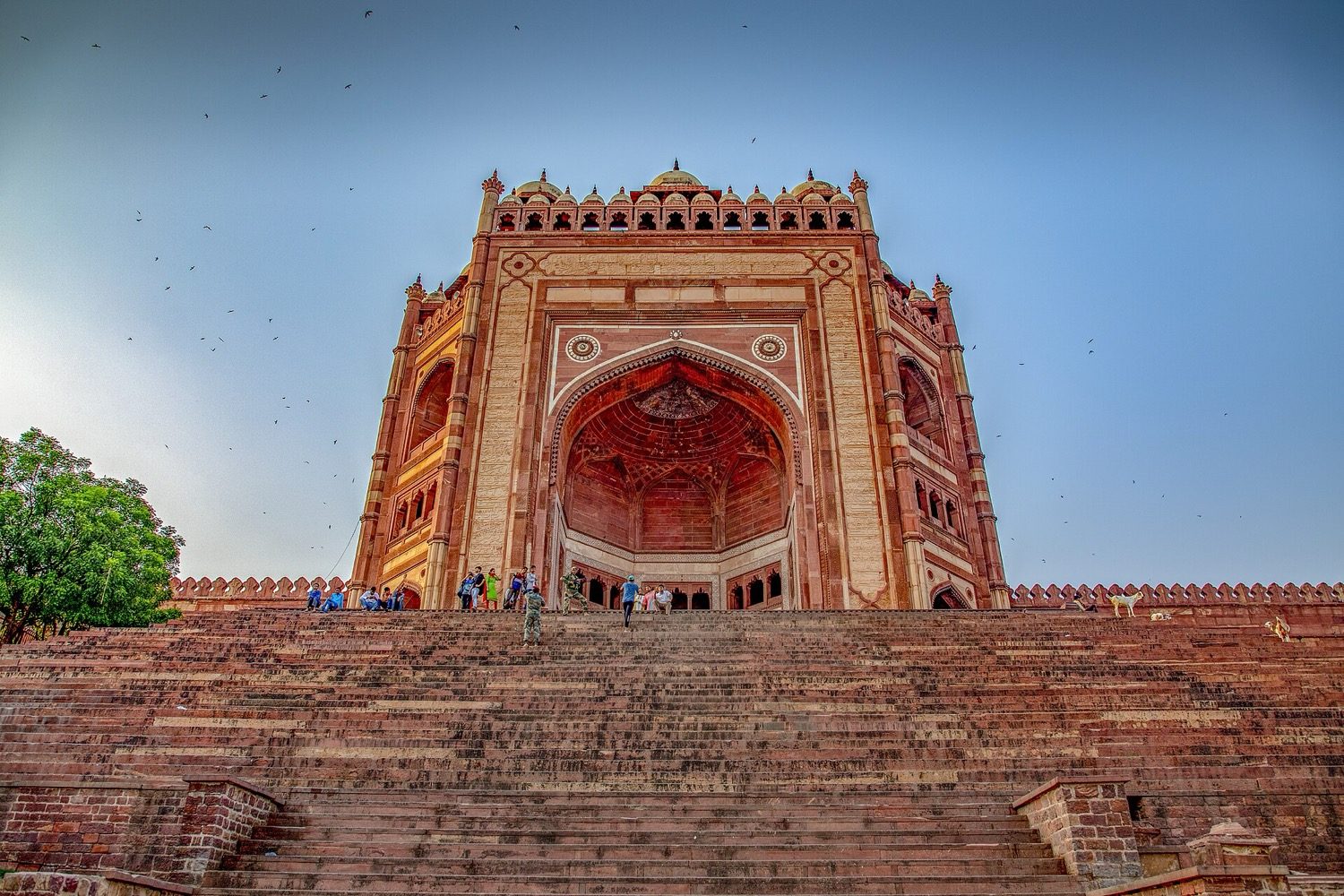
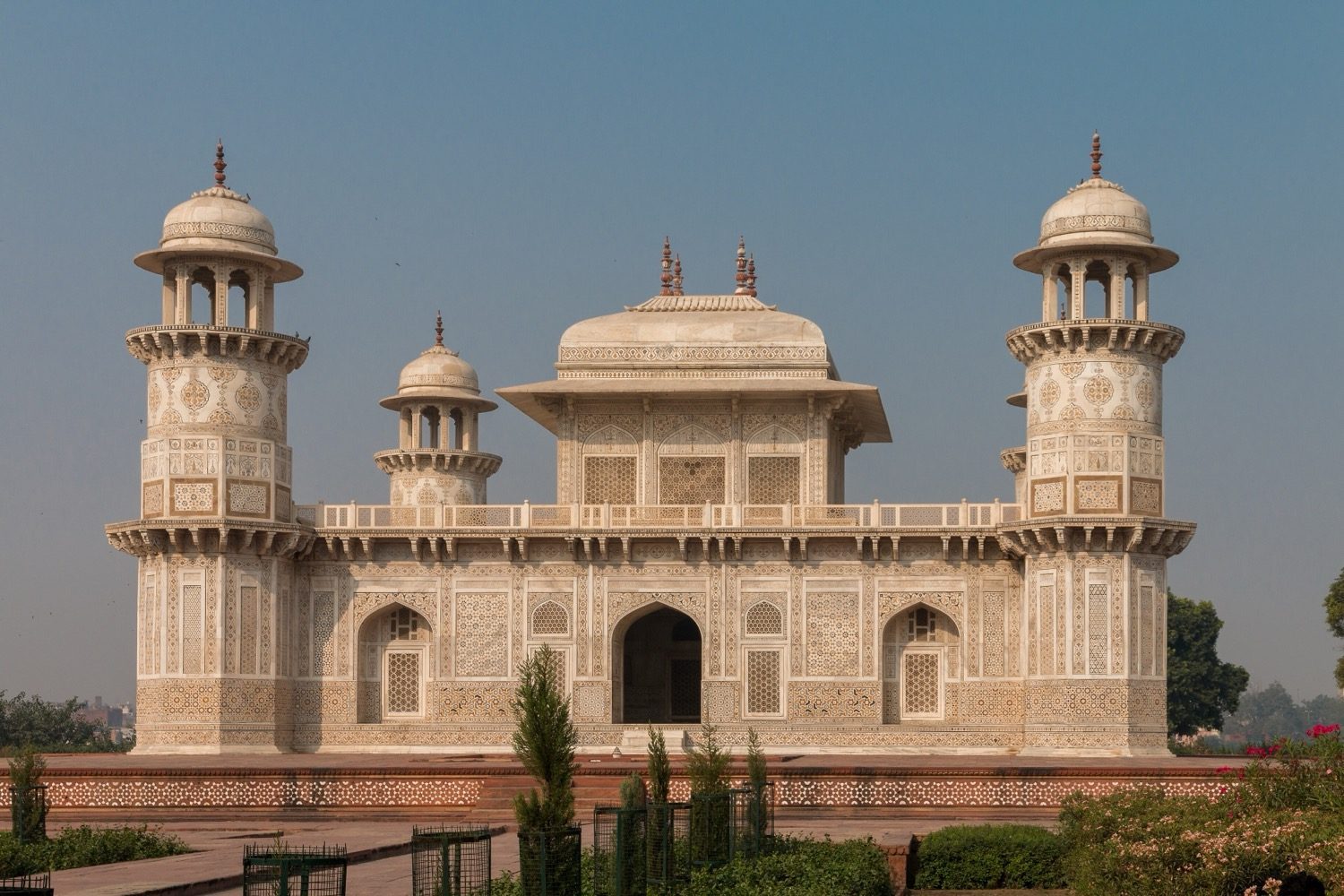
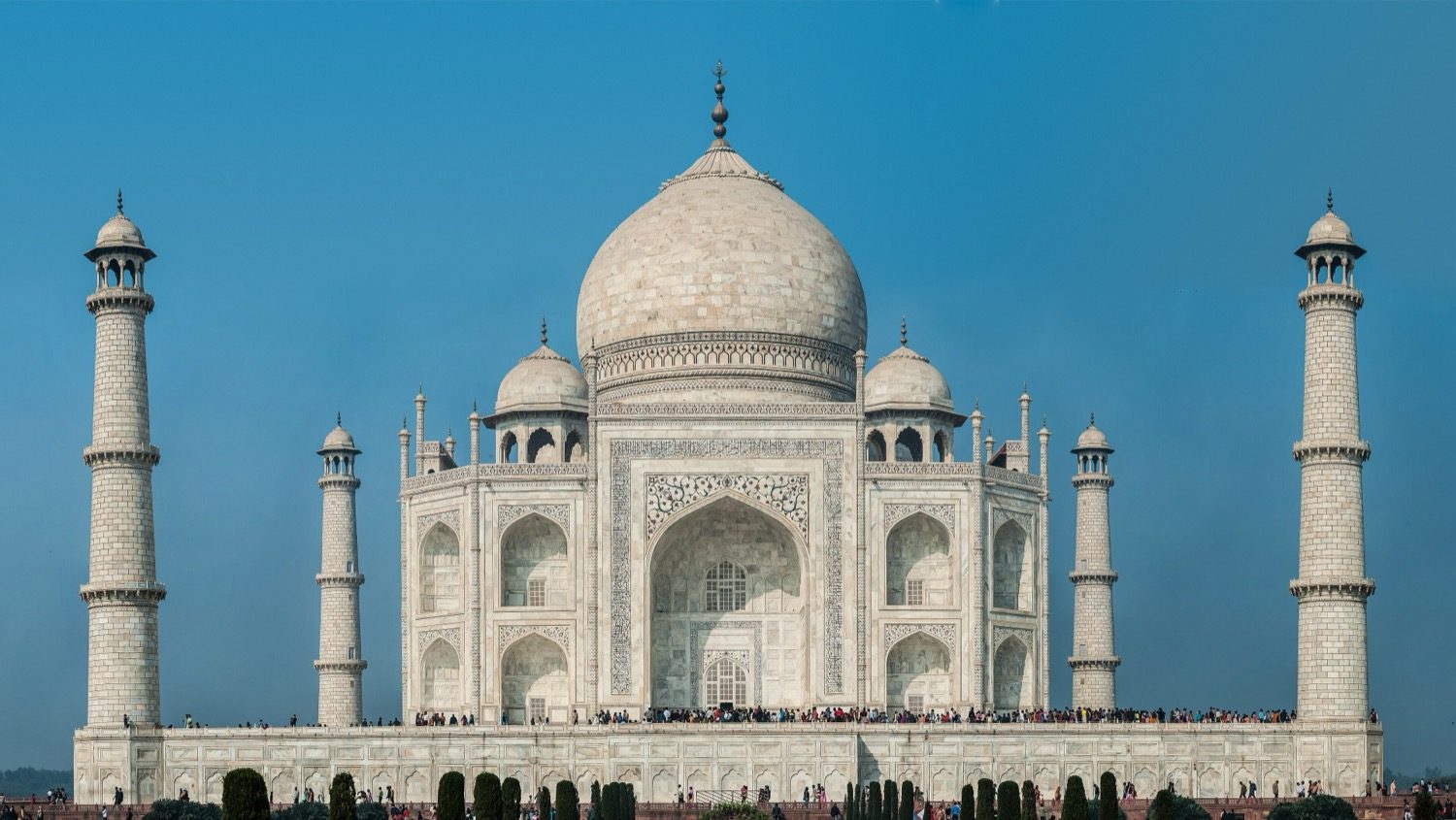
The clearest way to read Mughal change is to set Akbar's robust red sandstone against Shah Jahan's jewel-like white marble — and watch the arch turn cusped and the dome turn bulbous.
| Aspect | Akbar | Shah Jahan |
|---|---|---|
| Material | Akbar: red sandstone (marble accents) | Shah Jahan: white marble, pietra dura |
| Structure | Trabeate + arcuate mix | Predominantly arcuate |
| Arch form | Plain / pointed | Cusped, foliated (multifoil) |
| Dome | Lower, Indian-influenced | Bulbous (onion) double dome |
| Spirit | Syncretic, robust | Refined, symmetrical, jewel-like |
The charbagh — a garden of paradise
The Mughal tomb sits within a charbagh — a square garden split into four quadrants by two axial water channels, evoking the rivers of paradise. The tomb is raised on a platform: centrally at Humayun's Tomb, but innovatively on the riverfront edge at the Taj, so the garden reads as foreground.[1, 5]
Key terms
Four-quartered paradise garden divided by two axial water channels.
A tall framed entrance arch (pishtaq) over a vaulted, open-fronted recess (iwan).
Two masonry shells — a lower inner dome and a taller outer dome for silhouette.
An outer dome that swells beyond the drum before narrowing — a Shah Jahani hallmark.
An arch with scalloped lobes along its underside — the signature Shah Jahani arch.
Inlay of semi-precious stones into marble to form floral and geometric designs.
Domed pillared kiosk used on roofs and corners — an Indian element absorbed by the Mughals.
Curved sloping roof derived from the Bengali thatched hut, absorbed into Mughal vocabulary.
Study task
Pick any two provincial schools and, in a short paragraph each, name the local material and the single feature that makes the school recognisable. Then sketch a charbagh plan and mark where the Taj places its tomb compared with Humayun's.
Self-assessment
1. The first Mughal building executed entirely in white marble with extensive pietra dura is the —
2. The Jami Masjid at Gulbarga is architecturally unusual because it —
3. Humayun's Tomb is historically most significant as the —
Recap
References & further reading
- [1]Catherine B. Asher, Architecture of Mughal India (New Cambridge History of India I.4). Cambridge University Press, 1992.
- [2]Banister Fletcher, A History of Architecture (20th ed.). Architectural Press / RIBA, 1996.
- [3]Percy Brown, Indian Architecture (Islamic Period). D.B. Taraporevala Sons, 1942.
- [4]Satish Grover, Islamic Architecture in India. CBS Publishers, 1996.
- [5]UNESCO World Heritage Centre — Humayun's Tomb, Delhi (inscribed 1993). https://whc.unesco.org/en/list/232
- [6]UNESCO World Heritage Centre — Fatehpur Sikri (inscribed 1986). https://whc.unesco.org/en/list/255
- [7]UNESCO World Heritage Centre — Agra Fort (inscribed 1983). https://whc.unesco.org/en/list/251
- [8]UNESCO World Heritage Centre — Taj Mahal (inscribed 1983). https://whc.unesco.org/en/list/252
Further reading
- Catherine B. Asher, Architecture of Mughal India — the standard modern reference.
- Percy Brown, Indian Architecture (Islamic Period).
- Ebba Koch, Mughal Architecture: An Outline of its History and Development.
Sources gathered and fact-checked June 2026. Published values vary by source, sample and method — treat as indicative and confirm against the cited standard before structural use.
The author
Amogh N P
Architect, interior designer, and creative polymath. Studio Matrx began in his notebooks — his vision of design made honest, useful, and open to everyone. Its Academy is written and taught in his memory, and free, forever.
More about Amogh →