
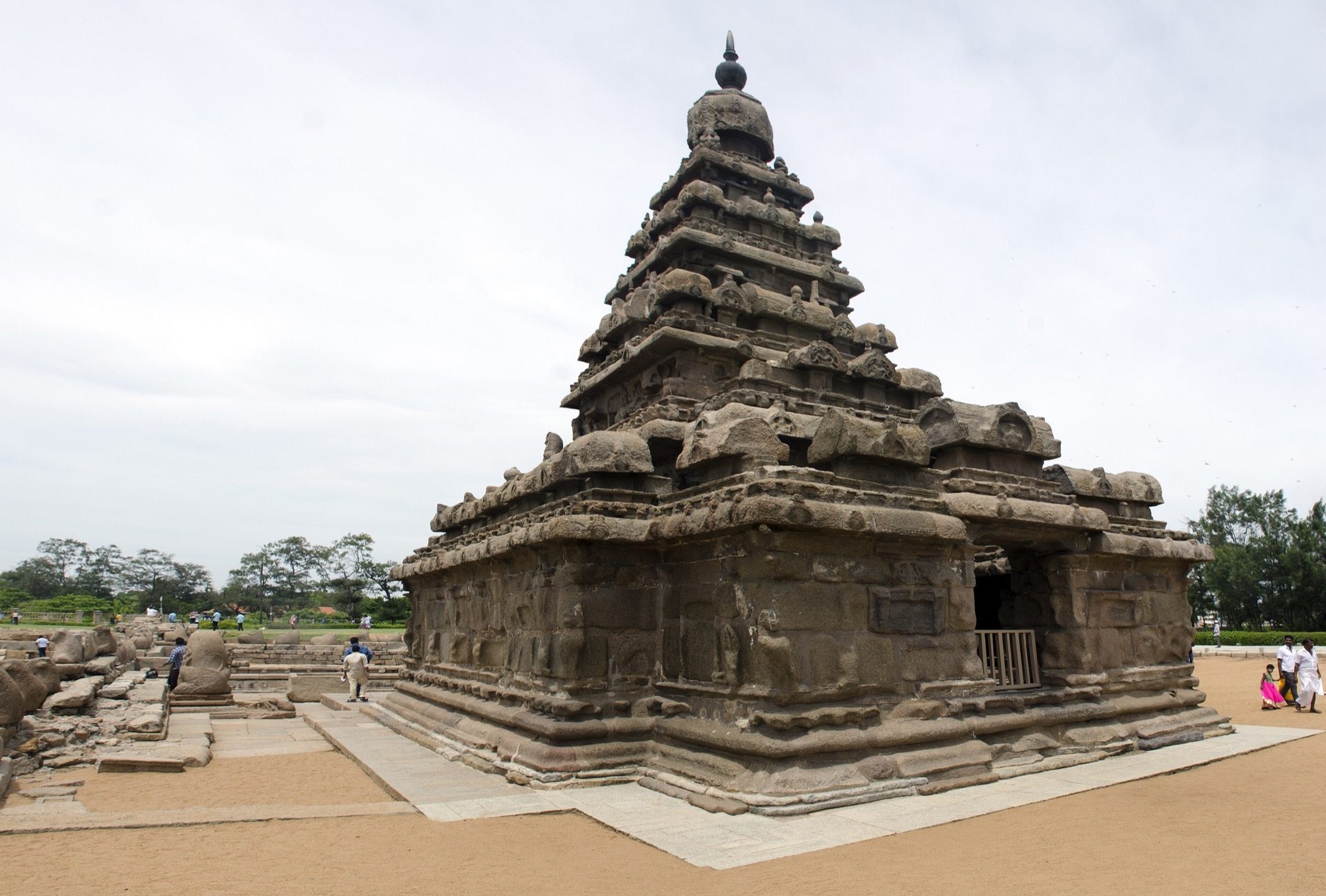
The Dravidian Temple — Pallava Beginnings
How the South Indian temple was born — in living rock, then in stone.
The South Indian temple is one of the world's great architectural traditions — and we can watch it being invented. Under the Pallavas of Kanchipuram and Mahabalipuram, in barely two centuries, the temple moved from a shrine cut into rock, to whole temples carved from single boulders, to temples built stone-by-stone. By the end the Dravidian order — sanctum, tower, hall, gateway and wall — was fixed, and every later dynasty would work from it.
Learning objectives
By the end of this lesson, you will be able to — mapped to the course outcomes for History of Architecture I:
Label the parts of a Dravidian temple and explain the role of each.
Define the Dravidian order and how it differs from the northern Nagara temple.
Trace the Pallava progression from rock-cut to monolithic to structural temples.
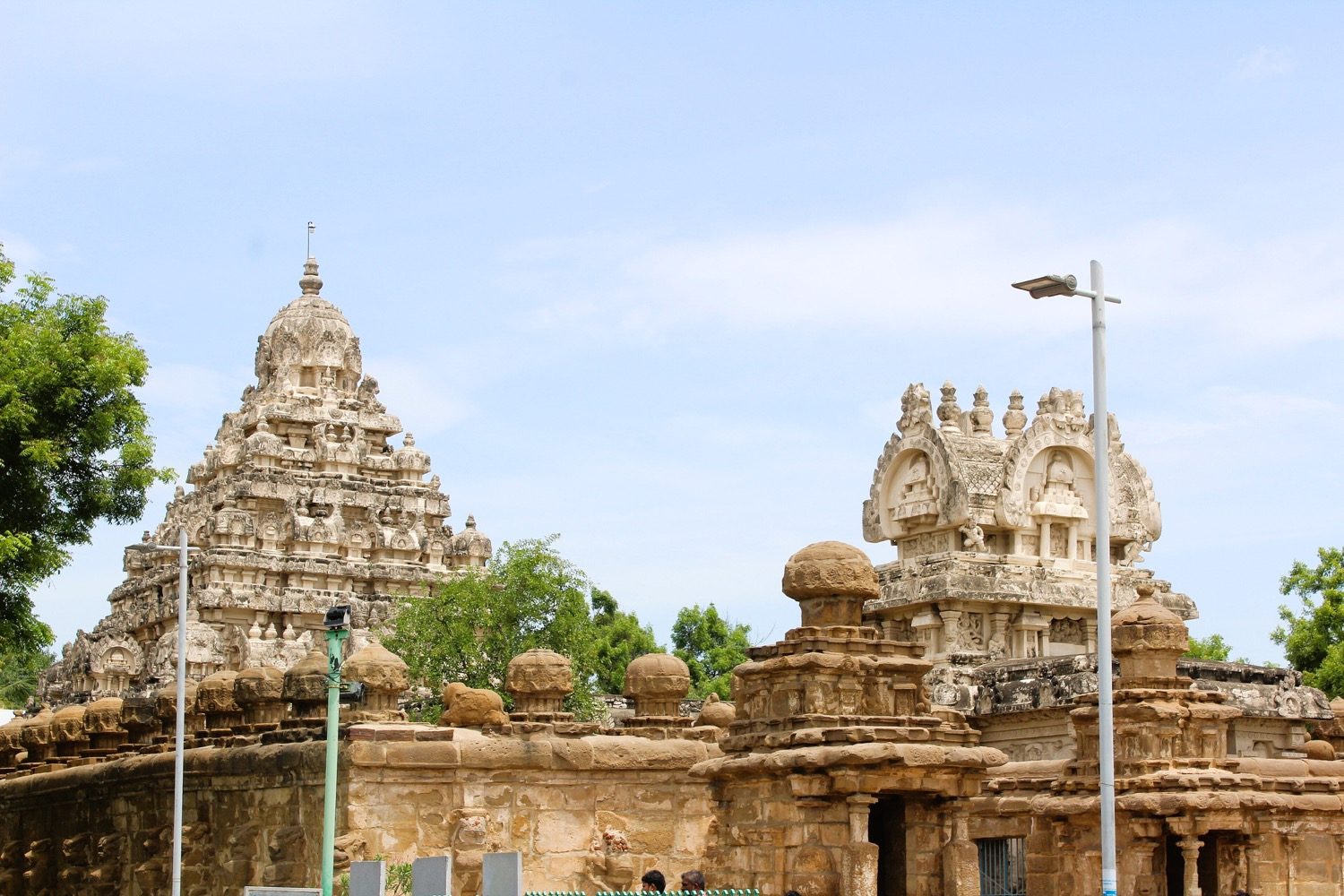
Read the Shore Temple and Kailasanatha as the first structural Dravidian temples.
The parts of a Dravidian temple
At the heart is the garbhagriha, the small dark sanctum, over which rises the pyramidal vimana tower capped by a stupi. In front, a pillared mandapa hall is linked by a short antarala vestibule. The whole stands in a walled prakara enclosure, entered through a towered gopuram gateway.[3, 1] Hold these names — every temple in the next two units is a variation on this diagram.
How the Pallavas invented the temple
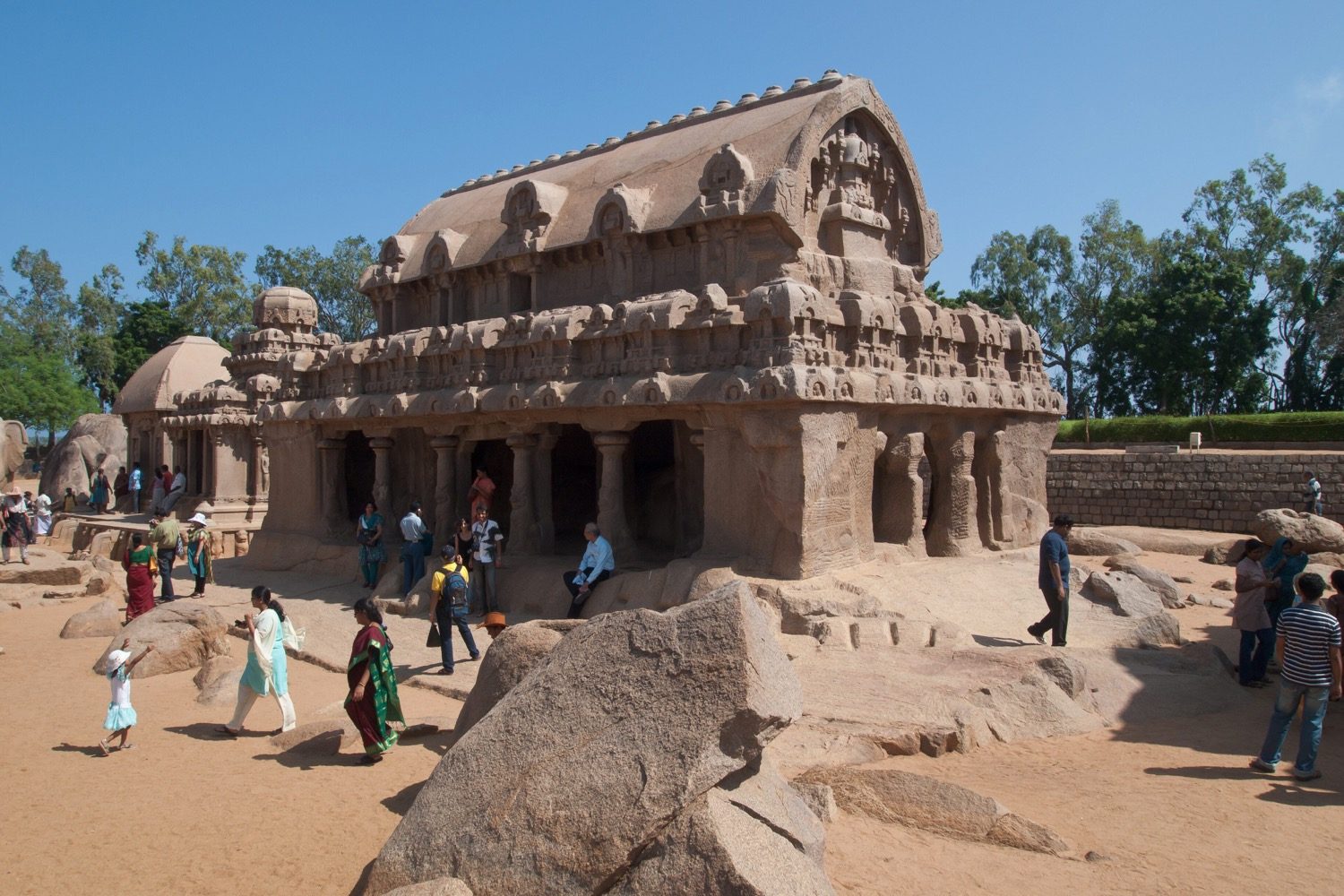
The Pallava progression is the clearest case study in Indian architecture: first rock-cut mandapas; then the monolithic Pancha Rathas at Mahabalipuram, each a different temple type carved whole from the granite; finally the structural temples — the Shore Temple by the sea and the larger Kailasanatha at Kanchipuram, the prototype of all that follows.[1, 4]
Dravida vs Nagara — two temple orders
India developed two great temple orders. The southern Dravida uses a stepped pyramidal vimana and a walled, gateway-pierced complex; the northern Nagara uses a curving beehive shikhara on a compact shrine. (There is a third, the Vesara, that blends them — but this course follows the Dravidian line.)
| Aspect | Dravida (South) | Nagara (North) |
|---|---|---|
| Region | Dravida — South India | Nagara — North India |
| Tower | vimana — stepped pyramid of talas | shikhara — curving beehive spire |
| Finial | octagonal/domed stupi | amalaka disc + kalasha |
| Enclosure | walled, with gopuram gateways | usually no monumental gateway |
| Plan emphasis | horizontal complex, tank, mandapas | compact, vertical shrine |
Study task
Draw a labelled section of a Dravidian temple naming all eight parts. Then sketch the Shore Temple at Mahabalipuram and, in two lines, explain why it counts as “structural” rather than rock-cut.
Self-assessment
1. The pyramidal tower over the sanctum of a Dravidian temple is the —
2. The Pancha Rathas at Mahabalipuram are —
3. Which is the prototype 'first structural' Pallava temple that later Dravidian temples follow?
Recap
References & further reading
- [1]UNESCO World Heritage Centre — Group of Monuments at Mahabalipuram (inscribed 1984). https://whc.unesco.org/en/list/249
- [2]Francis D.K. Ching et al., A Global History of Architecture. Wiley, 2007.
- [3]Percy Brown, Indian Architecture (Buddhist and Hindu Period). Taraporevala & Sons, 1983.
- [4]Satish Grover, The Architecture of India (Buddhist and Hindu). Vikas Publishing, 1981.
- [5]Christopher Tadgell, The History of Architecture in India. Longman, 1990.
Further reading
- Percy Brown, Indian Architecture (Buddhist and Hindu Period).
- George Michell, The Hindu Temple: An Introduction to its Meaning and Forms. University of Chicago Press.
- Adam Hardy, Indian Temple Architecture: Form and Transformation.
Sources gathered and fact-checked June 2026. Published values vary by source, sample and method — treat as indicative and confirm against the cited standard before structural use.
The author
Amogh N P
Architect, interior designer, and creative polymath. Studio Matrx began in his notebooks — his vision of design made honest, useful, and open to everyone. Its Academy is written and taught in his memory, and free, forever.
More about Amogh →