
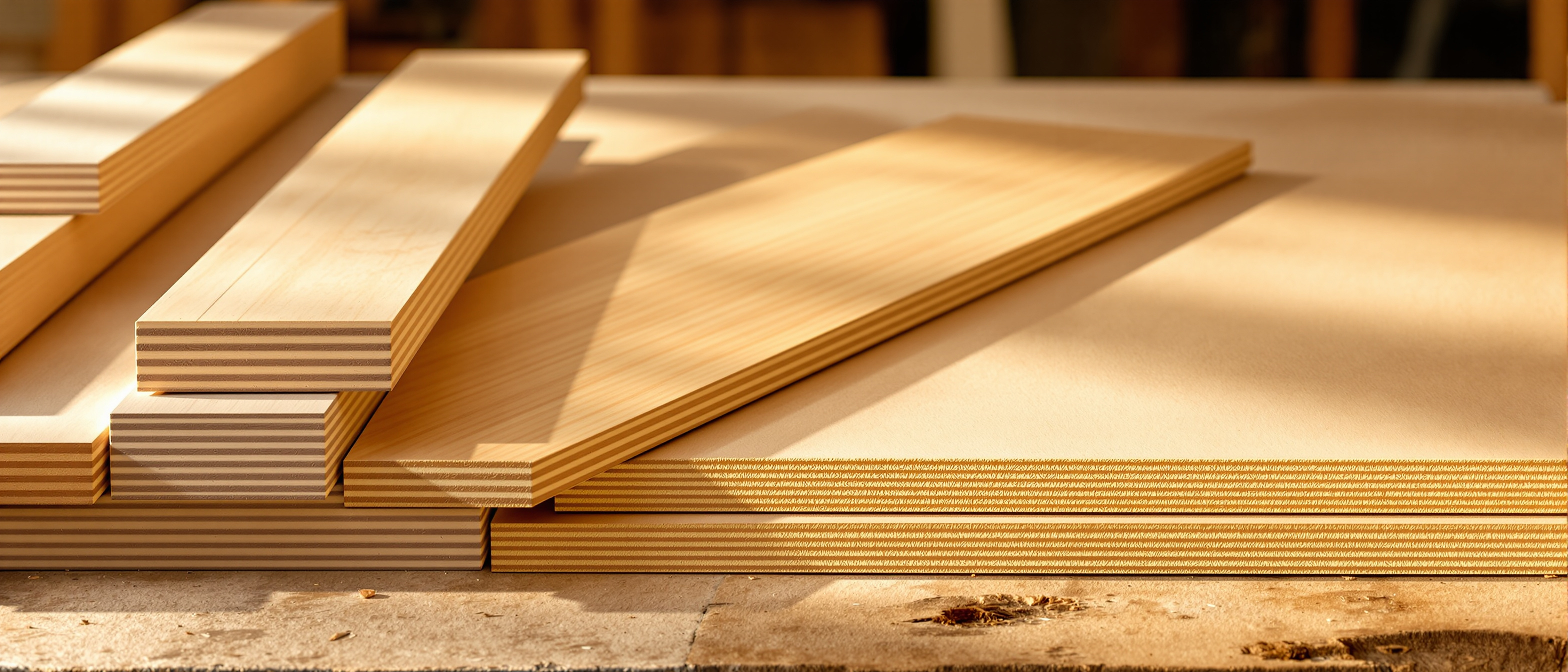
Wood & Wood-Based Panels
Wood is a living material that moves — and 'hardwood' isn't a hardness
Every good furniture-maker knows one thing beginners miss: wood is alive, and it moves. It takes up and gives off moisture with the humidity around it, swelling and shrinking for its whole life — mostly across the grain — so the first law of furniture construction is to design with that movement, never against it. This unit builds the material foundation: why wood moves, why ‘hardwood’ is a botany and not a hardness, how plywood, MDF, particle board and blockboard each have a right job, and why a good board often beats solid wood — with veneer being real wood, not fake.
Learning objectives
By the end of this lesson, you will be able to — mapped to the course outcomes for Furniture Construction & Detailing:
Explain that wood is hygroscopic and moves with humidity (mostly across the grain), and why you design with it.
State that 'hardwood/softwood' is a botanical split, not a hardness, and select timber by species.
Match plywood, MDF, HDF, particle board and blockboard to the right furniture job.
Judge solid wood vs board by stability, and distinguish veneer (real wood) from laminate (printed plastic).
Wood is a living material
Wood is hygroscopic: it swells and shrinks with humidity forever, mostly across the grain. So panels must float, wide tops need breadboard ends, and you never pin wood rigidly across the grain. And ‘hardwood’ is a botany (broadleaf vs conifer), not a hardness — balsa is a hardwood.[1]
The first law of furniture
Wood is HYGROSCOPIC: it absorbs and releases moisture with the air around it, swelling in the humid monsoon and shrinking in the dry season, for as long as it exists. And it moves unevenly — a lot ACROSS the grain, very little along it, and more tangentially than radially. So the first law of furniture construction is to design WITH the movement: let a solid panel float in its frame, give a wide top breadboard ends or buttons, and never pin wood rigidly across the grain, or it will split. Every good detail in this course respects wood movement.[1]
Explore — the board & timber decoder
The furniture-maker’s whole material palette in one place — solid timbers, engineered boards and surfaces. Filter by category; each card shows what it really is, its best furniture use, and its honest weakness, graded VERIFIED, NUANCED or MYTH.
Board & timber decoder · the maker’s materials, honestly
Each material shows what it is, its best furniture use and its real weakness — graded VERIFIED, NUANCED or MYTH.
Teak (Sagwan)
Premium solid hardwood
Is: India's benchmark furniture timber — dense, naturally oily, dimensionally stable for a solid wood, and resistant to termites and water.
Best for: Heirloom furniture, doors, outdoor and bathroom joinery where its natural durability earns its high cost.
Weakness · Expensive and increasingly scarce; still moves with humidity (all solid wood does), so wide panels must be detailed to float.
Sheesham (Indian rosewood)
Hard solid hardwood
Is: A hard, dense, richly-grained Indian hardwood (Dalbergia sissoo) — the classic carved-furniture timber of North India.
Best for: Carved and turned furniture, beds, dining tables, chairs — pieces that want strength and figure.
Weakness · Heavy, hard to work, and prone to movement and checking if not properly seasoned; darker sapwood variation.
Mango wood
Affordable solid hardwood
Is: A sustainable, medium-density hardwood from timed-out fruit trees — attractive grain, takes stain and paint well.
Best for: Affordable modern solid-wood furniture, sideboards, tables — an eco-friendlier alternative to slow-growing hardwoods.
Weakness · Softer and less durable than teak or sheesham; susceptible to insects and moisture without treatment.
Rubberwood
Plantation solid hardwood
Is: The plantation-grown timber of tapped-out rubber trees — pale, even-grained, and genuinely eco-friendly (a by-product).
Best for: Budget and flat-pack solid furniture, table tops, often finger-jointed into wider boards.
Weakness · Low natural durability — must be pressure-treated against fungus and borers; not for damp or outdoor use.
Pine / softwood
Light solid softwood
Is: A light, inexpensive, fast-growing softwood — easy to work and to finish, with visible knots.
Best for: Rustic and painted furniture, cheap shelving, box frames, cores and hidden structure.
Weakness · Soft (dents easily), knotty, and it moves a lot — 'softwood' here really is soft, but remember hardness is not what the botanical name means.
Plywood (MR grade)
Cross-laminated board
Is: Thin wood veneers cross-bonded so the grain alternates — strong, light, and it holds screws far better than MDF. MR = moisture-RESISTANT.
Best for: The workhorse carcase board for interior furniture, wardrobes and cabinets.
Weakness · 'MR' is moisture-resistant, NOT waterproof — it is only for dry interiors; it delaminates if soaked. Use BWR/marine for wet areas.
Marine / BWR plywood
Boil-resistant board
Is: Plywood bonded with boil-water-resistant (BWR) or boil-waterPROOF (BWP/marine, IS 710) glue — the water-tolerant grade.
Best for: Kitchens, bathrooms and any damp-exposed furniture; genuine marine ply for boats and permanently-wet use.
Weakness · Costlier; only IS 710 marine is truly boil-proof — 'waterproof plywood' is loosely used, so check the actual grade and IS mark.
MDF
Medium-density fibreboard
Is: Wood fibres bonded under heat and pressure into a dense, perfectly smooth, uniform board with no grain — ideal for painting and routing.
Best for: Painted shutters, routed and moulded doors, CNC work, speaker boxes — anywhere a flawless painted surface matters.
Weakness · Weak at holding screws in its edges, sags over long unsupported spans, heavy, and it swells and crumbles if it gets wet.
HDF
High-density fibreboard
Is: A denser, harder version of MDF — stiffer and more damage-resistant.
Best for: Laminate-flooring cores, cabinet backs, door skins and thin panels that must stay flat.
Weakness · Even heavier than MDF and, like all fibreboard, poor in water; overkill (and cost) where MDF or ply would do.
Particle board
Chipboard
Is: Wood chips and shavings bonded with resin — the cheapest, flattest board, usually sold pre-laminated.
Best for: Budget and flat-pack modular furniture, cabinet carcases and shelves that will be faced and not over-loaded.
Weakness · The weakest board — poor screw-hold, sags under load, and swells irreversibly if it meets water. Not 'rubbish', but know its limits.
Blockboard
Batten-core board
Is: A core of solid softwood battens sandwiched between veneers — lighter than plywood and very stiff along the batten length.
Best for: Long shutters, door leaves, table tops and shelves — anywhere a light, rigid, long panel is wanted.
Weakness · Strong along the battens but weaker across them; possible core gaps; less screw-holding on the cut ends.
Pre-laminated board
Factory-faced board
Is: Particle board or MDF faced at the factory with a decorative laminate on both sides — ready to cut, edge-band and assemble.
Best for: Modular kitchens, wardrobes and office furniture — fast, consistent, no site polishing.
Weakness · Inherits the core's weaknesses (screw-hold, water); the exposed cut edges must be edge-banded or they chip and absorb moisture.
Veneer
Real-wood surface
Is: A thin slice of REAL wood — often the finest, rarest figured timber — glued over a stable board substrate.
Best for: Premium furniture and panelling: the beauty of solid hardwood with the stability (and economy of rare wood) of a board.
Weakness · 'Veneer is cheap and fake' is a MYTH — it is real wood, historically the mark of the finest furniture; but it is thin, so deep scratches can't be sanded out.
Laminate (Sunmica)
Printed decorative sheet
Is: A hard sheet of resin-impregnated paper with a PRINTED pattern (often a wood-look) — durable, wipeable, and NOT wood.
Best for: Hard-wearing surfaces — kitchen shutters, tables, counters — where durability beats authenticity.
Weakness · It is printed plastic, not veneer — a 'wooden-look' laminate is not wood. Excellent surface, but don't confuse the two.
Acrylic / PU finish
High-gloss surface
Is: A high-gloss factory surface — acrylic sheet or sprayed polyurethane — giving a deep, mirror-like modern finish.
Best for: Contemporary high-gloss kitchens and wardrobes where a seamless reflective face is the look.
Weakness · Shows every fingerprint and fine scratch; premium cost; acrylic and true PU differ in depth, repairability and price.
Solid wood vs board
Which is 'better'?
Is: Solid wood MOVES with humidity and can cup or crack across wide panels; engineered boards are dimensionally STABLE and stay flat.
Best for: Solid for frames, legs, edges and where movement is detailed for; board for wide, stable, faced panels (wardrobes, kitchens).
Weakness · 'Solid wood is always better than board' is a MYTH — for a wide flat stable panel, a good board is the RIGHT choice, not a compromise.
No material is ‘best’ — each has a right job. Match the board, and remember: solid moves, boards stay flat, veneer is real wood.
Wood-based panels
Plywood is cross-bonded, strong and holds screws (MR vs BWR vs marine grades); MDF is smooth and paintable but weak-edged and hates water; particle board is cheapest and weakest; blockboard is stiff along its battens for long panels.[2]
Cross-bonded and strong
PLYWOOD is thin wood veneers cross-bonded so alternate layers run at right angles — strong, light, stable, and (unlike MDF) it holds SCREWS well, which makes it the workhorse carcase board. Grade is by the glue: MR (moisture-resistant, for dry interiors), BWR (boil-water-resistant), and BWP/marine (boil-proof, IS 710). 'MR plywood is waterproof' is a MYTH — MR only resists humidity; use BWR or marine for kitchens and baths.[2]
Solid vs board, and veneer
‘Solid wood is always better’ is a myth — solid moves and cups across wide panels, so a stable board is the right choice for a wardrobe side or a shutter. And veneer is real wood over a stable substrate, not the printed plastic of laminate.[2, 3]
Stability decides
'Solid wood is always better than engineered board' is a MYTH. Solid wood MOVES and can cup or crack across a wide panel; boards are dimensionally STABLE and stay flat. So the honest rule is: use SOLID for frames, legs, edges and rails (where you detail for movement), and use BOARD for wide, flat, faced panels — the sides of a wardrobe, a kitchen shutter, a veneered table top. For a big stable panel, a good board is the RIGHT choice, not a cheap compromise.[2, 3]
At a glance
| Aspect | The fact | The folklore |
|---|---|---|
| Wood as a material | Living and hygroscopic — moves with humidity forever | Dead, static and dimensionally fixed |
| 'Hardwood' | A botanical class (broadleaf) — not a hardness | Wood that is hard |
| MR plywood | Moisture-RESISTANT, for dry interiors | Waterproof |
| MDF | Smooth and stable, great for paint; weak screw-edge, hates water | A cheap all-rounder like plywood |
| Solid wood vs board | Board is the RIGHT choice for a wide stable panel | Solid is always superior |
| Veneer | A thin slice of REAL wood over a stable board | Fake wood / the same as laminate |
Key terms
Wood absorbs and releases moisture with ambient humidity, swelling and shrinking for its whole life — mostly across the grain; furniture must be detailed to allow it.
A botanical split — broadleaf (angiosperm) vs conifer (gymnosperm) — NOT a measure of hardness. Balsa is a hardwood; some softwoods are harder than some hardwoods.
Drying timber to near its service humidity before use, so it is stable at the start — it still moves with humidity afterwards; 'seasoned wood won't move' is false.
Cross-bonded veneer board graded by its glue: MR (moisture-resistant, dry interiors), BWR (boil-water-resistant), BWP/marine (boil-proof, IS 710).
Engineered panels — MDF (smooth, paintable, weak edges), HDF (denser, floors/skins), particle board (cheapest, weakest), blockboard (batten core, stiff for long panels).
Veneer = a thin slice of REAL wood over a substrate (premium, historic); laminate ('Sunmica') = resin-impregnated paper with a PRINTED pattern — durable plastic, not wood.
Studio task
Collect offcuts or clear photos of five materials — a solid hardwood, plywood, MDF, particle board and a veneered or laminated board — and write a one-line honest spec for each: what it is, its best furniture use, and its real weakness. Then design (in words and a quick sketch) one wide cabinet panel and justify your choice of solid wood vs board on the basis of wood movement and stability, not price or prestige. Finally, note where you would use veneer over a board to get the beauty of a rare timber with the stability of a panel — and state clearly how you would tell that veneer apart from a wood-look laminate.
Self-assessment
1. What is the first law of furniture construction about wood?
2. Why is 'hardwood is harder than softwood' a myth?
3. What does 'MR' plywood actually mean?
4. When is a board the RIGHT choice over solid wood?
5. What is veneer?
Recap
References & further reading
- [1]Wood as a material — hygroscopic movement (tangential vs radial), the hardwood/softwood botanical split, seasoning, conversion and defects (Ching, Building Construction Illustrated; wood-science references). https://www.woodworkingnetwork.com/
- [2]Wood-based panels — plywood (IS 303 general, IS 710 marine), MDF/HDF, particle board, blockboard; screw-holding, water resistance and formaldehyde emission grades (E1/E0/CARB). https://www.bis.gov.in/
- [3]Solid wood vs board (dimensional stability) and veneer vs laminate — furniture-making practice (McKay, Building Construction; Fevicol Furniture Book). https://www.pidilite.com/
Further reading
- Francis D.K. Ching, Building Construction Illustrated (Wiley) — wood and wood products.
- W.B. McKay, Building Construction (Vols 1 & 3) — timber and joinery.
- Fevicol Furniture Book / Design Ideas series (Pidilite) — boards, laminates and Indian practice.
Sources gathered and fact-checked June 2026. Published values vary by source, sample and method — treat as indicative and confirm against the cited standard before structural use.
The author
Amogh N P
Architect, interior designer, and creative polymath. Studio Matrx began in his notebooks — his vision of design made honest, useful, and open to everyone. Its Academy is written and taught in his memory, and free, forever.
More about Amogh →