
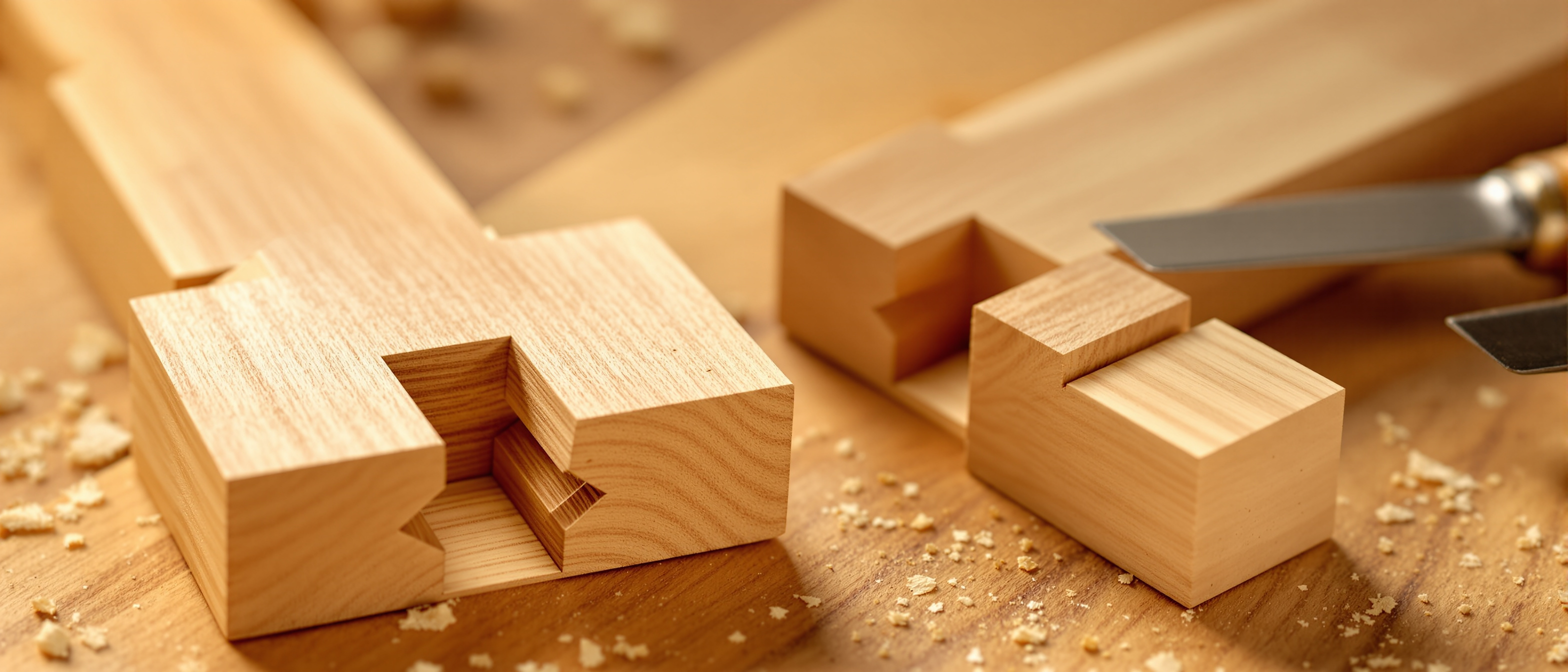
Furniture Joinery
Why joints exist — glue behaves by grain, so the interlock matters
Why not just screw it together? Because glue behaves by grain: a long-grain glue joint is stronger than the wood itself, but an end-grain glue joint is weak, and screws into end grain hold poorly. That single fact explains the whole vocabulary of joinery — every traditional joint turns a weak end-grain meeting into a strong long-grain area plus a mechanical interlock. This unit is why the mortise-and-tenon keeps a chair from racking, why the dovetail resists a drawer being pulled apart, and why ‘modern glue makes joinery obsolete’ is false — alongside the modern knock-down fittings that flat-pack and modular furniture actually use.
Learning objectives
By the end of this lesson, you will be able to — mapped to the course outcomes for Furniture Construction & Detailing:
Explain why glue is grain-direction-dependent and why mechanical interlocking joints exist.
Choose the right joint for a load and a look — butt, dowel, biscuit, mortise-tenon, dovetail, edge.
Distinguish permanent (glued) joints from knock-down (demountable) fittings, and their logics.
Why joints exist
Long-grain glue is stronger than the wood; end-grain glue and end-grain screws are weak. So mechanical interlocking joints exist to resist the racking and pull-apart loads a butt-and-screw cannot — ‘modern glue makes joinery obsolete’ is a myth.[1]
Long grain strong, end grain weak
The key fact behind all joinery: wood glue bonds LONG grain to long grain stronger than the wood itself (the panel breaks elsewhere first), but an END-grain glue joint is weak, because end grain drinks the glue and offers little bonding area. Likewise, screws and nails hold well into face/long grain but poorly into end grain. Every traditional joint is a way to turn a weak end-grain meeting into a strong long-grain glue area plus a mechanical lock.[1]
Explore — the joint explorer
Pick any joint and read its diagram, its strength rank, the skill it needs, where to use it, and whether it is a permanent glued joint or a demountable knock-down fitting. Compare the humble butt with the mighty mortise-and-tenon.
Joint explorer · pick a joint, read its strengths
Tongue into a socket
Mortise & tenon
PermanentUse: The classic frame joint — chair and table legs to rails, doors, anything that must resist racking.
A tenon (tongue) fits a mortise (socket) for a huge long-grain glue area and mechanical interlock. The strongest traditional frame joint; the reason chairs survive.
Strength is a teaching rank, not a lab number. Glue behaves by grain — the strongest joints turn a weak end-grain meeting into a big long-grain area plus a mechanical interlock.
The joints
The butt is weakest; the edge joint makes a wide panel stronger than the wood; dowel and biscuit align and add strength; the mortise-and-tenon is the frame joint and the dovetail the drawer joint.[1]
The simplest, and the panel
The BUTT joint (two faces meeting, glued or screwed) is the weakest — fine only when hidden and reinforced. The EDGE (butt) joint is the opposite success story: gluing narrow boards edge to edge, long-grain to long-grain, makes a wide panel or table top that is stronger than the wood itself — just alternate the growth rings board to board to fight cupping. Use the tool below to compare all the joints.[1]
Modern fittings
Knock-down fittings (the cam-lock) let furniture assemble and disassemble — a different logic for flat-pack and modular, not inferior joinery. Pocket-hole screws are fast and legitimate; and plain screws still obey the grain rule.[1, 2]
A different logic, not inferior
KNOCK-DOWN (KD) fittings — the cam-lock (a cam disc that turns to grip a bolt), plus corner blocks and threaded inserts — let furniture ASSEMBLE and DISASSEMBLE with an Allen key. 'Flat-pack KD joints are just cheap, inferior joinery' is a MYTH: they are a different LOGIC, built for transport, modular systems and the 32 mm world. They are demountable by design; they simply are not permanent glued joints, and you choose them for that reason.[2]
At a glance
| Aspect | The fact | The folklore |
|---|---|---|
| Long-grain glue joint | Stronger than the wood itself | The weakest part |
| End-grain glue / screws | Weak — needs an interlock or glue blocks | Just as strong as long grain |
| Traditional joinery | Resists loads screws can't (racking, pull-apart) | Made obsolete by modern glue |
| Mortise & tenon | The strong frame joint (chairs, tables, doors) | Old-fashioned and unnecessary |
| Dovetail | Resists being pulled apart — the quality drawer joint | Only decorative |
| Knock-down (cam-lock) | A demountable logic for flat-pack and modular | Inferior joinery |
Key terms
Long-grain-to-long-grain glue is stronger than the wood; end-grain glue is weak and screws hold poorly into end grain — the reason interlocking joints exist.
A tongue (tenon) fitting a socket (mortise) — a large long-grain glue area plus mechanical interlock; the classic frame joint for chairs, tables and doors.
Interlocking fan-shaped pins and tails that resist being pulled apart even without glue — the mark of a quality drawer; strong and decorative.
Dowels (round pins) and biscuits (compressed-beech ovals) that align parts and add glue area — biscuits are mainly for alignment of edge-joined panels.
Boards glued edge to edge, long-grain to long-grain, to make a wide panel — stronger than the wood; alternate the growth rings to resist cupping.
A demountable fitting (cam-lock, corner block, threaded insert) that lets furniture assemble and disassemble — a different logic for flat-pack and modular, not inferior joinery.
Studio task
Take one small piece of furniture — a side table, a stool, a small drawer unit — and specify the joint for each connection, justifying every choice by the load and the grain. Where is a mortise-and-tenon earning its keep against racking? Where does a dovetail resist a pull-apart? Where is an edge joint making a wide top, and how will you alternate the growth rings? Where would a knock-down fitting be the honest choice because the piece must ship flat? Sketch at least two of the joints in section, and write one sentence on why glue alone — without the right grain direction or interlock — would not have been enough.
Self-assessment
1. Why do mechanical interlocking joints exist at all?
2. Which joint is the classic choice for a chair leg to rail?
3. What makes a dovetail special for drawers?
4. How should you regard knock-down (cam-lock) fittings?
5. What is true about an edge (butt) glue joint for a table top?
Recap
References & further reading
- [1]Furniture joinery — grain-direction glue behaviour, mortise-and-tenon, dovetail, dowel, biscuit and edge joints (McKay, Building Construction; Ching; woodworking joinery references). https://www.woodworkingnetwork.com/
- [2]Knock-down (KD) fittings, cam-locks, pocket-hole screws and the flat-pack/modular logic (furniture-hardware and 32 mm-system references). https://en.wikipedia.org/wiki/32_mm_cabinetmaking_system
Further reading
- W.B. McKay, Building Construction (Vols 1 & 3) — joinery.
- Francis D.K. Ching, Building Construction Illustrated — wood joints.
- Fevicol Furniture Book (Pidilite) — joinery and adhesives in Indian practice.
Sources gathered and fact-checked June 2026. Published values vary by source, sample and method — treat as indicative and confirm against the cited standard before structural use.
The author
Amogh N P
Architect, interior designer, and creative polymath. Studio Matrx began in his notebooks — his vision of design made honest, useful, and open to everyone. Its Academy is written and taught in his memory, and free, forever.
More about Amogh →