
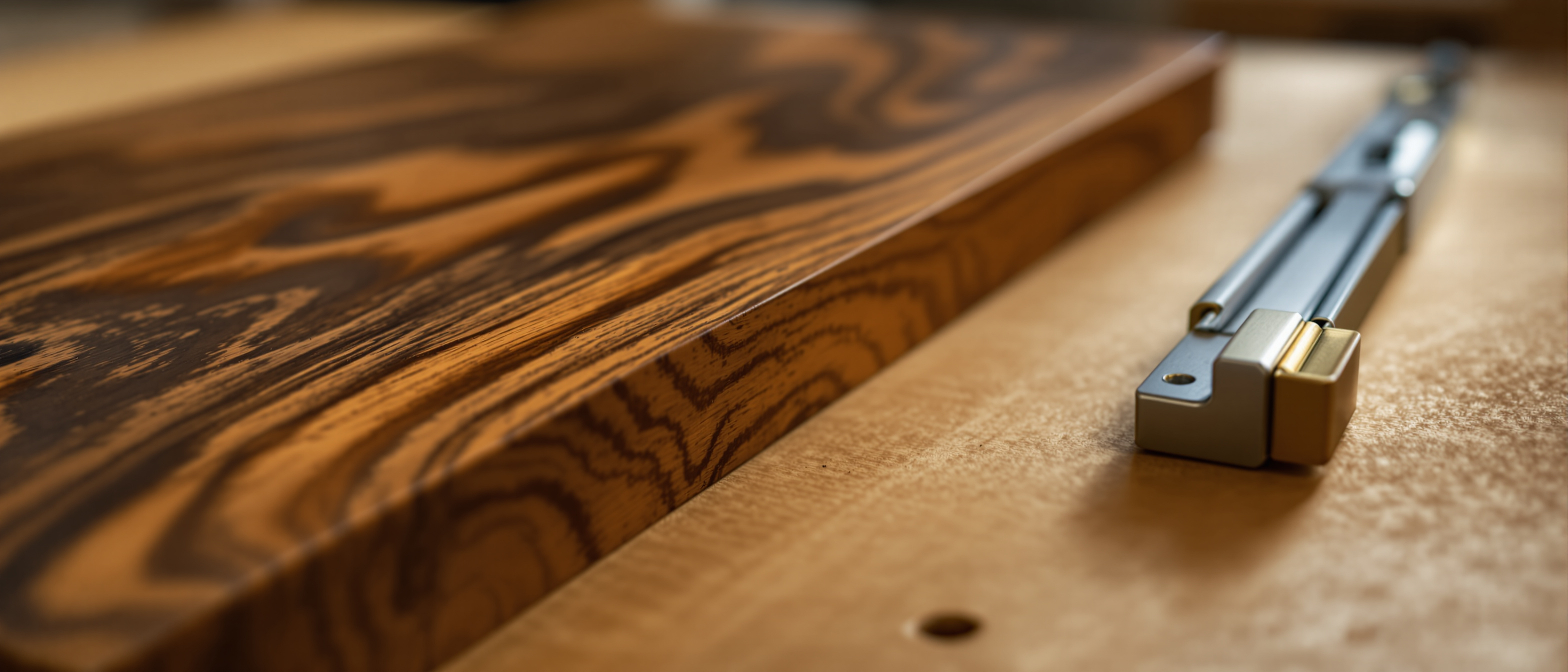
Finishes, Hardware & the Maker's Craft
A finish seals as well as beautifies — and 'waterproof wood' is a myth
The last mile decides how long a piece lasts. A finish is not only cosmetic — it seals the wood against moisture, slowing the very movement this whole course is about, and protects the surface — and ‘waterproof wood finish’ is a myth, because finishes slow water, they do not stop movement. This unit covers finishes (film versus penetrating), the hardware that quietly decides a piece’s working life, and the block models that let a maker fail cheaply before the real cut — the sum of the furniture-maker’s craft the syllabus is really about.
Learning objectives
By the end of this lesson, you will be able to — mapped to the course outcomes for Furniture Construction & Detailing:
Explain that a finish seals and protects (slowing wood movement), not just decorates, and bust 'waterproof wood'.
Distinguish film finishes (PU, lacquer) from penetrating ones (oil, wax) and choose for use and repairability.
Judge furniture hardware quality, and use models to test the maker's craft before committing material.
Finishes that seal, not just shine
A finish seals against moisture (slowing movement) and protects — it is not only cosmetic. Film finishes (PU, lacquer) build a hard layer on top; penetrating ones (oil, wax) soak in. And ‘waterproof wood’ is a myth — finishes slow water, they don’t stop movement.[1]
Not just for looks
'A finish is only cosmetic' is a MYTH. A finish beautifies, yes — but it also SEALS the wood against moisture, which slows the swelling and shrinking the whole course has been about, and it PROTECTS the surface from wear, stains and UV. An unsealed piece moves more and stains and greys faster. Finish the whole piece, including undersides and backs, so it takes up and loses moisture evenly and doesn't cup.[1]
Hardware, models & the maker's craft
Hardware (soft-close hinges and slides, handles, connectors) is where a piece’s working life is decided — spend on what moves and carries load. And block models let the maker test proportion and clearance cheaply before the real cut — the sum of the whole craft.[2, 3]
Hinges, slides, handles
HARDWARE is what makes furniture WORK and decides how long it lasts: concealed hinges (with adjustment and soft-close), drawer SLIDES (telescopic or tandem, soft-close), handles and knobs, locks, connectors and levelling legs. The visible piece is only as good as its hidden fittings — a beautiful cabinet on cheap hinges fails first. Spend on the hardware that moves and carries load; it is the least glamorous and most important line in the budget.[2]
At a glance
| Aspect | The fact | The folklore |
|---|---|---|
| A finish | Seals against moisture + protects, as well as beautifies | Only cosmetic |
| Film finish (PU/lacquer) | Hard layer on top — durable, harder to spot-repair | The only kind of finish |
| Penetrating finish (oil/wax) | Soaks in — natural feel, easy to repair, less protection | Always inferior to PU |
| 'Waterproof' wood finish | A myth — finishes SLOW water, they don't stop movement | Makes wood impervious |
| Furniture hardware | Where longevity lives — spend on hinges and slides | An afterthought |
| Before the real cut | Test the craft with cheap models | Commit material and hope |
Key terms
A surface treatment that beautifies AND seals the wood against moisture (slowing movement) and protects it from wear, stains and UV — not merely cosmetic.
Film (PU, lacquer, melamine, varnish) builds a hard layer on top — durable, harder to spot-repair; penetrating (oil, wax) soaks in — natural feel, easy repair, less protection.
No finish stops wood taking up moisture and moving; a good film finish SLOWS water and vapour but standing water and unsealed end grain still get in.
Hinges (concealed, soft-close), drawer slides (telescopic/tandem), handles, locks, connectors and levellers — where a piece's working life and quality are decided.
A damped hinge or slide mechanism that eases a door or drawer shut silently — a hardware-quality marker in modern furniture and kitchens.
A mock-up of furniture in wood, board, foam/thermocol, clay or soap/wax to test proportion, clearance and use cheaply before cutting real material.
Studio task
Take a piece you detailed earlier and finish the specification, literally. Choose a finish and justify it by USE, not looks: film (PU or lacquer) for a hard-worked kitchen or table, or a penetrating oil for a piece someone will touch and maintain — and state how you will seal the end grain and finish the hidden faces so the piece moves evenly and does not cup. Specify the hardware honestly, naming the hinges and slides where the money should go. Then write the paragraph the whole course has been building to: how each decision — the wood chosen, the joint, the detail for movement, the finish, the hardware — respects the fact that wood is a living material. And make one final block model to prove a detail works before you would commit the real material.
Self-assessment
1. Why is a finish more than cosmetic?
2. What is the difference between film and penetrating finishes?
3. Is a 'waterproof' wood finish real?
4. Where does a piece of furniture's working life mostly get decided?
5. Why do professional makers build study models?
Recap
References & further reading
- [1]Wood finishes — film (PU, lacquer, melamine, varnish) vs penetrating (oil, wax), sealing and moisture control, and why 'waterproof wood' is a myth (finishing references; Fevicol). https://www.pidilite.com/
- [2]Furniture hardware — concealed soft-close hinges, drawer slides, handles and connectors; quality and longevity (hardware and 32 mm-system references). https://en.wikipedia.org/wiki/32_mm_cabinetmaking_system
- [3]Furniture model-making — block models in wood, board, foam/thermocol, clay and soap/wax to test form before cutting (model-making references; Ching). https://www.wiley.com/
Further reading
- Fevicol Furniture Book (Pidilite) — finishes, laminates and hardware in Indian practice.
- Bob Flexner, Understanding Wood Finishing — film vs penetrating finishes.
- W.B. McKay, Building Construction — finishing and ironmongery.
Sources gathered and fact-checked June 2026. Published values vary by source, sample and method — treat as indicative and confirm against the cited standard before structural use.
The author
Amogh N P
Architect, interior designer, and creative polymath. Studio Matrx began in his notebooks — his vision of design made honest, useful, and open to everyone. Its Academy is written and taught in his memory, and free, forever.
More about Amogh →