
Structural silicone & point-fixed glazing
When the metal frame disappears and the glass appears to float, something is still carrying the wind. Sometimes it is a bead of silicone the width of your thumb; sometimes it is four steel bolts.
Lesson byAmogh N P· Architect & interior designer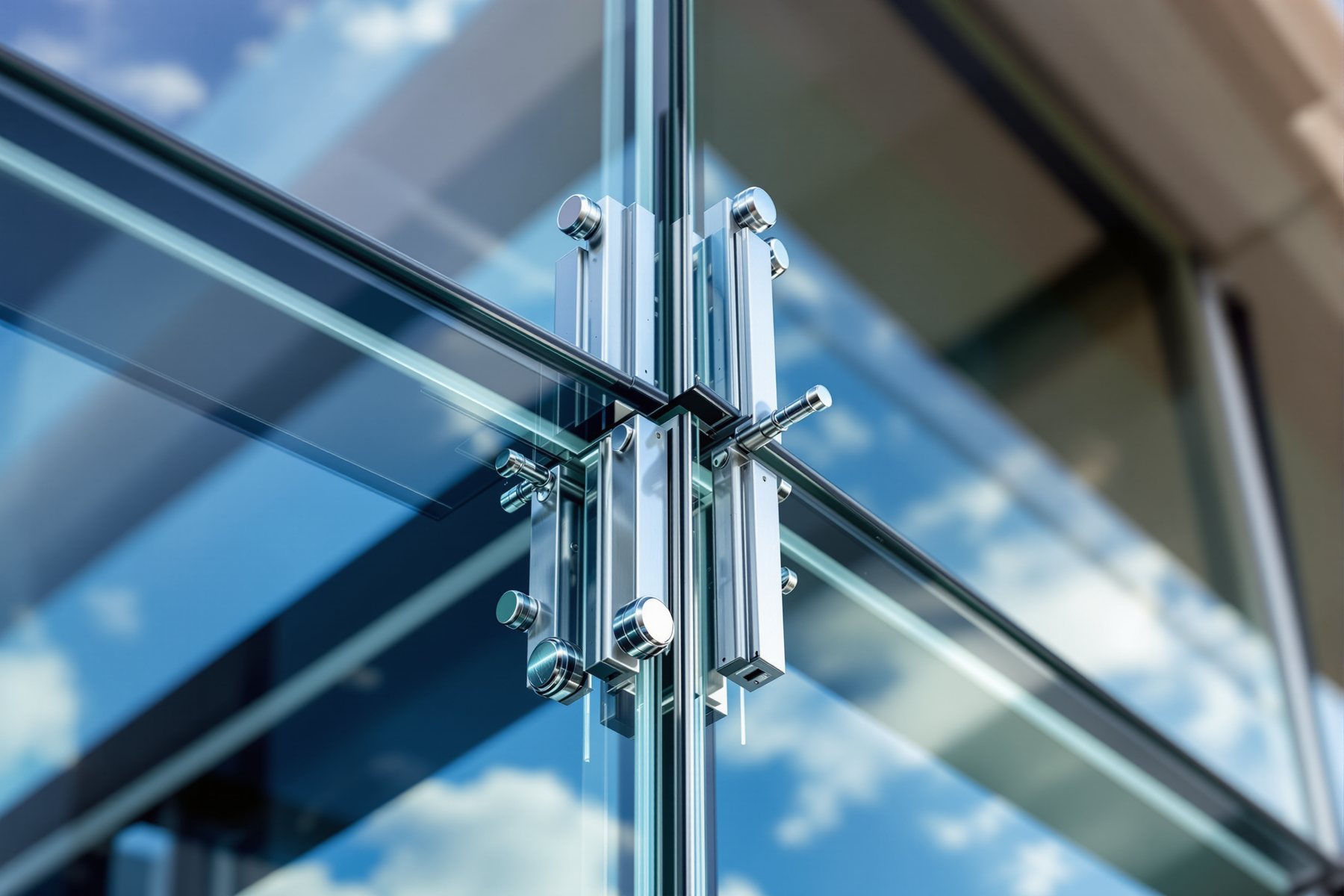
There is a glass tower in your city held to its frame by nothing you can see. The thing holding it is calculated to the millimetre.
The most striking modern facades hide their structure. No visible mullion caps, no clamps - just a flush plane of glass. But the wind still has to go somewhere. On a structural-silicone facade, the glass is bonded to its frame by a bead of high-strength silicone running around the pane edge, and that bead carries the wind load. On a point-fixed facade, the glass hangs from a few stainless bolts through drilled holes, often on a 'spider' arm. Both look effortless and both are precisely engineered: the silicone bead has a calculated width called the **bite**, and the bolt holes turn the glass into a structural plate with stress concentrations you must respect. Get the bite wrong and the glass peels off in a storm. This lesson is how the invisible fixing is sized.
How frameless glass is actually held on
A silicone bead bonds the glass to the frame and carries the wind
In structural silicone glazing (SSG), the glass is not captured by a metal pressure plate on its outer face. Instead it is adhesively bonded to the aluminium frame by a bead of structural silicone sealant - a two-part or one-part silicone formulated for high strength and decades of UV durability. That bead does real structural work: it transfers the wind load on the pane (both positive pressure pushing in and, critically, negative suction pulling out) into the framing.
SSG comes in two arrangements. Four-side SSG bonds the glass on all four edges - the cleanest flush look, no visible metal at all. Two-side SSG bonds two opposite edges with silicone and mechanically captures the other two with a slim pressure plate - common where codes or risk tolerance want a mechanical back-up. Either way the silicone is doing structural duty, which is why the bond width is calculated, not chosen by eye.
The key dimensions of an SSG joint are the bite (the width of the silicone bond, measured across the glass-to-frame contact - this is what resists wind) and the glue-line thickness (the depth of the bead perpendicular to the glass, which lets the joint accommodate differential movement between glass and aluminium). A separate weatherseal silicone closes the joint against water; the structural silicone is not the waterproofing.
Bite resists the wind. Glue-line thickness absorbs the movement. Weatherseal keeps the rain out. Three jobs, three dimensions - never confuse them.
Holes, bolts and spiders: hanging glass from a few points
Point-fixed glazing abandons the continuous edge support entirely. The glass is drilled and held by a small number of bolted fittings - typically four per pane near the corners. The fittings often connect to a spider - a cast or machined stainless-steel arm, usually four-legged, that gathers the corners of adjacent panes onto a single node and back to a supporting structure (a mullion, a glass fin, or a steel/cable truss behind the wall).
The fittings come in two families. Through-bolted fittings clamp the glass between an outer and inner disc with a bush in the hole - simple but they leave a raised button on the outer face. Countersunk fittings sit the bolt head into a conical recess machined into the glass, giving a flush outer surface - the elegant detail, but it stresses the glass cone more sharply and demands tighter tolerances and laminated/toughened glass.
The engineering trade is clear: a drilled hole is a stress raiser. All the wind load on a whole pane funnels into four small zones around the holes, so the glass must be toughened (often heat-soaked) and the hole positions, edge distances and fitting design are governed by glass-stress limits (the kind of plate-bending check ASTM E1300 underpins). Point fixing buys you a near-frameless look at the cost of higher local glass stress and far less tolerance for error.
Sizing the silicone bite from the wind load
The structural-silicone bite is sized from first principles, and the logic is simple force balance. The wind acts as a pressure over the area of the pane. That total force has to be carried by the silicone bead running around the perimeter. So the bead must be wide enough that the stress in the silicone (force divided by bond area) stays under the sealant's allowable design strength.
The industry rule of thumb falls straight out of that: for a rectangular pane, the structural bite B (mm) is approximately the wind pressure times the shorter pane dimension, divided by twice the silicone's allowable stress - because two of the four edges effectively share each span of load. Sealant makers publish an allowable design tensile stress (commonly around 0.14 N/mm2, i.e. 140 kPa, with a large safety factor against the ultimate). A minimum bite (often 6 mm) and a minimum glue-line (often 6 mm) apply regardless of the sum, for buildability and movement.
This is why SSG is never improvised. The bite depends on the design wind pressure (from IS 875 Part 3 in India), the pane size and the specific sealant's approved allowable stress - and the sealant manufacturer must usually approve the project's joint design and adhesion to the actual substrates. A bead that looks generous but is under-sized for a corner suction zone is exactly how panes detach in cyclones.
SSG and point fixing are how you get the flush, frameless, 'all glass' elevation - but they are not free aesthetics. Four-side SSG gives the purest look and the least visible metal; point-fixed and spider systems give a high-tech, articulated look with visible nodes. Both push glass thickness up (more wind funnelled into fewer supports) and both demand bigger margins around openable vents, corners and parapets where suction peaks. Decide early, because the structural depth behind a 'frameless' wall - fins, trusses or cables - is substantial and has to be coordinated with the structure, not discovered at tender.
Own the bite, the glue-line and the substrate approval. Size the structural bite from the project's IS 875 Part 3 design wind pressure (use the worst local zone - corners and parapets, not the field), the pane geometry and the sealant maker's published allowable stress, then apply the minimums (typically 6 mm bite, 6 mm glue-line). Get the sealant manufacturer to approve adhesion to your actual anodised/PVDF aluminium and glass, and to the specific cleaning/priming regime. For point fixing, run the glass-plate stress around the holes (ASTM E1300-type checks), set edge distances, and specify heat-soaked toughened glass. Never let the structural silicone double as the weatherseal.
Structural silicone is unforgiving of dirt and weather. The bond surfaces must be cleaned and primed to the manufacturer's exact two-cloth method, applied in the right temperature and humidity window, and the bead has to be fully wetted-out and the right width and depth - which is why four-side SSG is almost always done in a factory, not on a scaffold. On site you mostly see two-side SSG and point fixing. For bolted glass, the torque on each fitting and the bushes that stop steel touching glass are critical - metal hard against glass cracks it. If a structural bead looks thin, voided or skinned-over, stop: that joint is carrying the wind.
ASTM C1401 / ETAG 002
Structural silicone glazing
ASTM C1401 is the North-American guide to SSG design; ETAG 002 is the European structural-sealant approval route. Both set bite/glue-line logic and safety factors - but neither replaces the sealant maker's project-specific adhesion and joint approval.
ASTM E1300
Glass thickness/strength under load
The standard for determining the load resistance of glass in buildings - used to size panes and check stress around point-fixings. It is a probability-of-breakage method, so it gives you a thickness for a target risk, not an absolute guarantee.
IS 875 (Part 3): 2015
Wind loads (India)
Supplies the design wind pressure the bite and the glass are sized against. Corners, edges and parapets carry much higher local suction than the field - design the bite for the worst zone, not the average.
EN 12150 / IS 2553 (Part 1) + heat-soak
Toughened glass for fixings
Point-fixed and SSG glass is toughened; for drilled and bolted glass, heat-soaking (Lesson 6.3) is effectively mandatory to manage nickel-sulphide risk. The toughening standard sets strength; it does not by itself guarantee against spontaneous breakage.
“Structural silicone is just strong glue - if it sticks, it is holding, and more silicone is always safer.”
The bite is a sized structural element, not a generous smear. Too little bite and the joint over-stresses and peels under suction; but the glue-line _thickness_ and the weatherseal are separate jobs, and piling on more silicone in the wrong place can stiffen the joint so it cannot absorb the differential movement between glass and aluminium, tearing it over thermal cycles. SSG works only when the bite, the glue-line, the substrate adhesion and the sealant's approved allowable stress are all engineered together - which is why sealant makers individually approve SSG joint designs.
Worked example - size the structural silicone bite
Size the structural bite for a four-side SSG vision pane on a Chennai office tower. The corner zone sees the worst suction. Use the standard SSG bite formula and the sealant's published allowable stress.
The project IS 875 Part 3 design wind pressures (field and corner zones), the structural-sealant datasheet (allowable stress), and the pane schedule.
GIVEN
  Pane (vision)   : W = 1.5 m  x  H = 3.0 m  (short side a = 1.5 m)
  Design wind p   : 2.0 kPa = 2.0 kN/m2  (corner zone, IS 875-3)
  Sealant allow.  : sigma_allow = 0.14 N/mm2 (140 kPa) [maker datasheet]
  Minimums        : bite >= 6 mm , glue-line >= 6 mm

  BITE FORMULA (rectangular pane, short span):
    B = (p x a) / (2 x sigma_allow)
units: p [kN/m2], a [m], sigma_allow [kN/m2] -> B [m]- 1Convert to consistent units. p = 2.0 kN/m2. sigma_allow = 140 kN/m2 (0.14 N/mm2 = 140 kPa = 140 kN/m2). Short pane dimension a = 1.5 m. We will get B in metres and convert to mm.
- 2Apply the bite formula. B = (p x a) / (2 x sigma_allow) = (2.0 x 1.5) / (2 x 140) = 3.0 / 280 = 0.01071 m.
- 3Convert to millimetres. B = 0.01071 m = 10.7 mm. Round up to a buildable 11 mm structural bite.
- 4Check against the minimum. The calculated 11 mm exceeds the 6 mm minimum bite, so the wind governs here (on small panes the 6 mm minimum often governs instead). Use the larger of the two - 11 mm.
- 5Set the glue-line thickness independently. The glue-line (bead depth) handles differential movement, not wind; take it as the greater of 6 mm and the calculated movement allowance. Say 8 mm glue-line. Note this is a separate dimension from the 11 mm bite.
- 6Read the joint back and flag approvals. Structural bite 11 mm, glue-line 8 mm, plus a separate weatherseal. Then require the sealant manufacturer to approve this joint against the actual PVDF aluminium and glass and the site/factory cure conditions - the number is only valid once they sign the adhesion.
You’ll walk away with
A sized structural silicone joint - 11 mm bite, 8 mm glue-line, weatherseal separate - derived from the IS 875-3 corner wind pressure and the sealant's allowable stress, ready for the manufacturer's joint-design approval. The exact calculation behind a 'frameless' glass wall.
Two field observations to anchor the invisible fixing.
- 01Stand close to a flush all-glass facade and look at the joint between panes. A thin uniform silicone line with no metal cap is four-side SSG; a slim metal strip on two edges and silicone on the other two is two-side SSG. You are looking at the structural bite edge-on.
- 02Find a point-fixed glass entrance or atrium and look at the bolt heads. A raised disc is a through-bolted fitting; a flush, cone-set head is a countersunk fitting. The flush one stresses the glass cone harder - which is why it needs thicker, toughened, often laminated glass.
Frameless glass is never unsupported - the support is just engineered to be invisible. In SSG a calculated silicone bite carries the wind from glass to frame; in point fixing a few bolts do, turning the pane into a stressed plate with concentrations at the holes. The bite is sized from wind pressure, pane size and the sealant's allowable stress, with a separate glue-line for movement and a separate weatherseal for water - three jobs you must never merge.
SSG bonds glass to frame with structural silicone; four-side is fully flush, two-side keeps a mechanical edge. The bite (bond width) carries wind, the glue-line absorbs movement, the weatherseal stops water. Point-fixed glazing hangs glass from drilled bolts, often on spiders; countersunk fittings are flush but stress the glass cone harder. Size the bite from IS 875-3 wind and the sealant's allowable stress, apply 6 mm minimums, and get the maker to approve the joint.
What is the structural silicone bite, and how is it calculated?
The bite is the width of the structural silicone bond between the glass and the frame - the dimension that carries the wind load. For a rectangular pane it is sized as roughly the design wind pressure times the shorter pane dimension, divided by twice the sealant's allowable design stress, with a minimum (often 6 mm) applied. The design wind pressure comes from IS 875 Part 3 in India, and the sealant manufacturer must approve the final joint and its adhesion to the actual substrates.
Is structural silicone glazing safe, or can the glass fall off?
Properly engineered SSG is very safe and has decades of track record, but it depends entirely on a correctly sized bite, the right glue-line, clean primed substrates and an approved sealant - which is why four-side SSG is usually factory-applied under controlled conditions. Some codes and clients require two-side SSG (silicone on two edges, mechanical capture on the other two) or a mechanical retention back-up for tall buildings, precisely so that a single bond failure cannot drop a pane.
What is a spider glazing system?
A spider glazing system is a form of point-fixed glazing where the corners of adjacent glass panes are gathered onto a cast or machined stainless-steel 'spider' - typically a four-legged arm - which transfers the load back to a supporting structure such as a glass fin, mullion, steel truss or cable net. The glass is drilled and held by bolted (through-bolted or countersunk) fittings. It gives a near-frameless, high-tech look at the cost of higher local glass stress at the holes.
Peer-reviewed journals & authoritative standards
- 01Bedon, C. et al. Performance of structural glass facades under extreme loads - design methods, existing research, current issues and trends. Construction and Building Materials, 163. — Construction and Building Materials (Elsevier), 2018.
- 02Review on Glass Curtain Walls under Different Dynamic Mechanical Loads: Regulations, Experimental Methods and Numerical Tools. IntechOpen. — IntechOpen (peer-reviewed chapter), 2023.
- 03Li, X. & Wu, Y. A review of complex window-glazing systems for building energy saving and daylight comfort. — Journal of Building Physics (SAGE), 2025.
The author
Amogh N P
Architect, interior designer, and creative polymath. Studio Matrx began in his notebooks — his vision of design made honest, useful, and open to everyone. Its Academy is written and taught in his memory, and free, forever.
More about Amogh →_All this fixing assumes the glass itself behaves - that it does not shatter on a calm afternoon for no visible reason. But toughened glass sometimes does exactly that. Why, and how the industry tests it out, is next._