
Safety, breakage & thermal stress
Toughened glass is strong until the day a microscopic crystal grown inside it decides otherwise. Understanding spontaneous breakage and thermal stress is what separates a glass that lasts from a glass that rains onto the pavement.
Lesson byAmogh N P· Architect & interior designer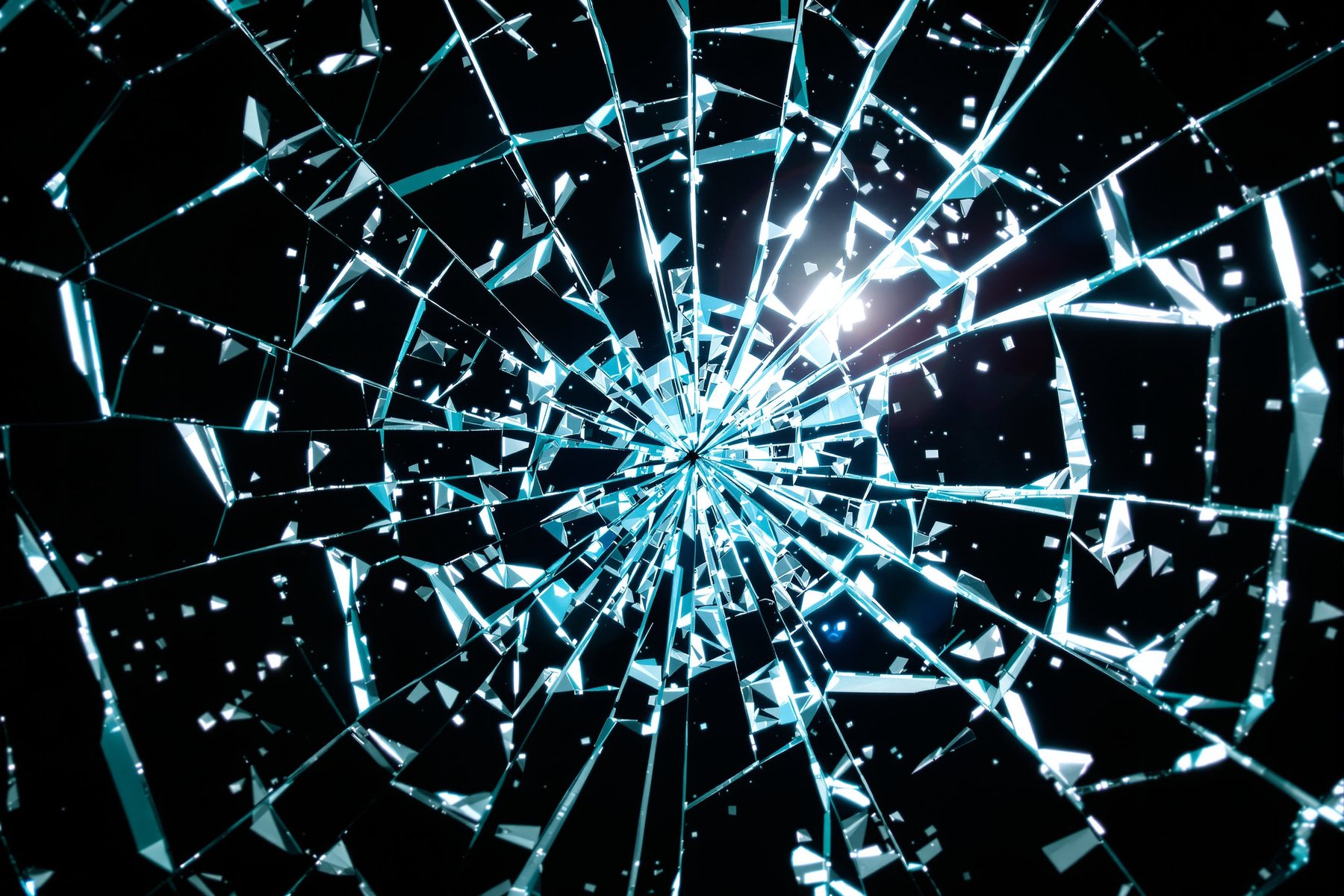
A pane of toughened glass on a quiet building, no impact, no storm, simply explodes. It happened because of a crystal smaller than a grain of sand.
Every facade engineer has seen the photographs: a tower with a single shattered pane, the glass gone to a frozen web, no impact, no cause anyone witnessed. It is one of the eeriest failures in the trade - **spontaneous breakage** of toughened glass. The culprit is usually a microscopic **nickel-sulphide inclusion** baked into the glass, which slowly grows and, under the stored stress of tempering, splits the pane apart years later. Separately, glass that is part-shaded by an overhang or a spandrel can crack from **thermal stress** alone, when one zone bakes in the sun and the cool edge tries to hold it back. Neither is bad luck. Both are predictable, and both are managed - by safety glazing, by heat-soaking, and by edge-quality and thermal-stress checks. This lesson is how glass is made to fail safely, or not at all.
How glass breaks, and how to make it break safely
Toughened dices, laminated stays put - choose the safe failure mode
Safety glazing is glass that, when it breaks, will not cause serious injury - and there are two routes to it. Toughened (fully tempered) glass, when it fails, dices into small, relatively blunt fragments instead of long daggers; the surface compression locked in by quenching forces this fragmentation pattern. Laminated glass takes the opposite approach: it may crack, but the tough interlayer holds the broken pieces in place, so the pane stays in its opening and nothing falls.
The two have different jobs. Toughened is the workhorse for strength and for vertical glazing where dicing is acceptable. Laminated is mandatory where falling glass is the hazard - overhead glazing, balustrades, point-fixed panes over entrances, anywhere a person could be below. The strongest and safest choice for high-risk panes is often toughened-laminated: toughened plies (for strength and benign fragments) bonded with an interlayer (so the dice stays in the frame). That combination is why a balustrade can break and still not let anyone through.
Indian codes (IS 2553 and the NBC fall-protection provisions) and global ones classify which locations demand which safety glass. The principle is constant: you do not prevent breakage absolutely - you choose the failure mode you can live with.
Nickel sulphide grows inside the glass - and heat-soaking screens it out
Nickel-sulphide (NiS) inclusions are tiny stones of nickel sulphide that occasionally form in the float melt from trace nickel contamination. They are harmless in annealed glass. But in toughened glass they are a time bomb: NiS exists in two crystal phases, and over months or years it slowly transforms to the larger-volume phase, expanding. Sitting in the highly stressed core of a tempered pane, that tiny expansion is enough to trigger the stored energy and shatter the glass - spontaneous breakage, with no external cause, sometimes years after installation.
The screening tool is the heat-soak test (HST). The toughened glass is held in an oven at around 290 C for a defined dwell time; the elevated temperature dramatically accelerates the NiS phase change, so panes carrying a dangerous inclusion are provoked into breaking in the oven, in the factory - not on the building. EN 14179 defines the test and its statistical confidence. Heat-soaking does not make glass NiS-free; it reduces the residual risk to a small, quantified probability. It is destructive of the bad panes and adds cost, which is why it is specified where the consequence of a spontaneous break is high: tall buildings, overhead glazing, point-fixed and any glass over public space.
Note the trap: a standard fragmentation or strength certificate does not prove heat-soaking. It must be specified and certified separately.
Sun on the centre, shade on the edge - and the glass cracks itself
Glass can crack with no impact and no NiS at all, purely from thermal stress. When part of a pane is heated by the sun while another part stays cool - a shadow from a deep reveal, a spandrel behind part of the glass, a partly-drawn internal blind, a cold framing edge - the hot zone expands and the cool zone does not. The hot glass is pushed into compression and the cool edge is pulled into tension. Glass is strong in compression but weak in tension, especially at a damaged or low-quality edge, so the crack starts at the edge and runs straight in, typically perpendicular to it.
Two factors decide whether this matters: the temperature difference across the pane (driven by solar absorption - dark, heavily-coated and tinted glass absorbs more and is more at risk) and the edge quality (a clean, ground, undamaged edge tolerates far more tension than a nipped or seamed-only edge). The fix is to upgrade the heat treatment: heat-strengthened glass (a milder temper) roughly doubles the thermal-stress tolerance of annealed, and toughened more than triples it.
This is a real design check, not a footnote. Spandrel panels, partly-shaded vision glass and dark solar-control units in a climate like India's high-radiation north and west facades routinely need heat-strengthened or toughened glass specifically to survive thermal stress - independent of their wind or safety requirements.
Your shading and your glass colour are also a breakage decision. A deep reveal, a brise-soleil, a spandrel behind clear glass or a dark, high-absorption tint all create the partial-shade, high-absorption conditions that crack glass thermally - so the more dramatic the shadow and the darker the glass, the more likely the engineer has to upgrade to heat-strengthened or toughened. And for any glass a person could fall against or that sits overhead, expect laminated: it is non-negotiable for safety. Flag your overhead, balustrade and heavily-shaded panes early so the glass spec can follow the design intent rather than fight it.
Run three separate checks on every pane: safety (toughened/laminated per location and fall risk), spontaneous-breakage risk (specify heat-soaking to EN 14179 for toughened panes on tall buildings, overhead, point-fixed and over public areas), and thermal stress (estimate the centre-to-edge temperature difference from solar absorption and shading, and pick annealed / heat-strengthened / toughened accordingly with a real edge-quality requirement). These are independent - a pane can pass wind and still fail thermal; toughened solves thermal but reintroduces NiS risk, which heat-soaking then manages. Specify edge finish (ground/polished) explicitly; thermal cracks start at bad edges.
Edge quality is the field variable that decides thermal-stress life, so protect it: a chipped or nipped edge, a corner knocked on a stillage, a pane dragged across grit - all seed the crack that thermal stress later opens. Handle and store toughened panes on edge with edge protection. Never field-cut, drill or grind toughened glass - it will explode; all processing happens before tempering. If a building shows scattered single-pane shatters over months with no impact, suspect NiS and check whether heat-soaking was specified and certified. The certificate to ask for is the heat-soak record, not just the toughening one.
EN 14179
Heat-soak test for toughened glass
Defines the heat-soak (290 C dwell) process and its statistical confidence for reducing nickel-sulphide spontaneous-breakage risk. It reduces residual risk to a small quantified probability - it does not make glass NiS-free, and it must be specified separately from toughening.
EN 12150 / IS 2553 (Part 1)
Toughened safety glass
Set the strength, surface-stress and fragmentation requirements for safety toughened glass. They verify the dicing pattern and strength but do not require heat-soaking; that is an additional, separately specified test.
ASTM E1300
Glass load resistance / thickness
Determines glass thickness for wind and other loads to a target breakage probability. It addresses mechanical load resistance, not thermal stress or NiS - those are checked separately.
NBC 2016 (India) - safety glazing & fall protection
Where safety glass is required
Frames where safety/laminated glass and fall protection are mandated (overhead, balustrades, large vision panels). It points to the locations; the specific glass make-up and edge quality remain the engineer's call.
“Toughened glass is the strongest and safest glass, so using it everywhere removes the breakage problem.”
Toughening solves strength and gives benign fragments, but it _introduces_ the spontaneous-breakage risk from nickel-sulphide inclusions, which annealed glass does not have - and it does not, by itself, keep broken glass in the opening. For high-consequence panes you often need toughened-laminated _and_ heat-soaking: the lamination keeps the dice in place if it does break, and the heat-soak test screens out the NiS time bombs beforehand. 'Just toughen everything' trades one failure mode for another.
Worked example - thermal-stress check on a part-shaded pane
A dark solar-control vision pane on a west facade in Jaipur is partly shaded by a deep reveal: a band of glass bakes in the sun while the edge stays cool in the frame. Estimate the thermal stress and decide the heat treatment.
The pane's solar absorptance (from the glass datasheet), the shading geometry, and the glass supplier's allowable edge-stress and heat-treatment options.
GIVEN
  Glass             : dark solar-control, high absorption
  Estimated dT      : centre-to-edge temp difference = 40 C
    (sunlit centre ~60 C, shaded/framed edge ~20 C)
  Glass properties  : E = 70000 N/mm2 (70 GPa)
                      alpha = 9.0 x 10^-6 per C (thermal expansion)
  Approx thermal stress (restrained edge):
    sigma_th ~ k x E x alpha x dT     (k ~ 0.5, edge restraint factor)
  Allowable EDGE tensile stress (clean edge):
    annealed         ~ 18-20 N/mm2
    heat-strengthened~ 35-40 N/mm2
toughened ~ 50+ N/mm2- 1Estimate the temperature difference. Dark, high-absorption glass against a deep-reveal shadow on a Jaipur west wall: take the sunlit centre at ~60 C and the framed/shaded edge at ~20 C, so dT = 40 C. (Light, low-absorption glass with little shading might give dT ~ 15-20 C and rarely need an upgrade.)
- 2Compute the indicative thermal stress. sigma_th ~ k x E x alpha x dT = 0.5 x 70000 x (9.0 x 10^-6) x 40. Work it stepwise: 70000 x 9.0e-6 = 0.63 ; 0.63 x 40 = 25.2 ; x 0.5 = 12.6 N/mm2 as an indicative edge tension.
- 3Compare with annealed. Clean annealed edge allowable ~18-20 N/mm2. 12.6 is below it on a perfect edge - but real edges are nipped, the dT estimate is approximate, and west-facade peaks can run higher. The margin is thin and the consequence (a cracked occupied-floor pane) is high.
- 4Decide the upgrade. Because the glass is dark/high-absorption, the shading is deep, and the edge quality cannot be guaranteed in the field, specify heat-strengthened glass (allowable ~35-40 N/mm2) - more than double the margin - rather than gamble on a perfect annealed edge.
- 5Tie in the other two checks. If this pane were also point-fixed or overhead it would jump to toughened + heat-soaked (EN 14179); here, heat-strengthened covers thermal stress, and we add a ground (not just seamed) edge requirement, because the whole calculation assumes a clean edge.
- 6Read it back. Indicative thermal stress ~12.6 N/mm2 against a thin annealed margin -> specify heat-strengthened, ground edges for this part-shaded dark west pane. The number turned a 'looks fine' pane into a defensible glass spec.
You’ll walk away with
A thermal-stress decision with a number behind it: ~12.6 N/mm2 indicative edge tension on a part-shaded dark west pane drives a heat-strengthened, ground-edge specification. The check that stops shaded spandrel and vision panes cracking themselves in a high-radiation Indian climate.
Two ways to see breakage physics in the wild.
- 01Look for the classic shattered-but-intact pane on a tower: toughened glass that has gone to a fine frozen web yet stayed in its frame is almost always toughened-laminated, and the web is the fragmentation pattern toughening forces. A clean diagonal or perpendicular crack from an edge, by contrast, is the signature of thermal stress.
- 02Examine a glass balustrade edge-on: if it is two plies with a faint line between them, it is laminated (so it stays standing if it breaks). A single-ply toughened balustrade that could dice and collapse is exactly what laminated requirements exist to prevent.
You do not stop glass breaking - you engineer how it breaks and screen out the breaks you cannot tolerate. Toughened dices, laminated stays in place, toughened-laminated does both; nickel-sulphide inclusions cause spontaneous breakage in toughened glass, and heat-soaking to EN 14179 provokes the bad panes to fail in the factory; thermal stress cracks part-shaded, high-absorption glass from a poor edge, and a heat treatment upgrade with a clean edge fixes it. Three independent checks on every pane.
Safety glazing = toughened (dices into blunt fragments) or laminated (stays in the opening); high-risk panes use toughened-laminated. Nickel-sulphide inclusions cause spontaneous breakage in toughened glass; the heat-soak test (EN 14179, ~290 C) provokes bad panes in the factory but does not make glass NiS-free. Thermal stress cracks part-shaded, dark, poor-edge glass; heat-strengthened or toughened glass with a clean ground edge tolerates it.
Why does toughened glass spontaneously break for no reason?
It is almost always a nickel-sulphide (NiS) inclusion - a microscopic crystal of nickel sulphide trapped in the glass during melting. In toughened glass, which stores high internal stress, the inclusion slowly changes to a larger crystal phase over months or years, expanding just enough to trigger the stored energy and shatter the pane with no external cause. Annealed glass does not have this problem; the risk is specific to the highly-stressed core of tempered glass.
What is the heat-soak test and is it the same as toughening?
No. Toughening (tempering) strengthens the glass; the heat-soak test (EN 14179) is a separate, additional process that holds the already-toughened glass at about 290 C to deliberately provoke nickel-sulphide inclusions into breaking the bad panes in the oven, in the factory, rather than on the building. It reduces but does not eliminate spontaneous-breakage risk, so it must be specified and certified separately from the toughening - a toughening certificate alone does not prove heat-soaking was done.
What causes thermal stress cracking in facade glass?
A temperature difference across a single pane - typically when the sun heats part of the glass while a shadow, a spandrel, an internal blind or the cool framing edge keeps another part cold. The hot zone expands and pushes the cool edge into tension, and because glass is weak in tension at a damaged edge, a crack starts at the edge and runs in. Dark, high-absorption glass, deep shading and poor edge quality all raise the risk; heat-strengthened or toughened glass with a clean ground edge resists it.
Peer-reviewed journals & authoritative standards
- 01Bedon, C. et al. Performance of structural glass facades under extreme loads - design methods, existing research, current issues and trends. Construction and Building Materials, 163. — Construction and Building Materials (Elsevier), 2018.
- 02Review on Glass Curtain Walls under Different Dynamic Mechanical Loads: Regulations, Experimental Methods and Numerical Tools. IntechOpen. — IntechOpen (peer-reviewed chapter), 2023.
- 03Li, X. & Wu, Y. A review of complex window-glazing systems for building energy saving and daylight comfort. — Journal of Building Physics (SAGE), 2025.
The author
Amogh N P
Architect, interior designer, and creative polymath. Studio Matrx began in his notebooks — his vision of design made honest, useful, and open to everyone. Its Academy is written and taught in his memory, and free, forever.
More about Amogh →_Strength and safety are only half of what the glass does. The other half is light and heat - and that is decided by a coating thinner than a wavelength of light, or by glass that changes its own tint on demand. Solar control and switchable glass close the module._