
Green walls, retrofit & recladding
The greenest facade is usually one that already exists. The art is making the buildings we already have perform - and, after Grenfell, making them safe.
Lesson byAmogh N P· Architect & interior designer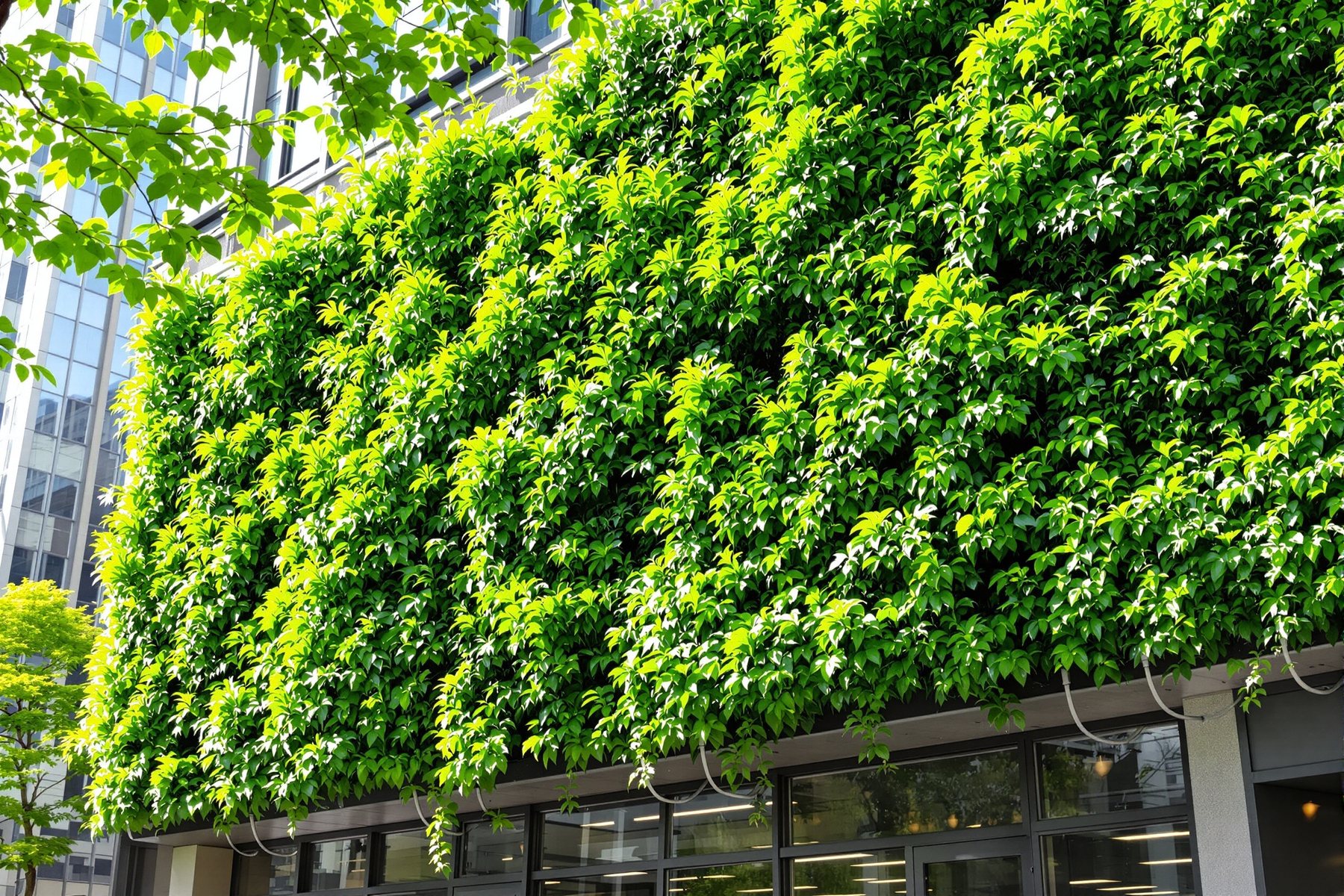
There is more carbon to save in the buildings that already stand than in everything we will ever build new.
New facades get the magazine covers. But the world's biggest facade problem is the millions of skins already in place - leaky, uninsulated, overheating, and in too many cases dangerously combustible. The Grenfell Tower fire in 2017 turned facade remediation from a niche into a global, urgent industry: thousands of towers worldwide were found wrapped in cladding that should never have been there. At the same time, the carbon maths is unforgiving - **demolishing and rebuilding a facade spends a huge embodied-carbon lump**, while keeping the structure and upgrading the skin saves it. Greening, retrofitting and recladding existing buildings is where most of the next two decades of facade work actually lives.
Work with what stands - green it, upgrade it, make it safe
Living walls cool, clean and soften - but they are a wet, heavy, maintenance-hungry facade system
A green or living wall clothes a facade in vegetation. The lighter version is a green facade - climbers growing up a cable or mesh trellis, rooted at the base, cheap and slow. The intensive version is a living wall system - modular planted panels or felt pockets fed by an irrigation grid, lush from day one and far more demanding. The benefits in a hot Indian city are real: evapotranspiration cools the surface (shaded, planted walls can run several degrees cooler than bare ones), the plants trap dust and improve the microclimate, and the visual and biophilic value is high.
But treat a living wall as a facade system, not landscaping. It adds weight (saturated soil and water), it needs a waterproofing and root barrier so the wet system never touches the structure, it demands a reliable irrigation and drainage strategy, and it carries a real maintenance commitment - a dead living wall is worse than no wall. The control-layer spine still applies: behind the greenery there must be a continuous water and air barrier, because the wettest facade you will ever design is the one you are deliberately keeping wet.
Deep-energy retrofit upgrades the skin in place - often by over-cladding the existing wall
A deep-energy retrofit transforms an existing building's envelope performance - cutting energy use by half or more - without demolishing it. The dominant facade technique is over-cladding: building a new, insulated, weather-tight outer skin over the existing wall, often as a rainscreen. This adds the thermal and water control layers the original building lacked, fixes its leaks, and refreshes its appearance in one move - while the occupants often stay inside.
The engineering is genuinely hard. The existing structure must carry the new skin's weight and wind load - so you survey and test the substrate before you hang anything off it. You must continue the new control layers around old, irregular geometry and tie them back to the existing air and water barriers. And you must avoid creating thermal bridges and interstitial condensation by wrapping insulation over a wall whose vapour behaviour you have just changed. Done well, over-cladding is the highest-leverage carbon move in the existing building stock: it keeps the structure (and its embodied carbon) and slashes operational energy for decades.
Post-Grenfell: recladding to remove combustible cladding is now a global safety programme
The Grenfell Tower fire (London, 2017) killed 72 people when an aluminium-composite (ACP) rainscreen with a combustible polyethylene core, over combustible insulation, turned a kitchen fire into a vertical inferno in minutes. The research that followed (peer-reviewed analyses of modern facade fire behaviour) confirmed what the industry should have known: combustible cores and poorly-firestopped cavities create a chimney that propagates fire up a facade catastrophically. The result is a worldwide remediation programme - identifying, then recladding, buildings wrapped in dangerous materials.
Facade remediation means stripping the combustible system and replacing it with non-combustible (A1/A2) cladding and insulation, plus correctly installed cavity barriers that close the chimney. It is technically a recladding project, but driven by life safety rather than energy. India's NBC 2016 and the lessons of Grenfell push the same direction: limit combustible cladding on tall buildings, demand cavity barriers, and treat the facade as a fire-safety system. The honest, uncomfortable truth of this lesson: a great deal of facade engineering in the coming decade is undoing the mistakes of the last one - and the circular, disassemblable facade from Lesson 11.1 is exactly the skin that will be easy and safe to remediate next time.
Default to retain. Before drawing a demolition, ask whether the existing structure can be kept and the skin upgraded - it is almost always the lower-carbon, often lower-cost answer, and over-cladding gives you a fresh elevation for free. Treat a green wall as a serious building system with a maintenance budget, not a render flourish. And on any recladding, make fire the first conversation, not the last: non-combustible build-ups and honest cavity barriers shape the whole detail.
On retrofit, the substrate is your great unknown - survey and load-test before you hang a new skin off a wall you did not design. Re-run the control-layer logic for the _new_ assembly, watching for interstitial condensation when you add outboard insulation over an old wall. On recladding, specify A1/A2 non-combustible materials, design and detail cavity barriers that actually close the cavity at every floor and opening, and document the fire strategy. On living walls, own the waterproofing, root barrier, irrigation and the added dead and wind load.
Over-cladding and recladding are surgery on an occupied, irregular building - tolerances are worse than new-build and every fixing depends on what is actually behind the old wall. The non-negotiable on any recladding is the cavity barrier: it is the cheap, hidden component that stops a facade fire spreading, and it only works if installed continuously and correctly. On living walls, the irrigation and drainage are the system - a blocked drip line kills the wall and a failed waterproof layer wets the structure.
NBC 2016 (India)
Fire & cladding combustibility
National Building Code Part 4 (fire) frames cladding fire performance and cavity barriers on tall buildings in India. Post-Grenfell it is tightening, but enforcement and combustible-cladding limits on existing stock remain uneven as of 2026.
BS 8414 / BR 135 (UK)
Facade fire-spread test
The large-scale facade fire test and assessment route that defined post-Grenfell remediation. A global reference for whether a recladding build-up is safe - widely cited on Indian premium-project specs even though not Indian code.
Eco-Niwas Samhita 2018 / ECBC (India)
Retrofit envelope performance
Set the U-value, RETV and SHGC targets an over-clad retrofit should hit. Written for new build, so applying them to an existing irregular wall takes engineering judgement, not a simple lookup.
IGBC / GRIHA (India)
Green walls & circularity credits
Award credits for green/living walls, retained structure and recycled content - the rating-system home for retrofit and biophilic facades. Credit-based, so a green wall scores points without guaranteeing it is maintained for life.
“Demolishing a tired facade and building a brand-new high-performance one is the green choice.”
Usually it is not. Demolition throws away the embodied carbon already locked in the existing skin and structure, then spends a fresh embodied-carbon lump on the new one - hundreds of kgCO2e per square metre, emitted now. Keeping the structure and deep-retrofitting or over-cladding the envelope saves that embodied carbon while still delivering modern thermal, water and (crucially) fire performance. The greenest facade is very often the existing one, upgraded - which is also why design-for-disassembly matters: it makes the next upgrade cheap instead of destructive.
Worked example - size the energy saving from an over-clad retrofit
Let us put a number on the prize: how much annual cooling energy a deep over-cladding retrofit saves on an uninsulated wall in a hot Indian city, by improving its U-value.
A calculator and degree-day / equivalent full-load-hour data for a hot Indian city (typical values used here).
GIVEN - over-cladding 1,000 m2 of solid wall:

  WALL AREA            A    = 1,000 m2
  U BEFORE (bare RCC)  U1   = 2.8 W/m2K
  U AFTER (over-clad)  U2   = 0.5 W/m2K
  COOLING DEGREE-HRS   CDH  = 30,000 K.h/yr
      (annual indoor-outdoor temp gap x hours)
  CHILLER COP                = 3.0
  GRID FACTOR                = 0.71 kgCO2e/kWh

  CONDUCTED HEAT (kWh/yr) = A x U x CDH / 1000
ELECTRICITY = HEAT / COP- 1Conducted heat, before. A x U1 x CDH / 1000 = 1,000 x 2.8 x 30,000 / 1000 = 84,000 kWh/yr of heat conducted through the bare wall.
- 2Conducted heat, after. 1,000 x 0.5 x 30,000 / 1000 = 15,000 kWh/yr through the over-clad wall - the insulation has cut the conducted heat by 82%.
- 3Heat removed by retrofit. 84,000 - 15,000 = 69,000 kWh/yr of cooling load that no longer has to be pumped out.
- 4Electricity saved. Divide by chiller COP: 69,000 / 3.0 = 23,000 kWh/yr of grid electricity saved, every year.
- 5Carbon avoided. 23,000 kWh x 0.71 = ~16.3 tonnes CO2e per year, for the life of the retrofit.
- 6Compare to demolition (Lesson 11.1). Rebuilding instead of over-cladding would have spent a fresh embodied-carbon lump of hundreds of kgCO2e/m2 up front. The retrofit avoids that and delivers the operational saving - which is why 'retain and upgrade' beats 'demolish and rebuild' on carbon almost every time.
You’ll walk away with
An annual-saving estimate for an over-cladding retrofit (~23,000 kWh and ~16 tCO2e/yr on 1,000 m2 by cutting U-value from 2.8 to 0.5) - the number that makes the business and carbon case for retrofit over demolition.
Two quick ways to see retrofit opportunity.
- 01Find an older office block near you with a bare concrete or single-glazed facade. Picture a ventilated rainscreen over-clad over it - that is the highest-leverage carbon and comfort move available on that building.
- 02Look at any ACP-clad tower and ask the post-Grenfell question: is that core mineral-filled (safe) or polyethylene (combustible)? You cannot tell from the street - which is exactly why facade fire remediation became a global audit.
The greenest facade is usually the one that already exists, upgraded. Green walls cool and soften but are demanding wet systems; deep-energy retrofit by over-cladding adds the thermal and water layers an old wall lacked while keeping its embodied carbon; and recladding - driven by the post-Grenfell reckoning - strips combustible cladding for non-combustible build-ups with real cavity barriers. Across all three, the control-layer spine and the circular, disassemblable skin from Lesson 11.1 are what make the upgrade work and the next one easy.
Three moves on existing buildings: green/living walls (cooling and biophilic, but heavy, wet, maintenance-hungry systems needing waterproofing and irrigation); deep-energy retrofit by over-cladding (adds insulation and a weather barrier in place - the worked case saved ~23,000 kWh/yr); and post-Grenfell recladding (strip combustible ACP for A1/A2 build-ups with continuous cavity barriers, to NBC/BS 8414). Retain-and-upgrade beats demolish-and-rebuild on carbon.
What is over-cladding and why is it used to retrofit buildings?
Over-cladding means building a new, insulated, weather-tight outer skin - usually a rainscreen - over an existing wall, rather than demolishing it. It adds the thermal and water control layers an old building lacked, fixes leaks, refreshes the appearance and lets occupants stay inside, all in one move. It is the dominant deep-energy retrofit technique for facades because it keeps the existing structure (and its embodied carbon) while cutting operational energy substantially. The main risks are loading the old substrate, continuing the control layers over irregular geometry, and avoiding interstitial condensation.
What did the Grenfell Tower fire change about facade engineering?
Grenfell (London, 2017) showed that an aluminium-composite rainscreen with a combustible polyethylene core, over combustible insulation and through poorly firestopped cavities, can turn a small fire into a vertical inferno. It triggered a global remediation programme: identifying and recladding thousands of buildings wrapped in dangerous cladding, replacing combustible systems with non-combustible (A1/A2) materials and installing proper cavity barriers. It made facade fire performance a first-order design question and put cavity barriers and non-combustible build-ups at the centre of both new design and existing-building remediation.
Are green walls practical on facades in Indian cities?
Yes, with engineering. Living and green walls cool the surface through evapotranspiration, trap dust and add strong biophilic value - all valuable in hot Indian cities. But they must be treated as a facade system: they add weight from saturated soil and water, need a robust waterproofing and root barrier so the wet system never reaches the structure, require reliable irrigation and drainage, and carry a real maintenance commitment. A neglected living wall dies and looks worse than none - so a maintenance budget and a continuous water-and-air barrier behind the greenery are non-negotiable.
Peer-reviewed journals & authoritative standards
- 01McKenna, S.T. et al. Fire behaviour of modern facade materials - understanding the Grenfell Tower fire. Journal of Hazardous Materials, 368. — Journal of Hazardous Materials (Elsevier), 2019.
- 02Preliminary Study on Measures to Improve Fire Safety in Existing High-Rise Residential Buildings with Combustible Facades. Buildings, 16(6):1196. — Buildings (MDPI), 2026.
- 03Strategies and Techniques of Life Cycle-Embodied Carbon Reduction from the Building and Construction Sector: A Review. Journal of Architectural Engineering, 29(3). — Journal of Architectural Engineering (ASCE), 2023.
The author
Amogh N P
Architect, interior designer, and creative polymath. Studio Matrx began in his notebooks — his vision of design made honest, useful, and open to everyone. Its Academy is written and taught in his memory, and free, forever.
More about Amogh →You can now make a facade low-carbon, energy-positive, and you can upgrade and make safe the ones that exist. The course has covered every layer of the discipline - so the final lesson pulls it all together: a capstone where you engineer one facade, end to end.