
Energy-positive: BIPV, double-skin, kinetic
The next facade does not just keep energy out - it makes energy, breathes, and moves to track the sun. Where the skin stops being a wall and becomes a machine.
Lesson byAmogh N P· Architect & interior designer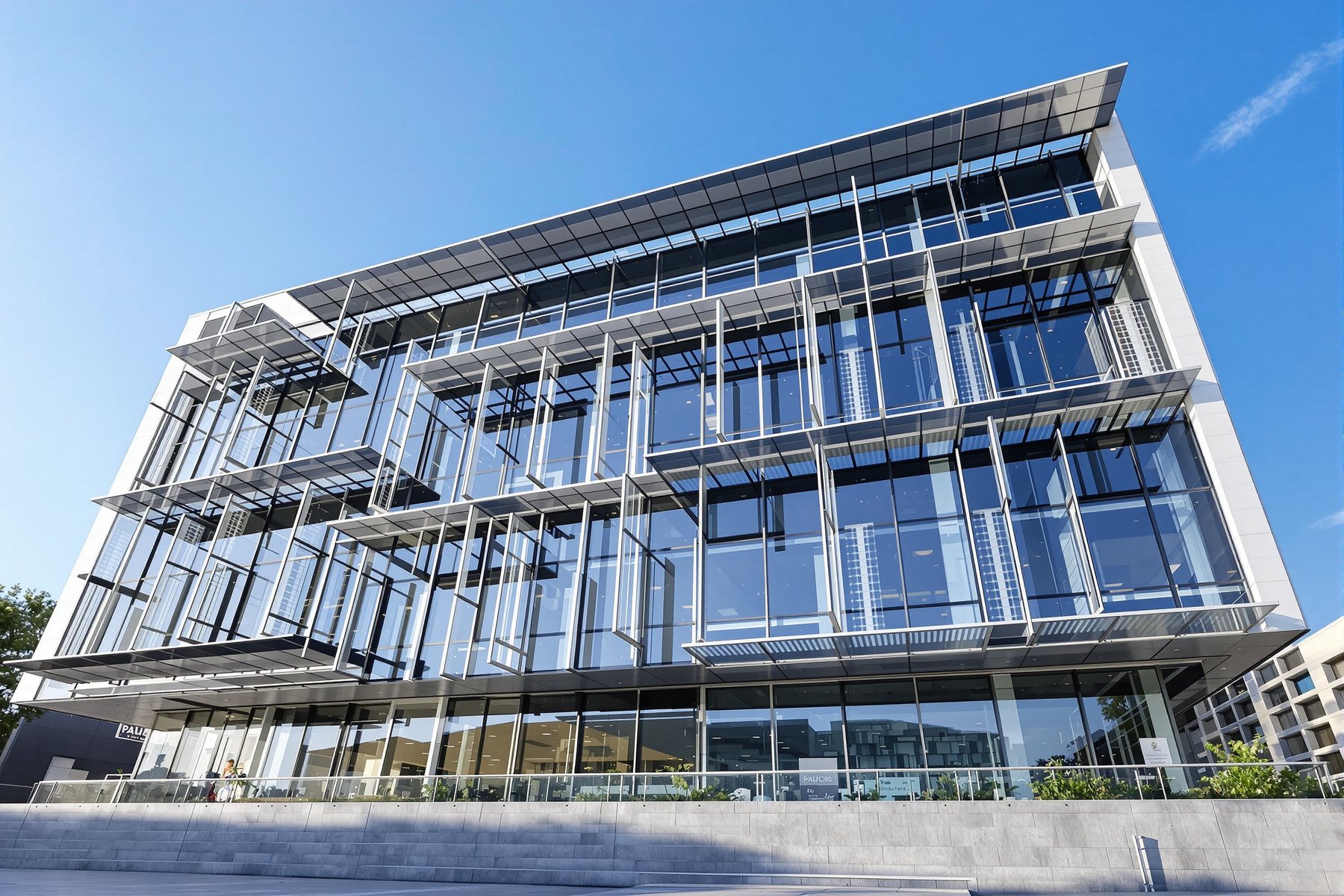
For a century the facade's job was to stop energy. The best ones now make it.
A facade is a vast vertical surface pointed at the sky. On a tower it can be more area than the roof, and most of it is doing nothing but holding back the weather. The energy-positive facade asks a harder question: what if the skin _generated_ more energy than the building behind it consumed? Three technologies are converging to make that real. **BIPV** turns cladding into a solar panel. The **double-skin facade** uses a glazed buffer to harvest or reject heat and drive ventilation. And **kinetic facades** physically move - louvres, fins, shutters tracking the sun. In a high-irradiance country like India, where a vertical south facade can still collect 900-1,200 kWh/m2 a year, the wall-as-power-station is not science fiction. It is an engineering calculation.
Three ways the skin turns active - generate, buffer, move
Building-integrated PV makes the cladding itself the power source
Building-integrated photovoltaics (BIPV) replaces a facade material - spandrel glass, a rainscreen panel, a shading fin - with a photovoltaic element that is the cladding, not a panel bolted on top (that is BAPV, building-applied PV). BIPV does double duty: it weatherproofs and it generates. Semi-transparent PV glass can even glaze a vision panel, trading a little daylight for power.
The physics that makes a facade harder than a roof: a vertical surface is tilted 90 degrees, so it sees less of the high summer sun and more of the low winter sun. In India's mostly cooling-dominated climate this is partly a feature - a south or west BIPV facade generates hardest in the hours it is also shading the building. Real-world yields are lower than a roof (poor tilt, more shading, higher cell temperatures bleeding efficiency), but the area is enormous. The engineering questions are tilt, orientation, shading losses, cell temperature, and how the DC wiring and inverters integrate without compromising the four control layers.
The double-skin facade is a glazed lung - it buffers heat and drives ventilation
A double-skin facade (DSF) puts a second, usually glazed, outer leaf in front of the main facade with a ventilated cavity (typically 200 mm to over a metre) between them, often holding the solar shading. The cavity is the trick. In a cooling climate it is vented top and bottom so the stack effect drives hot air up and out, exhausting the solar heat trapped behind the outer glass before it reaches the inner skin and the building. In a heating climate the cavity is closed to act as a warm thermal buffer, or its pre-warmed air is drawn inside.
The IEA's review of double-skin facades is blunt about the trade-off: a DSF can cut cooling load, improve acoustics and allow natural ventilation on a tall, windy building - but it adds glass, cost, weight and embodied carbon, and a badly designed cavity in a hot climate becomes a solar oven that makes things worse. Cavity ventilation design - opening sizes, stack height, control of dampers - is the whole game. Studies of condensation and ventilation in DSF cavities show it is a real building-physics problem, not a free lunch.
Kinetic facades change shape to track the sun; adaptive facades change their own properties
A fixed shade is a compromise - sized for one sun angle, wrong for all the others. A kinetic facade moves: motorised louvres, rotating fins, folding shutters or shading panels that track the sun through the day and the seasons, blocking direct gain while keeping the view and daylight when the sun is off-axis. The famous precedents (the Al Bahar towers' folding mashrabiya, countless tracking-fin facades) show the appeal - and the cost: motors, sensors, controls and a maintenance burden that a static fin never has.
Adaptive facades go further and change a property rather than a shape - electrochromic glass that tints on demand, thermochromic coatings, phase-change materials buffering heat. The frontier is the kinetic BIPV facade, where moving elements track the sun to both shade the building and maximise PV yield - a single surface optimising daylight, glare, solar gain and power generation at once. Research on kinetic BIPV facades reports meaningful gains in both energy generation and daylighting over fixed arrays. The spine still holds: a moving skin is still a system of control layers - it has just added time as a fifth dimension, and every moving joint is a new place for water and air to get in.
BIPV is now an aesthetic palette, not just a roof afterthought - coloured, patterned and semi-transparent PV glass let you generate power and keep an architectural face. Design the array as part of the elevation grid from concept, because PV strings hate partial shading and a single badly-placed mullion shadow can cripple a whole string. For kinetic facades, fall in love with the idea cautiously: the maintenance and control burden is real, and a beautiful moving facade that is stuck half-open in year three is worse than a good static one.
For BIPV, own the electrical-architectural interface: string layout to dodge shading, cell temperature (vertical, poorly-ventilated cells run hot and lose 0.3-0.5%/degC), DC routing that does not breach the air and water barriers, and inverter/fire isolation. For DSF, the cavity is your design object - size the inlet/outlet openings and stack height for the target air change, and model condensation in the cavity. For kinetic facades, every moving element is a weatherproofing and fail-safe question: where does it sit when the power fails, and how do you keep the joints watertight while they move?
An active facade is a building service, not just a wall - it has wiring, motors, sensors and inverters that must be commissioned and maintained. On a BIPV install, the discipline is clean DC connections and shading-free mounting; a shadow that looks trivial can halve a panel's output. On a DSF, the killer detail is cavity access for cleaning - a sealed cavity that fogs and stains is unfixable. On kinetic facades, the moving joints are the maintenance frontier: they are where the seals wear and where water finds its way in first.
ECBC 2017 / Eco-Niwas Samhita 2018 (India)
Envelope & on-site generation
India's commercial and residential energy codes set envelope performance and recognise on-site renewable generation. They reward a facade that generates or shades, but BIPV-specific provisions are still thin as of 2026 - much is project-specific.
IEC 61215 / 61730 (PV modules)
PV durability & safety
International standards for PV module performance and electrical safety. BIPV modules must also meet the building's facade requirements (impact, fire, fall protection) - dual qualification that off-the-shelf roof panels rarely carry.
IEA EBC Annex 43/44 (DSF)
Double-skin facade guidance
The IEA's literature review and guidance on double-skin facades - the reference for cavity behaviour and performance. It is global guidance, not code, and most of its case studies are temperate, so hot-climate cavity design needs local modelling.
NBC 2016 / IS 875 (Part 3) (India)
Fire, fall & wind on moving parts
Kinetic and BIPV elements are still facade elements: they must meet wind loads (IS 875-3), fall protection and NBC fire provisions. A moving fin or a PV panel that detaches is a life-safety event - the codes do not relax for innovation.
“A BIPV facade generates the same power as the same panels on the roof, so it always pays back.”
It almost never does. A vertical facade is tilted 90 degrees - far from the optimal tilt for most latitudes - so a BIPV facade typically yields well below a well-tilted roof array per square metre, and suffers more shading from neighbouring buildings and higher cell temperatures. BIPV earns its place through enormous _area_, dual function (it is also the cladding you would have built anyway), and generating in peak cooling hours - not through roof-equivalent yield. Always run the actual yield calculation for the real orientation before claiming payback.
Worked example - estimate the annual yield of a south BIPV facade
Let us put a real kWh number on a vertical BIPV facade on a south elevation in a sunny Indian city - the calculation that decides whether the wall-as-power-station pays its way.
A calculator and the local plane-of-array irradiation (here a typical south-vertical value for a high-irradiance Indian city).
GIVEN - a south-facing vertical BIPV facade:

  FACADE PV AREA        A   = 400 m2
  POA IRRADIATION (vert): H = 1,050 kWh/m2/yr
      (annual solar energy on a SOUTH-VERTICAL plane)
  MODULE EFFICIENCY      n = 0.18  (18%)
  PERFORMANCE RATIO      PR = 0.75
      (losses: temp, wiring, inverter, soiling, shading)

  ANNUAL YIELD (kWh) = A x H x n x PR
YIELD PER m2 = H x n x PR- 1Yield per square metre. H x n x PR = 1,050 x 0.18 x 0.75 = ~142 kWh/m2/yr. Hold this number: it is what one square metre of this vertical BIPV facade delivers.
- 2Total facade yield. A x (yield/m2) = 400 x 142 = ~56,700 kWh/yr - roughly 57 MWh a year from the south skin alone.
- 3Reality-check against a roof. A well-tilted roof array in the same city sees ~1,800 kWh/m2/yr of POA irradiation, not 1,050 - so per square metre the roof out-yields the facade by ~70%. The facade wins on area, not intensity.
- 4Translate to carbon avoided. At an Indian grid factor of ~0.71 kgCO2e/kWh, 56,700 kWh x 0.71 = ~40 tonnes CO2e avoided per year of operation.
- 5Compare to embodied carbon (from Lesson 11.1). If this 400 m2 also carries ~414 kgCO2e/m2 embodied = ~166 tonnes, the BIPV generation pays back the facade's embodied carbon in roughly 4 years of operation - then keeps giving.
- 6Sanity-check the sensitivity: halve the shading (raise PR to 0.82) and yield rises ~9%; drop module efficiency to 0.15 and it falls ~17%. The two levers that matter most on a vertical facade are shading control and module efficiency - which is exactly why kinetic, shade-tracking BIPV is being researched.
You’ll walk away with
An annual-yield estimate for a vertical BIPV facade (~142 kWh/m2/yr, ~57 MWh and ~40 tCO2e/yr for 400 m2) and a ~4-year embodied-carbon payback - the calculation that turns 'the facade makes power' into a defensible number.
Two quick estimates to size the opportunity.
- 01Take the south or west facade of a building you know, estimate its area, and run the ~142 kWh/m2/yr figure. The MWh you get is power the skin could make instead of merely blocking the sun.
- 02Stand in front of a fixed shading fin at noon and again in late afternoon. Notice how it is right once and wrong the rest of the day - that one observation is the entire argument for a kinetic facade.
The active facade stops being a passive barrier and becomes a machine: BIPV makes the cladding generate power, the double-skin facade buffers and vents solar heat, and kinetic and adaptive skins move or change to track the sun. None is a free lunch - vertical PV under-yields a roof, a hot-climate DSF cavity can become an oven, and every moving joint is a new leak path. But on India's vast, sun-struck facades the area is so large that even a modest yield per square metre turns the wall into a power station.
Three active strategies: BIPV (cladding that generates - high area, low vertical tilt yield, ~142 kWh/m2/yr in the worked case); double-skin facade (a vented glazed buffer that exhausts solar heat by stack effect, or oven-bakes if mis-designed); kinetic/adaptive skins (moving louvres or switchable glass tracking the sun). The frontier is kinetic BIPV. All remain control-layer systems bound by wind (IS 875-3), fire and fall codes.
What is the difference between BIPV and BAPV?
BIPV (building-integrated photovoltaics) means the PV element _is_ the building material - it replaces the spandrel glass, rainscreen panel or shading fin and does double duty as both weatherproofing and power generation. BAPV (building-applied photovoltaics) means panels bolted on top of an existing roof or wall, separate from the cladding. BIPV is more elegant and avoids a second material, but the PV module must also meet the facade's structural, fire and fall-protection requirements - dual qualification that ordinary roof panels lack.
Does a double-skin facade save energy in a hot climate like India's?
It can, but only if the cavity is designed to vent. In a cooling climate the cavity must be open top and bottom so the stack effect drives solar-heated air up and out before it reaches the inner skin. A poorly ventilated cavity in a hot climate traps heat and becomes a solar oven that increases cooling load - the opposite of the intent. Double-skin facades also add cost, weight and embodied carbon, so in India they need careful, climate-specific cavity-ventilation modelling rather than a copied temperate-climate detail.
Are kinetic facades worth the maintenance cost?
Sometimes. A kinetic facade tracks the sun so it shades direct gain while keeping daylight and view when the sun is off-axis - something a fixed fin can never do, because a static shade is right at one sun angle and wrong at all the others. The trade-off is motors, sensors, controls and a real maintenance burden, plus moving joints that are new paths for water and air. They earn their place where solar control is critical and the budget can sustain the upkeep; otherwise a well-designed static shading strategy is often the wiser choice.
Peer-reviewed journals & authoritative standards
- 01Energy and Daylighting Performance of Kinetic Building-Integrated Photovoltaics (BIPV) Facade. Sustainability, 16(22):9739. — Sustainability (MDPI), 2024.
- 02Su, Z. et al. Multi-Disciplinary Characteristics of Double-Skin Facades for Computational Modeling Perspective and Practical Design Considerations. Buildings, 12(10):1576. — Buildings (MDPI), 2022.
- 03IEA EBC Annex 43/44. Double Skin Facades: A Literature Review. — International Energy Agency (IEA-EBC), 2008.
- 04Squadroni, F., De Michele, G., Mazzucchelli, E.S. et al. Analysis of condensation and ventilation phenomena for double skin facade units. — Journal of Building Physics (SAGE), 2022.
The author
Amogh N P
Architect, interior designer, and creative polymath. Studio Matrx began in his notebooks — his vision of design made honest, useful, and open to everyone. Its Academy is written and taught in his memory, and free, forever.
More about Amogh →New buildings can be born active. But most of the carbon and most of the buildings already exist - so the next lesson turns to the larger prize: greening, retrofitting and re-cladding the facades that are already standing.