
Gaskets, sealants, tapes & fixings
The cheapest components on the facade are the ones that fail first and leak worst - the rubber, the silicone and the steel that hold a million-rupee skin together.
Lesson byAmogh N P· Architect & interior designer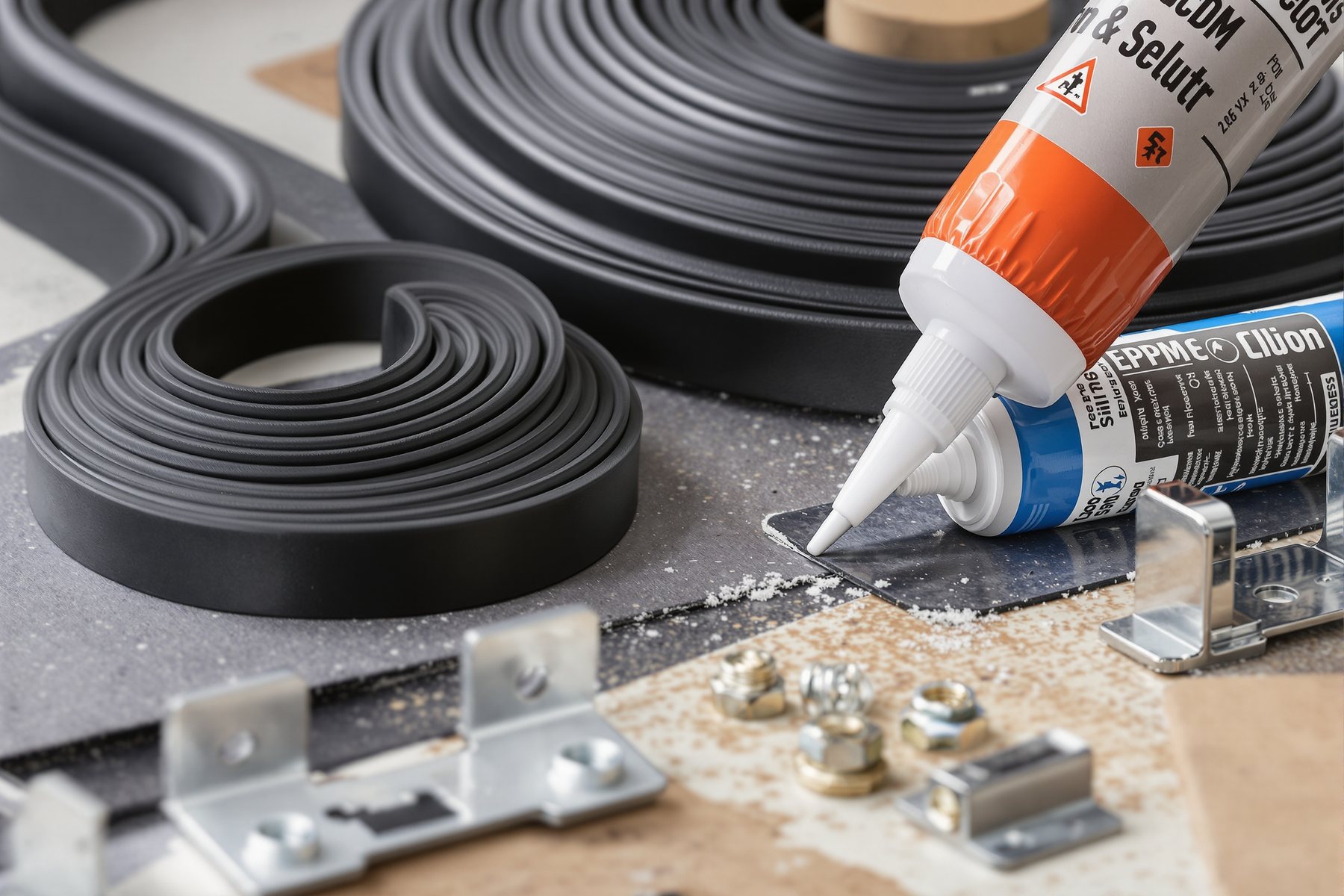
A leak dispute on a glass tower almost never traces to the glass - it traces to a 2 mm bead of the wrong silicone.
When a facade fails, the culprit is rarely the headline material. The glass is fine, the aluminium is fine, the stone is fine. What fails is the **joint** - the gasket that hardened, the sealant that lost adhesion, the tape that was applied to a dusty surface, the bracket that corroded. These are the cheapest items in the whole assembly, often a rounding error in the budget, yet they are the **continuity** of every one of the four control layers. A curtain wall is, from one angle, just a grid of expensive panels held apart by inexpensive seals - and the seals are where water, air and disputes get in. Worse, sealants are chemically fussy: the wrong silicone against the wrong substrate, or two incompatible products in contact, and the bond quietly dies. The smallest parts of a facade demand the most precise specification.
Rubber, silicone, tape and steel - the continuity of the skin
EPDM and silicone gaskets seal mechanically; structural and weather silicone do two different jobs
Gaskets are pre-formed elastomeric strips - usually EPDM (ethylene-propylene rubber) or silicone rubber - that seal by compression where glass meets frame. EPDM is tough, cheap and weathers well; silicone gaskets cost more but resist UV and heat far longer and stay flexible for decades, which matters on a sun-blasted Indian facade. A gasket that has gone hard and taken a permanent set (lost its springiness) no longer seals - and replacing a glazing gasket on an installed facade is a major operation.
The two silicone sealants on a facade do completely different jobs and must never be confused. Structural silicone is an adhesive: it bonds glass to the aluminium frame in structural sealant glazing (SSG), carrying wind load from the glass into the frame with no mechanical capture on the visible face. It is a high-strength, two-part or specially-cured product, designed, sized and tested as a structural element. Weather silicone is a seal: it fills the visible joint between panels to keep water and air out, and is chosen for movement capacity and weathering, not strength. Using a weather sealant where a structural one belongs - or vice versa - is a serious, sometimes dangerous, error.
Structural silicone is glue that holds the glass on. Weather silicone is a seal that keeps water out. Never swap them.
Tapes and membranes bridge the gaps; brackets and fixings carry the load - in stainless
Beyond the bead-applied sealants, facades rely on tapes and membranes. Structural glazing tapes (double-sided, high-bond acrylic foam) set the bond-line thickness and hold glass while structural silicone cures. Flashing tapes and weather-resistant membranes seal the air and water barrier across openings, slab edges and transitions - the continuity detail that decides whether the control layers carry on around a junction or stop dead. A membrane is only as good as the surface prep and the lap: applied over dust or unprimed, it peels; lapped the wrong way (shingle-fashion, upper over lower), it channels water in.
Then the fixings: the brackets that connect the facade to the slab and the bolts, screws and anchors that hold it all. The non-negotiable rule is corrosion resistance for the design life: facade brackets and fixings are stainless steel (austenitic grades - A2/304 inland, A4/316 for coastal or polluted air) or, for light duty, aluminium - never bare carbon steel exposed to weather, and never carbon steel touching aluminium (the galvanic trap from Lesson 2.2). The bracket usually has slotted holes to reconcile the rough concrete frame (built to about plus or minus 25 mm) with the precise aluminium skin (about plus or minus 2 mm) - it is the adjustable joint where the building's two tolerances meet.
The wrong chemistry kills a seal silently; the seal is also the shortest-lived part
Sealants are chemically fussy, and incompatibility is the silent facade killer. Some silicones do not adhere to certain coatings, PVB interlayer edges, plasticised PVC gaskets, or each other; a plasticiser migrating from a cheap gasket into an adjacent structural silicone can destroy its bond over months. The defence is a compatibility and adhesion test programme - the sealant maker tests their product against every substrate and adjacent material on the actual project (ASTM C1087, C794) before a drop goes on the building. Never assume a sealant sticks; prove it for this exact build-up.
The other hard truth is service life mismatch. The glass, aluminium and stone are designed for 30-60 years. A high-quality structural or weather silicone is realistically a 20-30 year product; a gasket maybe similar; a cheap sealant far less. So the seals are the shortest-lived, most maintenance-critical part of the facade - and the maintenance and re-sealing regime is part of the design, not an afterthought. A facade is only weathertight for as long as its seals last, which is why specifying a proven, compatible, long-life sealant system is not where you save money.
The seals are invisible in your renders and decisive in your building's life. Two things to protect: do not design joints so thin or so flush that there is no room for a sealant bead to move (a sealant needs a designed width-to-depth, typically about 2:1, to flex), and do not let the seal system be value-engineered to the cheapest silicone. A structural-sealant-glazed (SSG) facade gives the frameless glass look you may want - but it relies entirely on a silicone bond, so it demands the best products, tested compatibility and a maintenance plan.
Own the seal as engineering. **Size structural silicone** as a structural element (bite and thickness from the wind load and the maker's design stress), never by eye. **Specify a project-specific compatibility and adhesion test programme** (ASTM C1087/C794) against every substrate and adjacent material - this is the single most-skipped step that causes the most leaks. Set gasket material (silicone for UV life), fixing grade (A2 inland, A4 coastal), galvanic isolation, and a re-sealing maintenance interval. The seals are your shortest-life components; design their replacement in.
Sealing is a craft, not a smear. **Clean and prime the substrate** exactly as the sealant maker specifies - most seal failures are dirty or unprimed surfaces, not bad product. Tool the bead to wet both faces and fill the joint; respect the **cure time** before loading or testing (structural silicone especially). Lap membranes shingle-fashion so water sheds outward, never inward. Use the **stainless fixings specified**, isolate them from aluminium, and never substitute a carbon-steel screw 'just for now'. The most expensive facade in the city still leaks if the seals went on wrong.
ASTM C1184 / ETAG 002
Structural sealant glazing
Specification for structural silicone (C1184) and the European technical approval for structural sealant glazing systems (ETAG 002) - they set how SSG silicone is qualified and sized. They assume project-specific adhesion testing is also done.
ASTM C920 / IS 18154
Weatherproofing sealants
Classification of elastomeric joint sealants by movement capacity and use (C920); IS 18154 is the Indian counterpart for building sealants. They grade the sealant; they do not guarantee it sticks to your substrate.
ASTM C1087 / C794
Compatibility & adhesion
Test methods for sealant-substrate compatibility (C1087) and peel adhesion (C794) - the project-specific tests that catch incompatibility before installation. Skipping them is the most common root cause of seal failure.
ISO 3506 / IS 1367 (stainless fixings)
Corrosion-resistant fasteners
Mechanical and grade specifications for stainless-steel fasteners (A2/304, A4/316). They define the fixing; correct grade selection for the exposure (coastal = A4) and galvanic isolation remain the designer's call.
“Silicone is silicone - any good-quality sealant will do the job, and the brand or type does not really matter.”
Sealant type is critical and non-interchangeable. **Structural silicone bonds the glass on and carries wind load**; **weather silicone only seals the joint** - confusing the two can be dangerous. Beyond type, **compatibility is product-specific**: a sealant that bonds perfectly to one glass coating or gasket may not adhere to another, and incompatible materials in contact can silently destroy the bond over months. That is why every serious facade runs a project-specific adhesion and compatibility test programme before installation. 'Silicone is silicone' is how leaks and, occasionally, glass fall-outs happen.
Worked example - size a structural silicone bite for wind load
Structural silicone is a structural element, sized from the wind load - not a bead squeezed by feel. Let's calculate the minimum bond width (the 'bite') that holds a glass lite onto its frame against wind.
A calculator, the design wind pressure from IS 875-3, and the silicone manufacturer's allowable design stress and SSG design rules.
GIVEN a structurally-glazed glass lite on a Mumbai high-rise:

  GLASS lite          : 1.5 m wide x 3.0 m tall
  DESIGN WIND (suction): w = 2.0 kPa = 2.0 kN/m2 (from IS 875-3)
  SILICONE design stress: sigma = 0.14 N/mm2 (typical allowable, maker-confirmed)
  BITE = the bond width along each edge that resists the wind pull-off

  Equilibrium per metre of edge: wind on tributary width = silicone bite x sigma
- 1Find the governing edge load. The silicone runs around all four edges; the critical check is the long vertical edges, each taking a tributary half-width of glass = 1.5 m / 2 = 0.75 m. Wind force per metre of edge length = w x tributary width = 2.0 kN/m2 x 0.75 m = 1.5 kN/m.
- 2Convert the silicone capacity to per-metre terms: capacity per metre of edge = bite (mm) x sigma (N/mm2) x 1000 mm/m. Set capacity = demand: bite x 0.14 x 1000 (N/m) = 1.5 kN/m = 1500 N/m.
- 3Solve for the bite: bite = 1500 / (0.14 x 1000) = 1500 / 140 = 10.7 mm. So the structural silicone bond must be at least about 11 mm wide along the edge to carry this wind suction.
- 4Apply the practical minimums: structural silicone bite is rarely less than ~6-7 mm regardless of calculation, the bite-to-thickness ratio and joint geometry follow the maker's ETAG 002/ASTM C1184 design rules, and a safety factor (often built into the low allowable stress) applies. Round up and confirm with the silicone manufacturer's structural design service - they co-sign SSG designs.
- 5Finally, prove it sticks: this whole number is worthless if the silicone does not adhere to the actual glass coating and frame finish, so the bite design is always paired with a project-specific adhesion and compatibility test programme (ASTM C1087/C794) before any glass is bonded.
You’ll walk away with
A minimum structural-silicone bite (~11 mm here) derived from the wind load - the calculation that makes SSG a structural design, plus the rule that the bite is meaningless without project-specific adhesion testing.
Two quick checks to anchor the joint.
- 01Look closely at a glass facade joint and decide: is the glass mechanically captured by a visible aluminium pressure plate, or is it frameless and **structurally silicone-glazed** (held only by the silicone bond behind the glass)? The second relies entirely on the seal.
- 02Find an older sealed joint on a building and look for **cracking, loss of adhesion at one edge, or chalky hardening** of the silicone - that is a seal nearing the end of its 20-30 year life, while the glass and aluminium around it are barely middle-aged.
The cheapest components - gaskets, sealants, tapes, fixings - are the continuity of every control layer and the source of most facade failures and disputes. Structural silicone bonds glass on and carries load; weather silicone only seals; never confuse them. Sealant compatibility is product-specific and must be tested for the exact build-up, and the seals are the shortest-lived parts of the facade, so their replacement is designed in, not hoped for.
Gaskets (EPDM or longer-lived silicone) seal by compression. Two silicones do different jobs: structural silicone bonds glass to frame and carries wind load (sized as a structural element); weather silicone only seals the joint. Tapes and membranes carry the air/water barrier across junctions - surface prep and correct laps are everything. Brackets and fixings are stainless (A2 inland, A4 coastal), isolated from aluminium. Compatibility must be project-tested; seals are the shortest-lived (20-30 yr) parts, so re-sealing is designed in.
What is the difference between structural and weather silicone on a facade?
They do completely different jobs and are not interchangeable. **Structural silicone** is a high-strength adhesive that bonds the glass to the aluminium frame in structural sealant glazing (SSG) and carries wind load from the glass into the frame - it is designed, sized and tested as a structural element. **Weather silicone** is a sealant that fills the visible joint between panels to keep water and air out, chosen for movement capacity and weathering rather than strength. Using the wrong one - a weather sealant where structural is needed, or vice versa - is a serious and potentially dangerous error.
Why does sealant compatibility testing matter on a facade?
Because sealants are chemically fussy: a silicone that bonds perfectly to one glass coating, gasket or substrate may not adhere to another, and incompatible materials in contact - for example a plasticiser migrating from a cheap gasket into a structural silicone - can silently destroy the bond over months. A failed bond on a structurally glazed facade can mean leaks or even glass fall-out. That is why every serious project runs a project-specific adhesion and compatibility test programme (ASTM C1087/C794) against the actual substrates and adjacent materials before any sealant goes on the building. It is the most commonly skipped step and the most common root cause of seal failure.
What grade of stainless steel should facade fixings be?
Facade brackets and fixings should be austenitic stainless steel, with the grade chosen for the exposure. **A2/304** is suitable for inland and sheltered environments, while **A4/316** (which contains molybdenum for chloride resistance) is required for coastal, marine or heavily polluted air where A2 would pit and rust-stain. Bare carbon steel is unacceptable exposed to weather, and no carbon-steel fixing should touch aluminium (galvanic corrosion). Even stainless fixings into aluminium are usually isolated with nylon washers and sleeves to break any galvanic path, and the fixing grade is specified to ISO 3506 / IS 1367.
Peer-reviewed journals & authoritative standards
- 01Material Selection and Characterization for a Novel Frame-Integrated Curtain Wall. (PMC8069006). — Materials / NCBI-PMC, 2021.
- 02Squadroni, F., De Michele, G., Mazzucchelli, E.S. et al. Analysis of condensation and ventilation phenomena for double skin facade units. — Journal of Building Physics (SAGE), 2022.
- 03Ventilated facade system: A review (joints, seals and fixings in drained/ventilated facade systems). — ScienceDirect (Elsevier), 2025.
The author
Amogh N P
Architect, interior designer, and creative polymath. Studio Matrx began in his notebooks — his vision of design made honest, useful, and open to everyone. Its Academy is written and taught in his memory, and free, forever.
More about Amogh →_That completes the material palette - glass, metal, heavy cladding and the seals that bind them. Module 3 turns from what the facade is made of to what it must do physically: control heat, sun, light, moisture and sound, against the targets the energy codes set._