
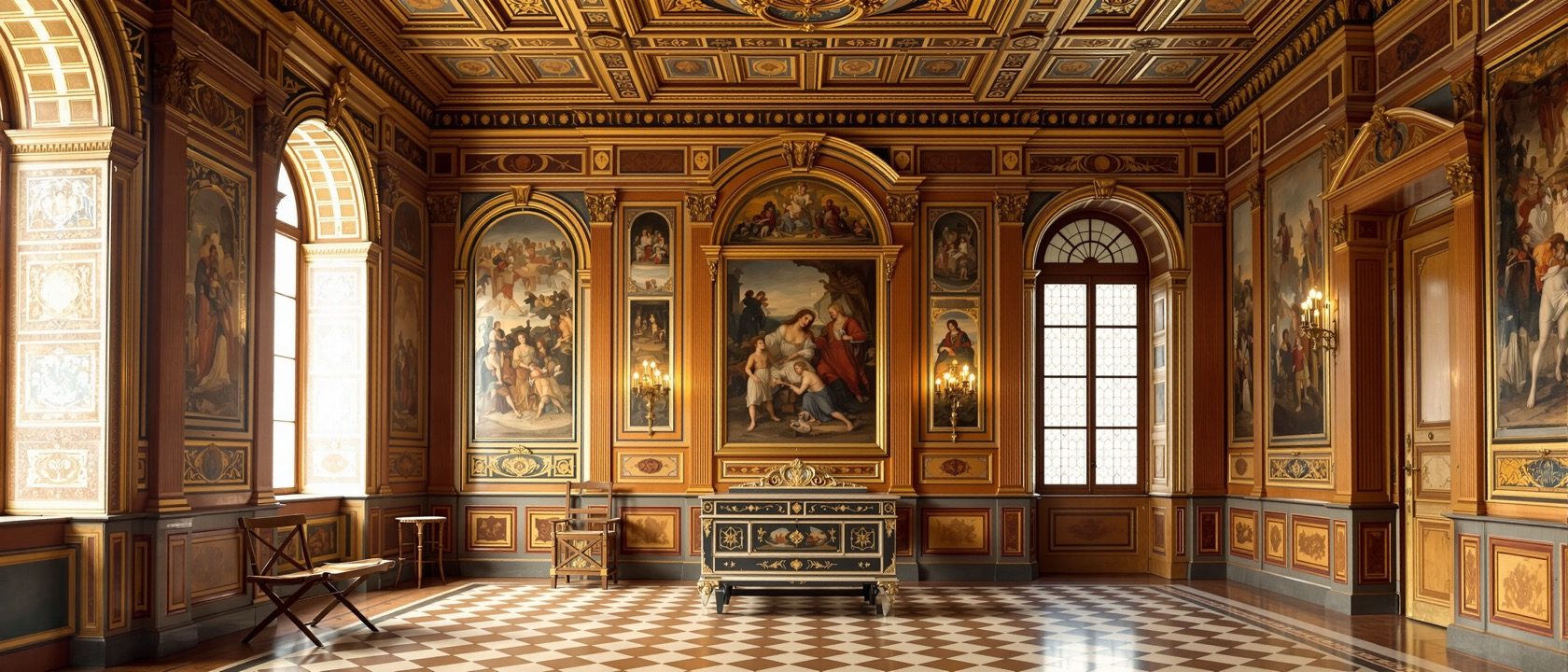
The Renaissance
Classical revival, the cassone and studiolo, and the northern spread.
From about 1400 the interior is reconceived around classical antiquity, proportion and harmony — the palazzo and its arcaded cortile, coffered ceilings and the private studiolo. This is the exam-critical unit: learn the named furniture (the cassone, cassapanca, sgabello and the X-frame chairs) and the grottesche ornament revived from Nero’s buried Golden House — then follow the style north to Fontainebleau and the bold carved oak of the Elizabethan interior.
Learning objectives
By the end of this lesson, you will be able to — mapped to the course outcomes for Evolution of Interiors I:
Explain the classical revival of the Italian Renaissance interior and the palazzo.
Name the Renaissance furniture types — cassone, cassapanca, sgabello, X-frame chairs.
Explain the studiolo, intarsia and the grottesche ornament revival.
Describe the northern spread — Fontainebleau strapwork and the Elizabethan/Jacobean oak interior.
The Italian Renaissance interior
Classical proportion and the palazzo, the named furniture types to memorise, and the intarsia studiolo with grottesche ornament.[1, 3]
Proportion, orders, the palazzo
From c. 1400 in Florence the interior is rebuilt around classical antiquity, PROPORTION and harmony — the rediscovery of Roman ruins and of Vitruvius revives the classical ORDERS, COFFERED ceilings, pilasters and grotesque ornament inside the room. The setting is the urban PALAZZO: a fortress-like block outside, but arranged inside around a serene arcaded courtyard (CORTILE), with a grand stair to the piano nobile, the principal reception floor.[1, 3]
The spread north
Strapwork from Fontainebleau, and England’s bold carved oak — the great chamber, the court cupboard and the four-poster tester bed.[1, 2]
Fontainebleau and strapwork
The Renaissance interior migrated north via prints, treatises and travelling craftsmen. In FRANCE, the châteaux of the Loire and FONTAINEBLEAU (from the 1530s under Francis I, with the Italians Rosso and Primaticcio) introduced Italianate ornament and STRAPWORK — interlaced band-and-strap decoration developed at Fontainebleau — and richer wall treatments.[4]
At a glance
| Aspect | One side | The other |
|---|---|---|
| The cassone | Myth: just a storage box | Reality: a prestige painted art object |
| 'Savonarola' / 'Dante' chairs | Myth: named for their owners | Reality: later romantic labels for X-frame types |
| 'Grotesque' | Myth: ugly / monstrous | Reality: from 'grotto' — a classical ornament |
| Renaissance rooms | Myth: single-purpose like today | Reality: multi-use, enfilade-connected |
| Elizabethan interiors | Myth: refined and delicate | Reality: bold, heavy, densely carved oak |
Key terms
The painted Renaissance marriage chest — a prestige art object, not mere storage.
A cassone given a back and arms — a chest-bench seat of honour against the wall.
A small private study, often clad in trompe-l'œil intarsia wood inlay.
Fanciful classical ornament revived from Nero's buried 'grotto' rooms — not 'hideous'.
An open tiered oak stand for displaying plate — the Elizabethan buffet.
The great carved four-poster with a canopy (tester) and heavy hangings.
Study task
Make an illustrated glossary sheet of five Renaissance furniture types — the cassone, cassapanca, sgabello, Savonarola and Dantesca — with a quick sketch and one line of what each was for, noting which names are later labels. Then contrast a refined Italian palazzo room with a bold Elizabethan oak great chamber in two annotated sketches, and say in a sentence why “grotesque” ornament is named for a grotto, not for anything hideous.
Self-assessment
1. The cassone is best described as —
2. The word 'grotesque' in Renaissance ornament comes from —
3. The Elizabethan and Jacobean interior is characterised by —
Recap
References & further reading
- [1]John Pile & Judith Gura, A History of Interior Design, Laurence King / Wiley (Renaissance and Northern-Renaissance chapters).
- [2]Ralph Edwards, The Shorter Dictionary of English Furniture, Country Life (Elizabethan/Jacobean oak types — court cupboard, tester bed, cup-and-cover).
- [3]Peter Thornton, The Italian Renaissance Interior 1400–1600, Weidenfeld & Nicolson / Abrams, 1991 (the definitive interiors study — cassoni, studioli, room use).
- [4]Helena Hayward (ed.), World Furniture, Hamlyn (furniture-type overview across periods).
Further reading
- Peter Thornton — The Italian Renaissance Interior 1400–1600.
- John Pile & Judith Gura — A History of Interior Design.
- Ralph Edwards — The Shorter Dictionary of English Furniture.
Sources gathered and fact-checked June 2026. Published values vary by source, sample and method — treat as indicative and confirm against the cited standard before structural use.
The author
Amogh N P
Architect, interior designer, and creative polymath. Studio Matrx began in his notebooks — his vision of design made honest, useful, and open to everyone. Its Academy is written and taught in his memory, and free, forever.
More about Amogh →