
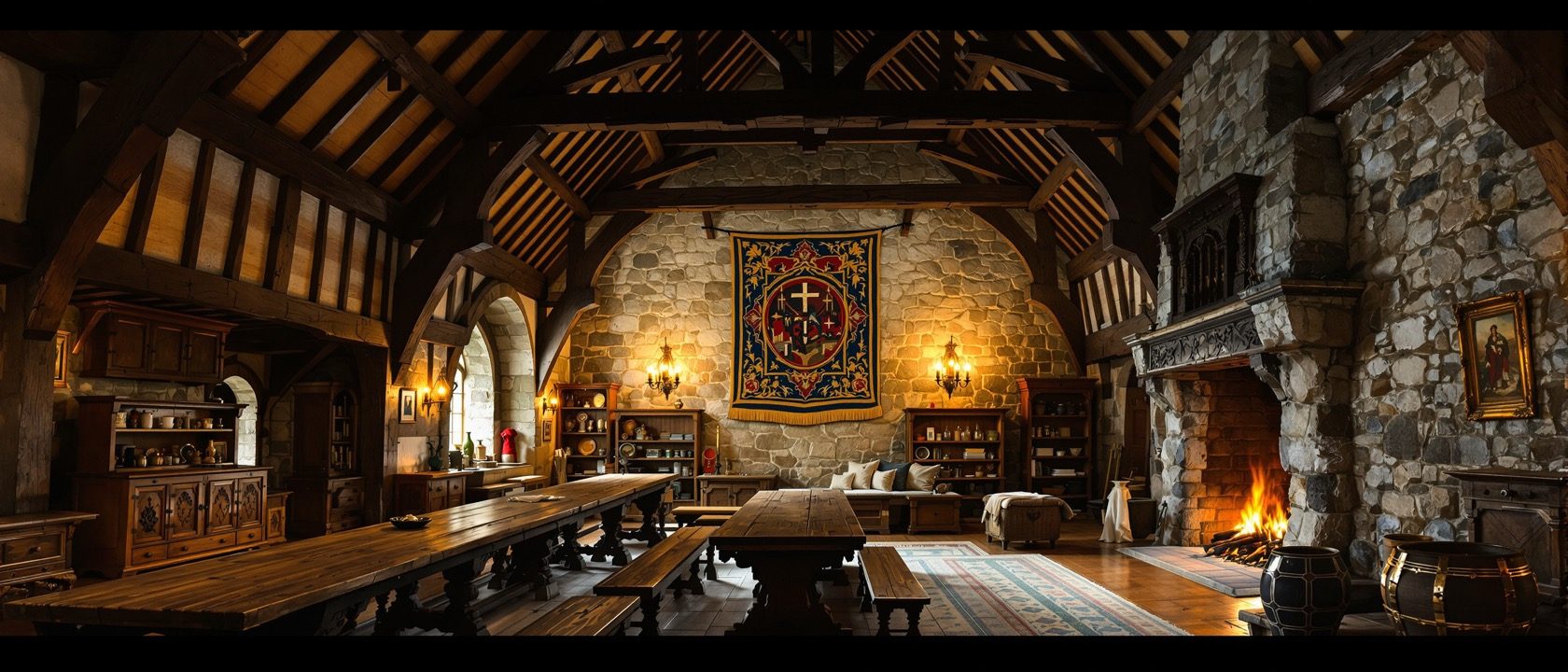
Medieval & Gothic
Gold-ground mosaic, the Great Hall, Gothic light — and rock-cut India.
Byzantium turned the interior into light, gold and colour — glass mosaic that dissolves the wall. In the medieval West, life centred on the multi-purpose Great Hall, sparsely furnished with mobile pieces and the all-purpose chest. Gothic then opened the wall to stained glass. And India offers the world’s finest painted rock-cut interiors at Ajanta, and a coherent floor-based domestic tradition — a system, never an absence.
Learning objectives
By the end of this lesson, you will be able to — mapped to the course outcomes for Evolution of Interiors I:
Describe Byzantine luminous interiors of mosaic, gold and marble.
Describe the medieval Great Hall and the chest as primary furniture.
Explain how Gothic opened the wall to stained glass and coloured light.
Describe Ajanta's painted rock-cut interiors and India's floor-based tradition.
Byzantium, the hall & Gothic light
Gold-ground mosaic that dissolves the wall, the sparse mobile furniture of the Great Hall, and Gothic’s opening of the wall into coloured light.[1, 2]
The wall becomes light
The Eastern Roman Empire turned the interior into light, gold and colour rather than sculpted mass. The revolutionary idea is glass-tessera MOSAIC on a GOLD GROUND — reflective cubes set at slight angles so the whole interior shimmers and dematerialises. HAGIA SOPHIA (completed 537) is the point: a dome that seems to float, book-matched MARBLE REVETMENT and mosaic. RAVENNA (San Vitale, c. 547) preserves the best-surviving imperial mosaics. The wall is no longer stone but light — an idea Gothic glass will echo.[1]
The early Indian thread
The painted rock-cut interiors of Ajanta and Ellora, the temple’s bright-to-dark sanctum sequence, and India’s sophisticated floor-based domestic tradition.[3]
Rooms subtracted from rock
India's great medieval-era interior achievement is the ROCK-CUT interior — rooms carved out of living rock. AJANTA's Buddhist caves hold wall and ceiling PAINTINGS (a famous later Vakataka phase, c. 460–480 CE) — among the finest surviving ancient painted interiors anywhere, to be taught beside Pompeii and Byzantium; ceilings imitate wooden rafters and textile canopies in paint. ELLORA's monolithic Kailasa temple (Cave 16, c. 8th c.) is an entire temple carved top-down — an interior produced by removing rock.[3]
At a glance
| Aspect | One side | The other |
|---|---|---|
| Medieval stone interiors | Myth: bare grey stone | Reality: plastered, vividly painted, hung with textiles |
| The great hall | Myth: crammed with furniture | Reality: sparse, mobile pieces — households travelled |
| Stained glass | Myth: mere decoration | Reality: light as the divine (Suger's program) |
| Ajanta | Myth: exterior architecture | Reality: essentially all painted, carved interior |
| Indian furniture | Myth: an absence of furniture | Reality: a complete floor-based system |
Key terms
Byzantine mosaic of gold-glass cubes that reflect light and dissolve the wall into shimmer.
The medieval multi-purpose room — central hearth, dais, trestle tables, benches, chests.
Primary medieval furniture — storage, seat, table and travelling trunk in one.
Carved wood panelling imitating folded linen, from the Gothic period.
The dark inner sanctum ('womb-chamber') of a Hindu temple, housing the deity.
A low Indian wooden platform / daybed — a cornerstone of floor-based living.
Study task
Compare two ways of making an interior luminous — the Byzantine gold-mosaic wall and the Gothic stained-glass wall — in a short illustrated note: what each does to the sense of the wall, and why. Then write a paragraph arguing, with specifics (takht, charpai, bolsters, jharokha-to-come), why India’s floor-based tradition should be described as a complete system rather than a lack of furniture.
Self-assessment
1. The Byzantine interior revolution was to make the wall read as —
2. The primary piece of furniture in a medieval hall was the —
3. India's floor-based interior tradition should be taught as —
Recap
References & further reading
- [1]John Pile & Judith Gura, A History of Interior Design, Laurence King / Wiley (Byzantine, medieval, Gothic chapters).
- [2]Penelope Eames, Furniture in England, France and the Netherlands from the Twelfth to the Fifteenth Century, Furniture History Society, 1977.
- [3]George Michell, The Hindu Temple: An Introduction to Its Meaning and Forms, University of Chicago Press, 1988; and Walter M. Spink, Ajanta: History and Development, Brill.
- [4]Banister Fletcher, A History of Architecture (for the Byzantine and Gothic structural context behind the interior).
Further reading
- John Pile & Judith Gura — A History of Interior Design.
- Penelope Eames — Furniture in England, France and the Netherlands (12th–15th c.).
- George Michell — The Hindu Temple.
Sources gathered and fact-checked June 2026. Published values vary by source, sample and method — treat as indicative and confirm against the cited standard before structural use.
The author
Amogh N P
Architect, interior designer, and creative polymath. Studio Matrx began in his notebooks — his vision of design made honest, useful, and open to everyone. Its Academy is written and taught in his memory, and free, forever.
More about Amogh →